
Se de Evora and its granite medieval form
Published on 09/24/2026 at 04:14 | Editorial responsibility: Rafael Müller, Editor-in-Chief AD HOC NEWS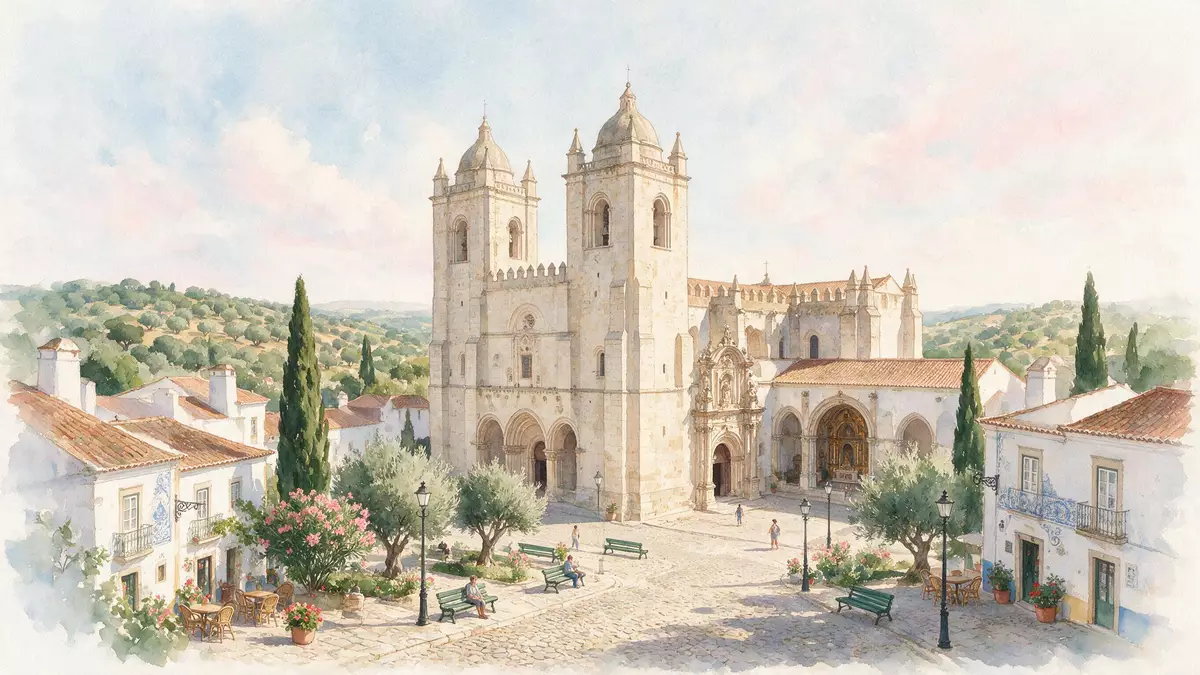
Se de Evora rises above Evora as a massive granite church, with towers, battlements and a lantern tower forming a fortress-like silhouette. The cathedral’s Romanesque and Gothic fabric belongs to the medieval history of Portugal, while its chapels, choir, organ and cloister preserve later layers of religious art.
Dedicated to Our Lady of the Assumption, it is the seat of the Archdiocese of Evora and part of the city’s UNESCO World Heritage historic centre. Its stone exterior and richly worked interior present two distinct architectural registers within one cathedral.
Se de Evora: granite walls and a fortress outline
The cathedral stands on the acropolis of Evora, the elevated historic core associated with the Roman Temple of Diana. Its granite walls, towers and battlemented terrace give the building a defensive appearance, while the lantern tower rises above the main mass.
The church has a Latin-cross plan, visible most clearly inside. Its architectural language combines Romanesque solidity with Gothic features, creating a transition between rounded medieval forms, pointed arches and taller vaulted spaces. Roman-Gothic cathedral history places the completed medieval complex in the thirteenth and fourteenth centuries.
From 1186 to the medieval cathedral
The first cathedral project began in 1186, after Christian forces established control over Evora. The building was consecrated in 1204, and the cathedral developed through the thirteenth century as its granite structure expanded.
The cloister belongs to the Gothic phase of the complex and was completed around 1350. Its galleries contain pointed arches, vaulted ceilings and sculpted figures, including representations of the four Evangelists. medieval construction dates place the cathedral within the transition from Romanesque to Gothic architecture.
Chapels, choir and the cathedral interior
The main chapel belongs to the eighteenth century and was built during the reign of João V. Its Baroque interior uses marbles of several colours across the walls and floor, contrasting with the heavier granite of the exterior.
The high choir dates from the sixteenth century and contains Renaissance decoration in carved relief. An Iberian-style pipe organ in an oak case occupies the choir level. The cathedral also contains the Gothic stone image known as Our Lady of Ó, a fifteenth-century figure associated with the Expectation of the Virgin.
The cloister adds a quieter architectural sequence to the complex, with Gothic arcades and a founder’s chapel. In the chapel, a marble recumbent effigy lies beneath a Gothic funerary structure. granite cathedral description records the building’s Romanesque-Gothic character and its rose-toned stone appearance.
Visiting Se de Evora: what travellers from Western Europe should know
- Se de Evora stands in the upper historic centre of Evora, near the Roman Temple of Diana and the medieval streets around the acropolis.
- The approach through the old centre follows narrow stone streets and uneven paving. Inside, the complex includes stairs, vaulted spaces and the cloister galleries.
- The official language is Portuguese and the currency is the euro.
Searching for Se de Evora on social platforms
These links open searches for Se de Evora on each platform.Frequently asked questions about Se de Evora
Where is Se de Evora?
Se de Evora stands in the upper historic centre of Evora, beside the Roman Temple of Diana and within the city’s UNESCO-listed historic area.
What can visitors expect inside?
The interior contains a Latin-cross church, a Baroque marble main chapel, a Renaissance high choir, a historic pipe organ and a Gothic cloister.
What makes the cathedral distinctive?
Its distinctive character comes from the contrast between granite medieval walls, fortress-like battlements, Gothic arcades and richly decorated later chapels.


