
Senso-ji and the gates that frame old Asakusa
Published on 09/24/2026 at 07:13 | Editorial responsibility: Rafael Müller, Editor-in-Chief AD HOC NEWS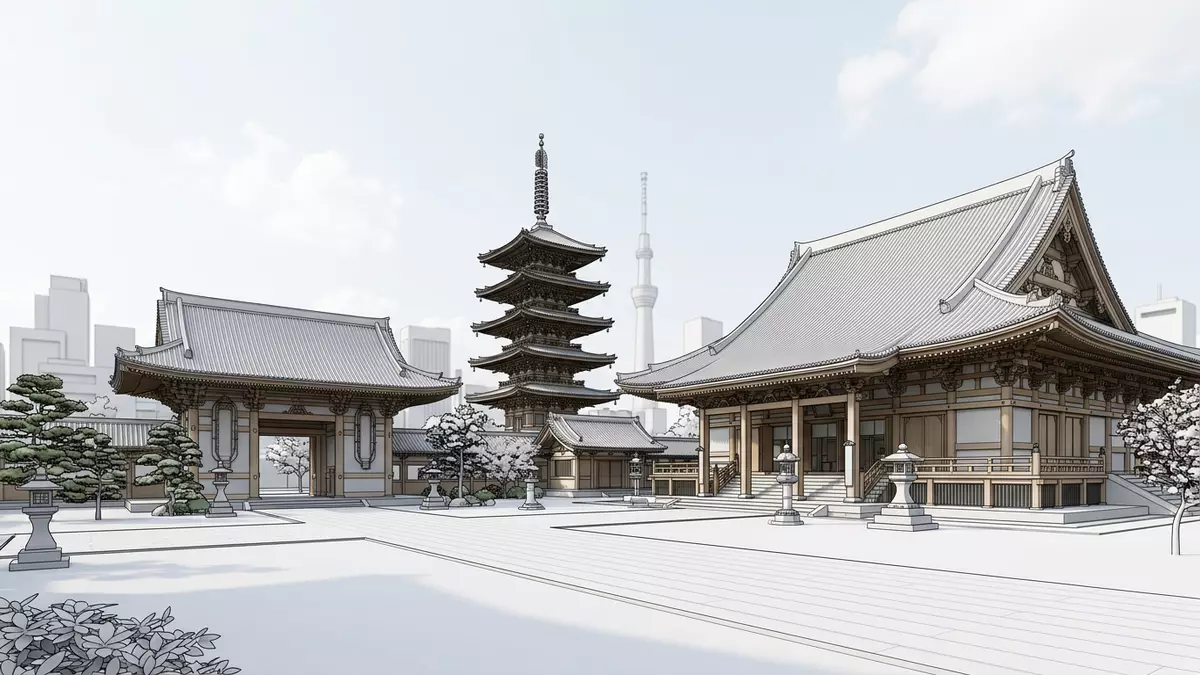
Senso-ji in Asakusa is a Buddhist temple arranged as a sequence of gates, lanterns, market stalls and halls. Its visible route begins at Kaminarimon, continues along Nakamise-dori and reaches the main precinct through Hozomon.
The complex joins a legend dated to 628 with a temple formally established in 645. Vermilion timber forms, guardian figures and the long approach give Senso-ji a recognisable architectural rhythm within Tokio.
Senso-ji begins beneath Kaminarimon
Kaminarimon means Thunder Gate. Its broad roof, massive central lantern and guardian figures create the first threshold of the temple precinct. The figures represent Fujin, the wind deity, and Raijin, the thunder deity.
The gate has existed in changing forms across the history of Asakusa. The structure seen at the entrance dates from 1960, when it was rebuilt after earlier destruction. Its traditional silhouette remains tied to the red lantern and the street leading towards Nakamise-dori.
The lantern carries the characters for Kaminarimon and hangs above the central passage. Large supporting pillars frame the entrance, while the guardians occupy protected spaces at either side.
From a river legend to a Buddhist temple
Senso-ji’s origin story begins on 18 March 628. Two brothers, Hamanari and Takenari Hinokuma, found a small statue of Kannon in their fishing net in the Sumida River.
Kannon is the bodhisattva associated with compassion. The statue became the sacred focus of a local place of worship, and a temple was established in 645. This date places Senso-ji within the seventh-century history of the settlement that developed into Tokio.
The temple is dedicated to Kannon, also known as Asakusa Kannon. Its religious identity remains visible in the main hall, where the hidden statue is venerated rather than displayed as an ordinary museum object.
Senso-ji’s founding legend connects the temple with the Sumida River and the two fishermen.
Nakamise-dori and the inner precinct
Beyond Kaminarimon, Nakamise-dori forms a straight approach towards Hozomon. Shops line the route with traditional snacks, crafts and souvenirs, creating a commercial passage before the inner temple grounds.
Hozomon means Treasure House Gate. It marks the entrance to the central precinct and carries a heavy roof above the passage. Guardian figures stand on the front, while large wooden sandals are displayed on the rear side.
The main hall rises beyond Hozomon, with a broad roof and deep eaves. A five-storey pagoda stands within the same precinct, adding a vertical element to the low roofs, lanterns and gates.
Many buildings were rebuilt after wartime destruction, while their forms retain the visual language of earlier Edo-period temple architecture. Tokugawa Ieyasu designated Senso-ji as a family temple during the seventeenth-century formation of Edo as a shogunal capital.
The temple’s official name is Kinryuzan Senso-ji. Its address is 2-3-1 Asakusa, Taito-ku, Tokyo, in the Asakusa district of Tokio.
The temple’s English name is presented as Asakusa Kannon Sensoji.
The temple’s 645 foundation date places it among Tokio’s oldest established Buddhist sites.
Visiting Senso-ji: what travellers from Western Europe should know
- Senso-ji stands in Asakusa, in northern Tokio. Asakusa Station serves the site through the Tokyo Metro Ginza Line, Toei Asakusa Line, Tobu Railway and Tsukuba Express.
- The approach from Kaminarimon to the main hall follows Nakamise-dori and passes through Hozomon. The route is paved, while steps occur around the temple buildings.
- The complex includes Kaminarimon, Nakamise-dori, Hozomon, the main hall and a five-storey pagoda. These elements occupy a connected temple precinct.
- The official language is Japanese and the currency is the Japanese yen.
Searching for Senso-ji on social platforms
These links open searches for Senso-ji on each platform.
Frequently asked questions about Senso-ji
Where is Senso-ji?
Senso-ji is in Asakusa, within Taito-ku in Tokio. The address is 2-3-1 Asakusa, Tokyo, Japan.
What does the route through Senso-ji include?
The route passes from Kaminarimon along Nakamise-dori and through Hozomon towards the main hall. The precinct also contains a five-storey pagoda and other Buddhist buildings.
What makes Senso-ji distinctive?
Senso-ji combines a seventh-century foundation date with a visible sequence of vermilion gates, a market approach and a Kannon temple hall.


