
Senso-ji in Tokio: a temple framed by gates and market
Published on 09/10/2026 at 07:24 | Editorial responsibility: Rafael Müller, Editor-in-Chief AD HOC NEWS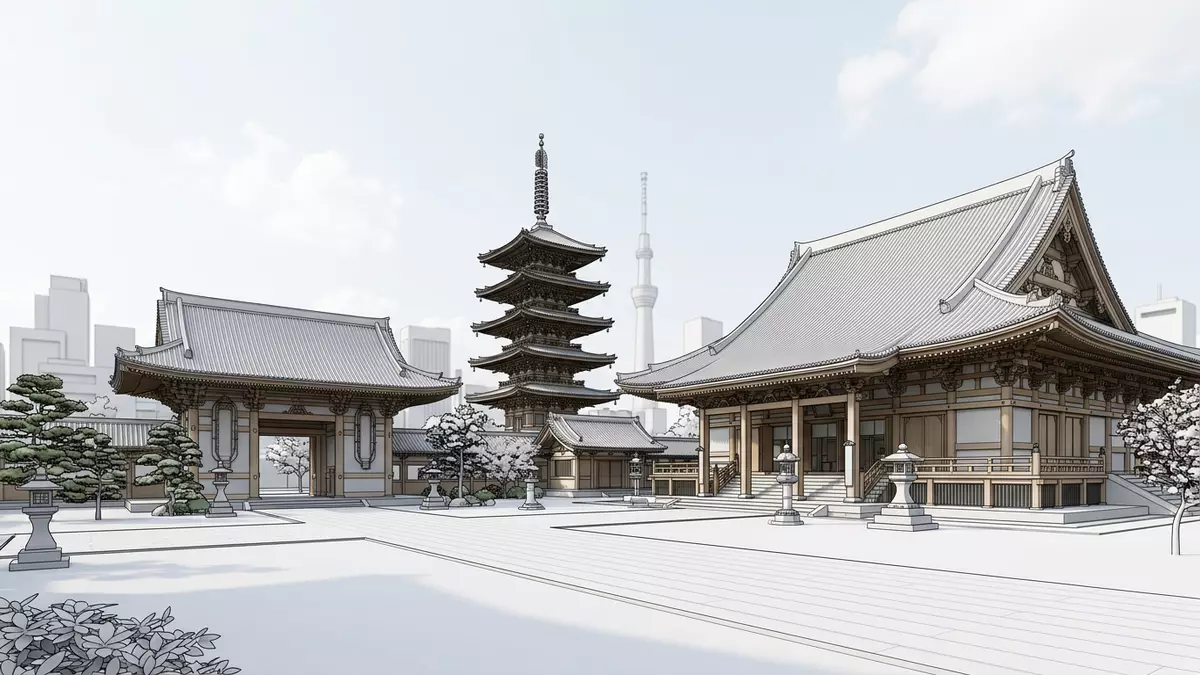
Senso-ji in Tokio’s Asakusa district is a Buddhist temple complex where a sequence of gates, market stalls and courtyards builds up to the main hall dedicated to Kannon, framed by a five-storied pagoda and companion shrine buildings from the Edo period.Asakusa Shrine from 1649 stands immediately beside the main hall, tying religious practice to a landscape of lanterns, incense burners and vivid red timber structures.
From river legend to Tokugawa patronage
According to long-established legend, the origins of Senso-ji lie in 628, when two brothers fishing in the Sumida River found a statue of Kannon, the Buddhist deity of mercy, in their nets.The discovery of a golden statue of Kannon led to the creation of a shrine that grew into a temple formally founded in 645, giving Senso-ji a seventh-century anchor in the history of the city that later became Edo and then Tokyo.Sens?-ji is Tokyo’s oldest temple and for centuries has served as a centre of Buddhist devotion in the Asakusa area.
When Tokugawa Ieyasu established his power base in Edo in 1590, Senso-ji already commanded local attention and he designated it as a prayer temple for the new shogunate.Tokugawa Ieyasu’s designation of Senso-ji as a shogunal prayer temple gave the complex land and status, and during the era of the third shogun Tokugawa Iemitsu in the seventeenth century the main hall, Hozomon gate, five-storied pagoda and neighbouring Nitenmon gate were developed in a coordinated programme that shaped the precincts visitors walk through today.The Edo-period building programme under Tokugawa Iemitsu tied Senso-ji’s architecture to the wider story of Edo-period temple construction.
Kaminarimon, Hozomon and the five-storied pagoda
The approach to Senso-ji begins at Kaminarimon, the “Thunder Gate”, a grand entrance with a single massive lantern and guardian statues that announces the temple from the surrounding streets of Asakusa.Kaminarimon’s large red lantern and guardian deities make it one of the most recognisable features of the district, and the gate’s present form dates from 1960, when it was rebuilt with support from industrialist Konosuke Matsushita after a nineteenth-century fire and wartime destruction.
Beyond Kaminarimon, the Hozomon gate stands as the inner guardian of the main precinct, rebuilt in 1964 in reinforced concrete with tile roofing after air raids in 1945 destroyed earlier structures.The post-war reconstruction of Hozomon and the five-storied pagoda shaped the skyline around the main hall, while retaining traditional forms such as heavy eaves, deep vermilion colour and guardians flanking the entrance. To one side rises the five-storied pagoda, a tiered structure reaching about 53 m (174 ft) above ground and rebuilt in 1973 using steel-framed reinforced concrete.Its height and construction as a five-storey pagoda give Senso-ji a vertical counterpoint to the wide spread of the main hall’s roof.
Nakamise, main hall and adjoining shrine
Passing through Kaminarimon, visitors walk along Nakamise, a traditional shopping street lined with small shops in wooden fronts, a commercial strip whose existence dates back to the Edo period, when stalls served pilgrims heading for the temple.Nakamise’s development during the Edo period makes Senso-ji unusual among temple complexes because the route from first gate to main hall is as much about everyday goods and regional snacks as it is about incense smoke and lotus motifs on roof tiles.
The main hall, devoted to Kannon, has been destroyed and rebuilt multiple times and took its current form in 1958 after wartime damage, using modern materials while maintaining traditional outlines such as deep eaves, timber cladding and a spacious worship hall raised above the surrounding courtyard.The 1958 reconstruction of the main hall anchors the ritual core of the complex, while the nearby Asakusa Shrine, built in 1649 under Tokugawa Iemitsu, preserves seventeenth-century wooden architecture and commemorates the fishermen brothers and landlord associated with the temple’s foundation.Asakusa Shrine as a seventeenth-century neighbour offers a quieter space with gabled roofs and carved details that contrast with the larger scale of the Kannon hall.
Visiting Senso-ji: what travellers from Western Europe should know
- Senso-ji stands in the Asakusa district of Taito City in north-eastern Tokio, with the temple precinct centred on the address 2-3-1 Asakusa, Taito-ku, Tokyo 111-0032, Japan, reached by urban rail lines serving Asakusa Station.
- The temple grounds are laid out along an axial approach lined with shops, followed by open courtyards, stone paving and flight of steps up to the main hall, and walking between Kaminarimon, Hozomon and the pagoda involves covering a sequence of outdoor spaces.
- The Asakusa area lies beside the Sumida River, and Senso-ji’s precincts sit in a dense urban fabric where temple buildings, shrine structures and commercial streets run close together.
- The official language is Japanese and the currency is the yen, with English signage present on transport routes and at major points such as Kaminarimon and Hozomon.
- Entry requirements depend on your nationality; UK travellers can check the FCDO travel advice at gov.uk/foreign-travel-advice, Irish travellers the Department of Foreign Affairs at ireland.ie.
Searching for Senso-ji on social platforms
These links open searches for Senso-ji on each platform.Frequently asked questions about Senso-ji
Where is Senso-ji located in Tokio?
Senso-ji is in the Asakusa district of Taito City in north-eastern Tokio, close to the Sumida River and served by metro and suburban rail stations such as Asakusa.Its location at 2-3-1 Asakusa in Taito City anchors the temple in one of Tokyo’s longest-established neighbourhoods.
What should visitors expect when walking through Senso-ji?
A visit to Senso-ji typically involves entering through Kaminarimon with its giant lantern, walking along the Nakamise shopping street, passing under Hozomon and arriving at the incense cloud and timber structure of the main hall, with the five-storied pagoda and Asakusa Shrine visible nearby.
What makes Senso-ji distinctive among temples in Tokyo?
Senso-ji is Tokyo’s oldest temple with seventh-century origins, rebuilt main hall from 1958, Edo-period neighbours such as the 1649 Asakusa Shrine, and the highly recognisable sequence of Kaminarimon, market street and Hozomon framing worship spaces within a dense urban setting.


