
Serengeti National Park and the rhythm of the Great Migration
Published on 09/14/2026 at 10:47 | Editorial responsibility: Rafael Müller, Editor-in-Chief AD HOC NEWS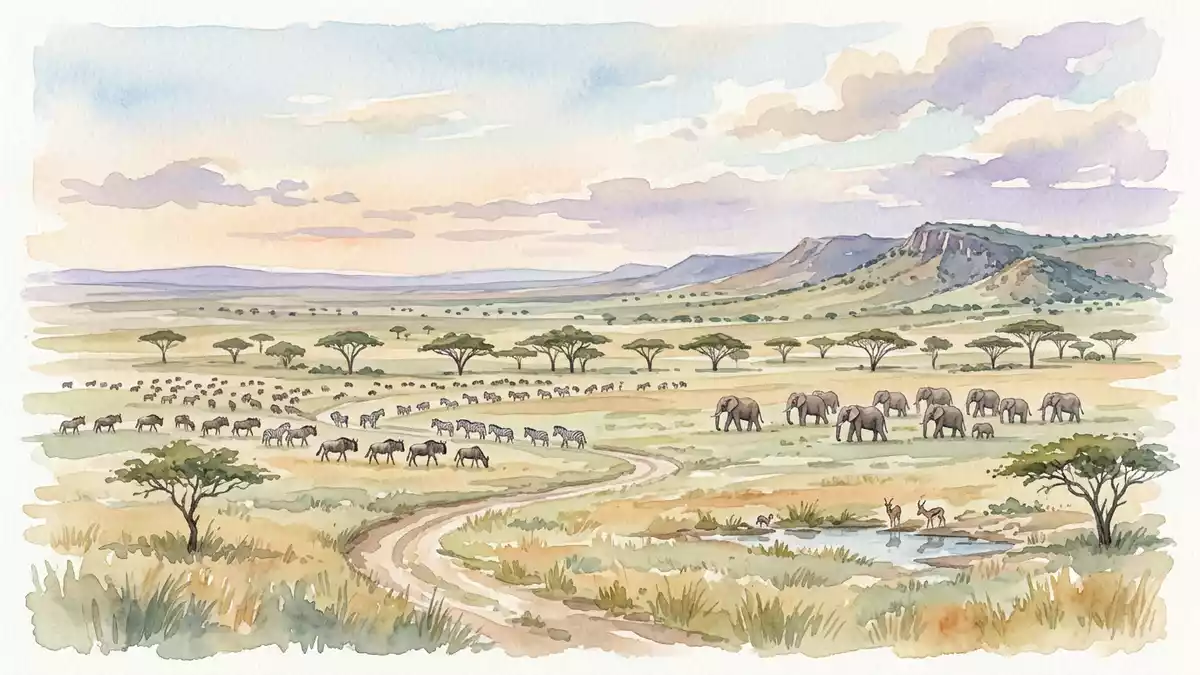
Serengeti National Park in northern Tanzania is defined by a wide, open landscape and by the movement of animals across it in vast herds. Established as a national park in 1951, the Serengeti connects grassland plains, scattered woodlands and river valleys into one continuous ecosystem where migration is written into the land itself.National park and wildlife refuge
A protected savannah shaped by scale
Serengeti National Park covers roughly 14,763 km² (5,700 sq mi), forming one of Africa’s largest protected savannah landscapes.14,763 km² in size The park lies in the Mara and Simiyu regions of north-central Tanzania, extending towards the border with Kenya and linking with neighbouring conservation areas such as the Ngorongoro Conservation Area and the Maasai Mara across the frontier.north-central Tanzania bordering Kenya
Elevations in the park range approximately between 920 and 1,850 m (3,020 to 6,070 ft), a gentle rise that shapes a broad plain rather than steep mountains.range of elevations Much of the Serengeti consists of grassland plains broken by acacia-dotted savannah, river corridors and rocky outcrops known as kopjes, with the wider ecosystem described as around 1.5 million hectares of savannah in the World Heritage documentation.1.5 million hectares of savannah
The Great Migration across the Serengeti plains
The Serengeti is widely associated with the Great Migration, an annual circular trek of ungulates that moves through Tanzania and into Kenya. World Heritage records describe over one million wildebeest accompanied by hundreds of thousands of zebras and gazelles on a journey of about 1,000 km (620 mi) in search of pasture and water.annual migration of wildebeest Other sources describe the wider Serengeti ecosystem as carrying about 1.5 million western white?bearded wildebeest, 250,000 zebras and large numbers of Thomson’s gazelles, together forming one of the most extensive land migrations remaining on Earth.largest annual animal migration
Movement within the park follows the character of its different regions. The southern plains are known for open grasslands where zebra and gazelle graze alongside wildebeest, while the western corridor follows rivers such as the Grumeti and hosts species including Nile crocodiles and hippopotamuses.three main eco-regions In the north, more open woodlands and hills lead towards the border with Kenya and the Maasai Mara, continuing the path taken by migrating herds as they cross between countries.
Conservation status and wildlife communities
Serengeti National Park holds a recognised place in global conservation. It is Tanzania’s oldest national park and was inscribed on the UNESCO World Heritage List in 1981 under natural criteria that emphasise both the scale of the migration and the integrity of the savannah ecosystem.added to the UNESCO World Heritage List in 1981 UNESCO records also note its role within the Serengeti?Ngorongoro Biosphere Reserve, reflecting the link between the park and adjoining protected areas.Serengeti-Ngorongoro Biosphere Reserve
The park supports large communities of predators and herbivores. Sources describe one of the largest lion populations in Africa within the national park, alongside cheetahs, leopards and hyenas that follow the migrating herds.largest lion population in Africa Elephants, giraffes, buffalo and numerous antelope species occupy the woodlands and riverine areas, while birdlife includes species such as lilac?breasted rollers, large raptors and wetland birds along the Mara and Grumeti rivers.acacia-dotted grasslands and rivers
Visiting Serengeti National Park: what travellers from Western Europe should know
- Serengeti National Park lies in north-central Tanzania, with road access from towns such as Arusha and entry gates including Naabi Hill on the eastern side of the park.
- Terrain in the Serengeti consists largely of flat or gently undulating plains with occasional rocky kopjes and river valleys; game drives follow dirt tracks across these open areas.
- The official language is Swahili and the currency is the Tanzanian shilling.
- Entry requirements depend on your nationality; UK travellers can check the FCDO travel advice at gov.uk/foreign-travel-advice, Irish travellers the Department of Foreign Affairs at ireland.ie.
Searching for Serengeti National Park on social platforms
These links open searches for Serengeti National Park on each platform.
Frequently asked questions about Serengeti National Park
Where is Serengeti National Park located?
Serengeti National Park is in north-central Tanzania, in the Mara and Simiyu regions, extending towards the border with Kenya and adjoining conservation areas.
What can visitors expect on a visit to Serengeti National Park?
Visitors encounter extensive savannah, seasonal rivers and rocky kopjes, with wildlife ranging from migrating wildebeest, zebra and gazelles to lions, elephants and diverse birdlife.
What makes Serengeti National Park distinctive among African parks?
The park combines large protected grassland plains, a recognised World Heritage status and one of the largest remaining land-animal migrations involving millions of ungulates.


