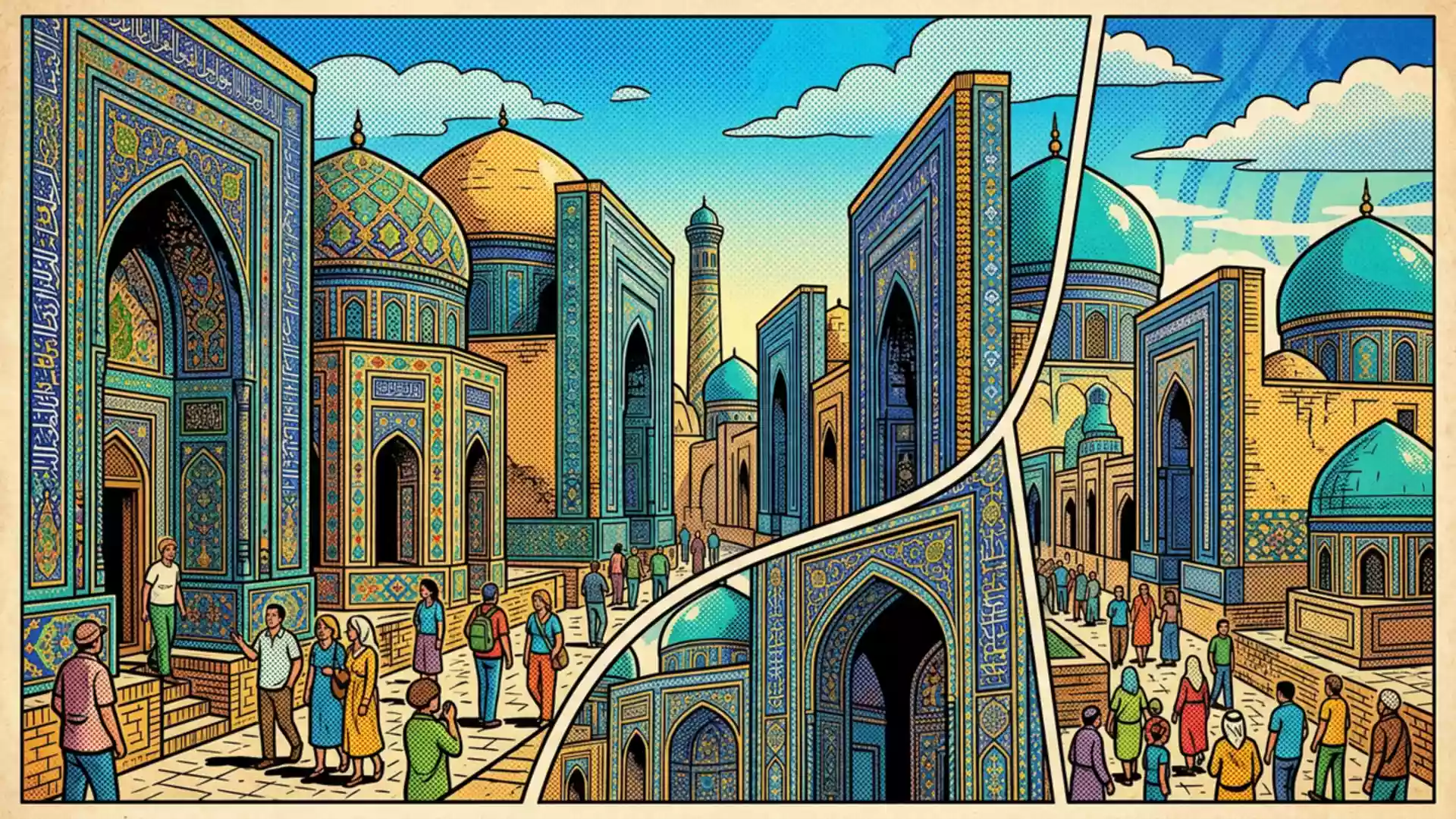
Shah-i-Zinda and the turquoise avenue of tombs in Samarkand
Published on 09/02/2026 at 11:46 | Editorial responsibility: Rafael Müller, Editor-in-Chief AD HOC NEWS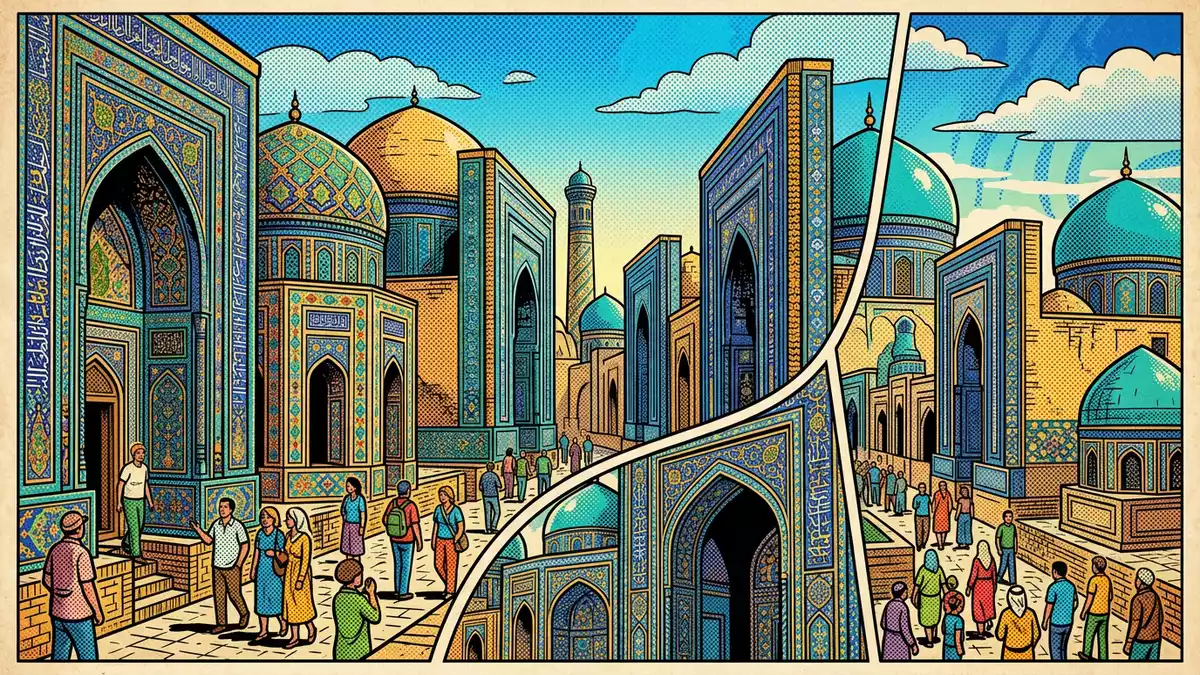
Shah-i-Zinda in Samarkand is a terraced avenue of mausoleums climbing the southern slope of Afrasiab, the ancient heart of this city in Uzbekistan. The necropolis brings together richly tiled tombs from the eleventh to the fifteenth centuries and later additions, all grouped around a shrine linked to Qusam ibn Abbas, a cousin of the Prophet Muhammad, whose burial made this an important Muslim sanctuary.
A necropolis on the slope of Afrasiab
Shah-i-Zinda stands on the north-eastern side of Samarkand, on the slope of the ancient settlement known as Afrasiab, just beyond the later city walls. From this height the necropolis looks across the Zarafshan valley, with views towards distant mountains and over the modern streets below.A mausoleum complex located just northeast of the city
The ensemble forms a long north–south corridor of tombs and small mosques placed on either side of a stepped passage. The route rises in stages, so that visitors move through successive groups of structures, each level revealing domes, facades and tiled portals facing one another across the narrow way.The corridor runs approximately north to south
Timurid tilework and the “Living King”
The name Shah-i-Zinda, meaning “the Living King”, refers to the shrine of Qusam ibn Abbas, who is associated with the spread of Islam to this part of Central Asia in the seventh century.The name refers to a shrine around what is probably his grave His tomb, or cenotaph, lies within a cluster of quiet rooms at the innermost end of the complex, forming the spiritual core from which the necropolis grew.
Most of the standing mausoleums date from the fourteenth and fifteenth centuries, when the Timurid rulers of Samarkand used Shah-i-Zinda as a burial ground for members of the royal family and high-ranking nobles.Shakhi Zinda is the burial place of royal persons and nobles Their architects covered the facades with glazed tiles in shades of turquoise and cobalt, using calligraphy, geometric patterns and floral motifs to turn the narrow street into a sequence of shimmering surfaces.
A street of mausoleums across the centuries
The Shah-i-Zinda ensemble includes mausoleums and other ritual buildings from the eleventh to the fifteenth centuries, with additional structures from the nineteenth century filling gaps along the corridor.The ensemble includes mausoleums and other ritual buildings of the 11th–15th and 19th centuries The oldest elements cluster near the shrine of Qusam ibn Abbas, while the later Timurid tombs form the best-known sequence of domed chambers and tiled portals.
Guides and guidebooks often describe the necropolis as a street cemetery, because the construction lines both sides of the passage in a way more reminiscent of houses than of isolated tombs.The ensemble is also called “Street cemetery” Over the centuries, a broader cemetery has developed around the monumental core, extending across the hillside beyond the main avenue.
Visiting Shah-i-Zinda: what travellers from Western Europe should know
- Shah-i-Zinda lies in the north-eastern part of Samarkand, on the slope of Afrasiab, close to landmarks such as the Bibi-Khanym Mosque and the Siab Bazaar.
- The approach within the necropolis consists of a stepped passage with several flights of stairs, and the mausoleums stand on terraces above and below this central corridor.
- Samarkand is reached overland and by air within Uzbekistan, and local buses and taxis connect the city centre with the area around Shah-i-Zinda.
- The official language is Uzbek and the currency is the Uzbekistani so?m.
- Entry requirements depend on your nationality; UK travellers can check the FCDO travel advice at gov.uk/foreign-travel-advice, Irish travellers the Department of Foreign Affairs at ireland.ie.
Searching for Shah-i-Zinda on social platforms
These links open searches for Shah-i-Zinda on each platform.Frequently asked questions about Shah-i-Zinda
Where is Shah-i-Zinda and what kind of place is it?
Shah-i-Zinda is a necropolis on the north-eastern edge of Samarkand in Uzbekistan, set on the slope of the ancient settlement of Afrasiab.
What should visitors expect when walking through the complex?
Visitors follow a stepped passage lined with mausoleums and small mosques, moving through terraces of glazed tilework and domed chambers grouped in successive levels.
What makes Shah-i-Zinda distinctive among sites in Samarkand?
The combination of a shrine linked to Qusam ibn Abbas, Timurid royal tombs and dense turquoise tile decoration along a narrow corridor gives Shah-i-Zinda a character unlike other monuments in the city.