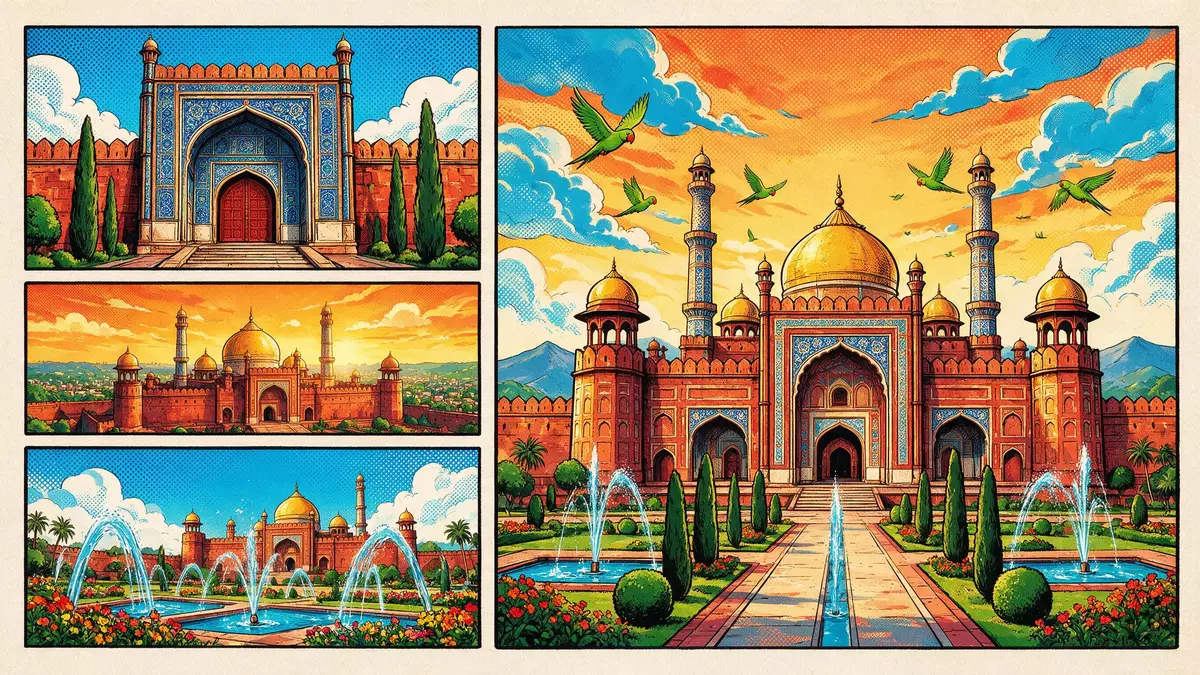
Shahi Qila and the red sandstone walls of Lahore
Published on 08/10/2026 at 15:06 | Editorial responsibility: Rafael Müller, Editor-in-Chief AD HOC NEWS
Shahi Qila in Lahore is the city’s great Mughal fortress, known for its red sandstone walls, marble pavilions and layered courtyards. The complex is closely associated with Akbar, who expanded the fort in the late 16th century, and with later Mughal rulers who added major buildings within it.
Akbar’s fort in Lahore
The fort occupies a commanding position within Lahore’s historic core. Its present fabric reflects several Mughal phases, with Akbar’s rebuilding in the late 1500s forming an important base for what survives.
Shahi Qila combines defensive walls with palatial architecture, so the site reads as both fortress and courtly residence. That mixture is part of its character: thick ramparts, gateways, terraces and ceremonial spaces all sit within one enclosed complex.
Marble, fresco and carved surfaces
Within the fort, the architecture shifts from red sandstone exteriors to finer interior finishes. Marble, tilework and painted decoration appear across the principal buildings, creating sharp contrasts of colour and material.
The fort is remembered for individual Mughal monuments such as the Sheesh Mahal and the Diwan-i-Khas. These elements show how the complex moved beyond military function into the ceremonial language of an imperial court.
The fort within Lahore’s old city
Shahi Qila stands beside the Badshahi Mosque and the old city, forming one of Lahore’s most recognisable historic ensembles. The fort’s scale is clearest from the walls, gateways and broad internal spaces rather than from any single monument.
Its surviving structures link different moments of Mughal rule, from Akbar through Shah Jahan and Aurangzeb. That layered character gives the site its particular interest: one complex, many royal periods, and a strong architectural identity.
Visiting Shahi Qila: what travellers from Western Europe should know
- Shahi Qila is in Lahore, reached by road and local transport within the city.
- Admission arrangements and opening hours are set by the site's operator and change with the season; the official website is the only binding source.
- Late morning or late afternoon often suit historic sites in Lahore better than the hottest part of the day.
- The fort has large stone surfaces, steps and uneven ground, so comfortable shoes are sensible.
- Expect a historic site in Urdu and English, with local payment methods often used on the ground.
- Entry requirements depend on your nationality. UK travellers should check the FCDO travel advice at gov.uk/foreign-travel-advice; Irish travellers the Department of Foreign Affairs at ireland.ie; EU and EEA citizens their own national foreign ministry.
Searching for Shahi Qila on social platforms
These links open searches for Shahi Qila on each platform.
Frequently asked questions about Shahi Qila
Where is Shahi Qila?
Shahi Qila is in Lahore, in Pakistan, close to the historic centre of the city. It forms part of the great Mughal landscape of Lahore.
What should visitors expect?
Expect a large fortified complex with gates, courtyards, walls and decorated Mughal buildings. The site involves walking on stone surfaces and steps.
What makes Shahi Qila distinctive?
Its mixture of military enclosure and imperial architecture gives it a strong identity. The red sandstone exterior, marble interiors and major Mughal monuments create a rich historical ensemble.