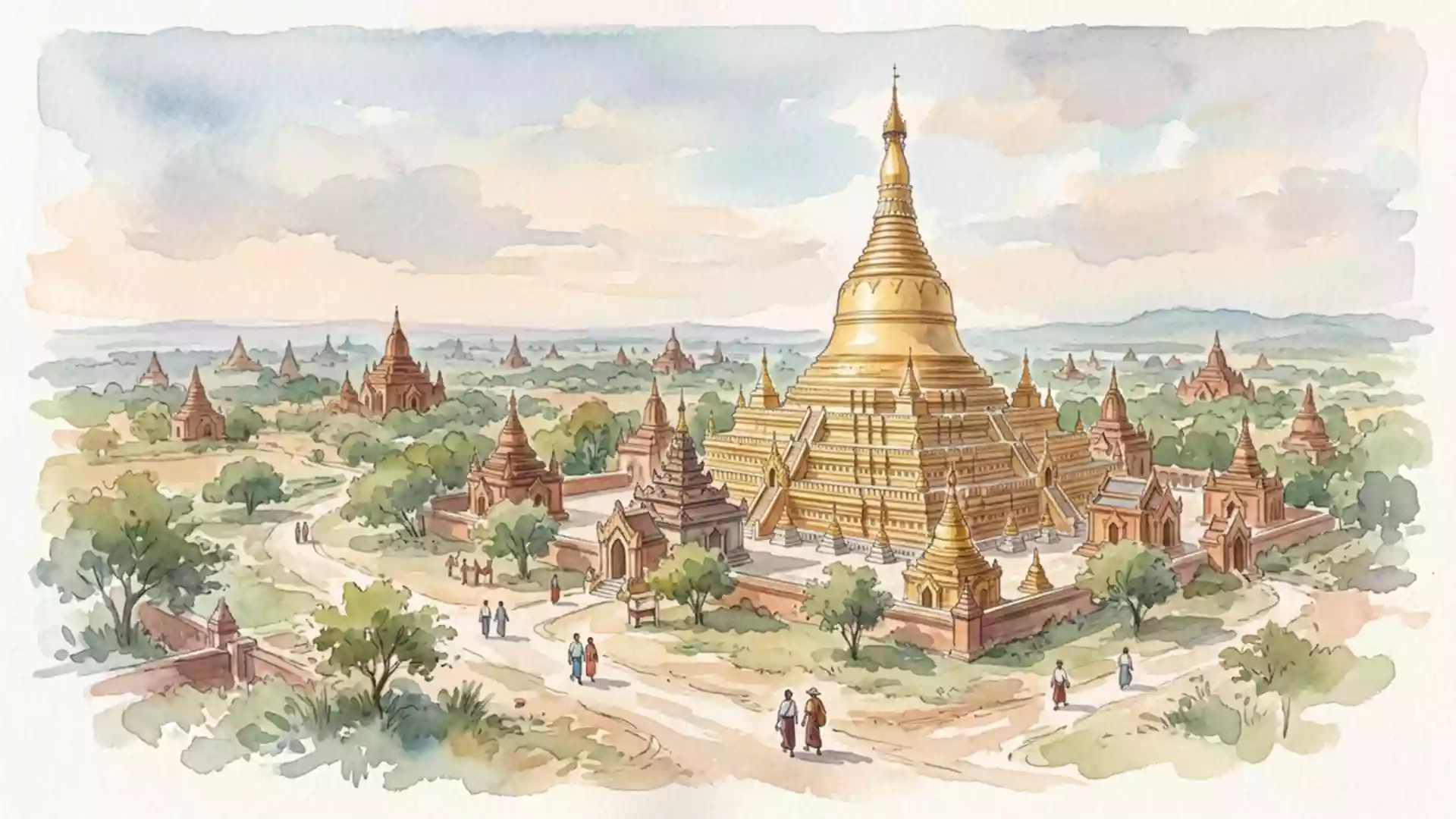
Shwezigon Pagoda and the golden heart of Bagan
Published on 08/26/2026 at 11:07 | Editorial responsibility: Rafael Müller, Editor-in-Chief AD HOC NEWS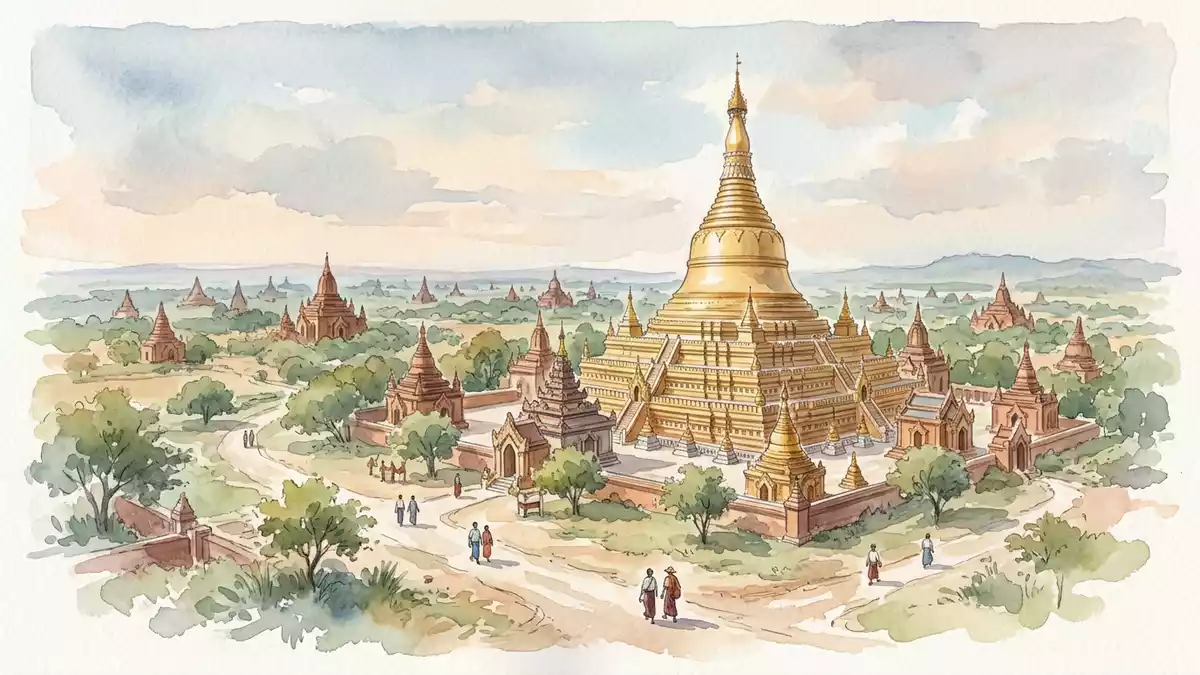
Shwezigon Pagoda brings together the golden mass of a great stupa, the flat light of the Irrawaddy plain and the long memory of the Pagan kings in one compact enclosure. Built in the eleventh century under King Anawrahta and completed under King Kyansittha, it stands near Nyaung U on the edge of Bagan as a landmark of early Theravada Buddhism in Myanmar.
An eleventh?century stupa between kings and kingdoms
The core of Shwezigon Pagoda dates to the reign of King Anawrahta, who ruled Pagan from 1044 to 1077 and established the Pagan Empire in central Myanmar.King Anawrahta began construction in the mid?eleventh century, and the pagoda was completed in the reign of his successor King Kyansittha in the early twelfth century.completed in the reign of his successor The result is a monument that belongs to the formative period of Bagan’s temple landscape, standing among the earliest stupas on the plain.
Shwezigon Pagoda occupies a low rise near the Irrawaddy River at Nyaung U, north of the main concentration of temples in Old Bagan.near the Irrawaddy River at Nyaung U The Burmese name can be translated as “golden pagoda on a dune”, a reference to the sandy rise on which the stupa stands and to the gilded exterior that has long defined its appearance.“golden pagoda on a dune” In the eleventh century, this site marked the northern limit of the early city, giving the reliquary stupa a place on the edge of the emerging capital.
Gold?clad terraces, courtyards and shrines
The stupa at the centre of Shwezigon Pagoda rises from a series of square terraces in a pyramidal arrangement, built in brick and covered in gilded metal plates.series of square terraces These terraces step up towards the bell?shaped upper section, giving the structure a clear profile against the sky and creating a sequence of straight edges and cornices that catch the light. The gilding wraps the stupa in a continuous metallic skin, so that the underlying masonry reads as a single golden mass.
A walled enclosure surrounds the central stupa, with covered walkways and secondary shrines lining the sides of the courtyard.covered walkways and secondary shrines Near the inner edge of the courtyard stand four large standing Buddha images, aligned with the cardinal directions and associated with the time of King Kyansittha.four large standing Buddha images The outer walkways carry smaller stupas and pavilions, creating a layered scene in which the main tower rises above a field of subsidiary structures, all tied together by the recurring use of gold, brick and whitewashed surfaces.
Relics, inscriptions and the meeting of traditions
Shwezigon Pagoda functions as a major reliquary, associated with relics of Gautama Buddha and with the spread of Theravada Buddhism in Bagan under King Anawrahta.associated with relics of Gautama Buddha Historical accounts describe the enshrinement of bone relics and copies of the celebrated tooth relic from Kandy, linking the pagoda to wider networks of Buddhist devotion between Myanmar and Sri Lanka.historical accounts describe the enshrinement This role as a reliquary gave Shwezigon Pagoda a central place in the religious life of the Pagan court.
Within the complex stands a stone pillar bearing Mon?language inscriptions of King Kyansittha, recording donations and articulating the Theravada Buddhist orientation of the court.stone pillar bearing Mon?language inscriptions Shwezigon Pagoda is also associated with the formal recognition of the 37 nats, the pre?Buddhist spirits of Myanmar, within a Buddhist framework, linking the gilded stupa to the older spirit traditions of the region.recognition of the 37 nats The result is a complex in which inscriptions, relic shrines and nat images share the same enclosure, giving a tangible form to the layered religious history of Bagan.
Visiting Shwezigon Pagoda: what travellers from Western Europe should know
- Shwezigon Pagoda stands near Nyaung U, north?east of Old Bagan, close to the east bank of the Irrawaddy River. It lies between the village of Wetkyi?in and the town of Nyaung U.
- The pagoda complex is arranged around a central courtyard with paved surfaces and covered walkways. Moving between the shrines involves walking on stone and concrete, with steps leading up to some of the platforms.
- Bagan lies in central Myanmar on the Irrawaddy plain. The official language is Burmese and the currency is the Myanmar kyat.
- Entry requirements depend on your nationality; UK travellers can check the FCDO travel advice at gov.uk/foreign-travel-advice, Irish travellers the Department of Foreign Affairs at ireland.ie.
Searching for Shwezigon Pagoda on social platforms
These links open searches for Shwezigon Pagoda on each platform.
Frequently asked questions about Shwezigon Pagoda
Where is Shwezigon Pagoda?
Shwezigon Pagoda stands near Nyaung U on the Irrawaddy plain in central Myanmar, north?east of the main temple cluster of Bagan.
What can visitors expect inside the complex?
Visitors encounter a gilded central stupa on stepped terraces, surrounded by paved courtyards, covered walkways, shrines and large standing Buddha images aligned with the cardinal directions.
What makes Shwezigon Pagoda distinctive among Bagan’s monuments?
Shwezigon Pagoda is an early royal reliquary of the Pagan Empire, tying together gilded stupa architecture, royal inscriptions and the formal recognition of Myanmar’s 37 nats within a Theravada Buddhist setting.