
Sidi Bou Said: blue-and-white hilltop village above the Bay of Tunis
Published on 08/06/2026 at 22:39 | Editorial responsibility: Rafael Müller, Editor-in-Chief AD HOC NEWS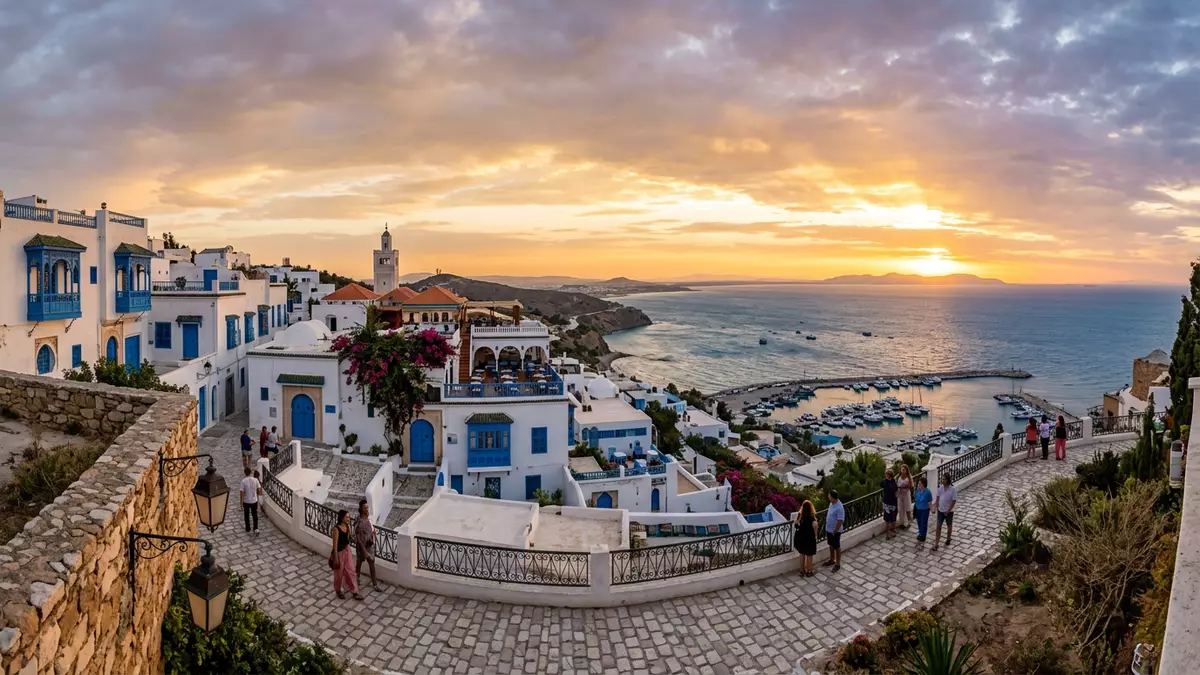
Sidi Bou Said is a hilltop village above the Bay of Tunis, known for its blue-and-white houses, cobbled lanes and long views over the Mediterranean Sea. The village takes its name from the Sufi saint Abu Saïd al-Baji, who settled here in the Middle Ages and turned the headland into a spiritual retreat. In the twentieth century it attracted painters, writers and musicians, and Sidi Bou Said became a symbol of coastal Tunisia for visitors from Europe and beyond.
Blue-and-white architecture on a Mediterranean headland
The first impression of Sidi Bou Said is visual: whitewashed walls, doors and shutters painted in a strong shade of blue, and ironwork casting patterns on plaster. Many houses are built in an Andalusian-influenced style, with inner courtyards, tiled floors and carved doors facing the street. Seen from below, the village climbs the hill in layers, with roofs, terraces and minarets stepping up towards the lighthouse on the headland.
Much of the village’s layout dates from the Ottoman period, when Tunis was an important port on the southern shore of the Mediterranean. Narrow streets twist between houses, sometimes opening into small squares with cafés and shops. Architectural details vary from house to house: some façades carry ceramic tiles in deep blues and greens, others show carved stone frames around doorways. The repetition of white walls and blue woodwork gives the whole settlement a coherent character against the sea and sky.
A village shaped by saints, scholars and artists
Sidi Bou Said grew around the zawiya, or religious complex, dedicated to Abu Saïd al-Baji, whose tomb lies within the village. Pilgrims visited the site for centuries, and religious buildings, including mosques and prayer halls, became part of the village fabric. From the eighteenth century onwards, wealthy families from Tunis built residences here as summer houses, adding gardens and terraces that overlook the bay.
In the early twentieth century, Sidi Bou Said drew European artists and intellectuals, some of whom stayed for extended periods. French painter Paul Klee visited Tunisia in 1914 and travelled through coastal towns including this village, recording colours and light in his notebooks. The blue-and-white palette became closely associated with Sidi Bou Said during this period, reinforced by regulations introduced in the 1920s that encouraged the use of white walls and blue woodwork. The result is a place where religious history, Ottoman town planning and twentieth-century artistic interest are all visible in the street scene.
Views, cafés and daily life on the hill
One of the most striking aspects of Sidi Bou Said is its position above the Bay of Tunis. Several terraces and café roofs offer views across the water towards Tunis, La Goulette and the archaeological site of Carthage, which lies nearby along the coast. On clear days the line of the horizon is sharp, and the contrast between white buildings and the deep blue sea is particularly strong.
Daily life in the village plays out along the main street and its side alleys. Cafés serve mint tea, coffee and local pastries, often on tiled terraces. Small shops sell ceramics, textiles and metal lanterns, many of them using the same blue and white colours found on the buildings. Away from the busiest lanes, residential areas feel quieter, with flowering bougainvillea spilling over walls and narrow stairways linking different levels of the settlement. The combination of views, colour and everyday activity makes Sidi Bou Said a compact place to experience coastal Tunisia in a single walk.
Visiting Sidi Bou Said: what travellers from Western Europe should know
- Sidi Bou Said is reached from Tunis by road and by the suburban rail line that serves the coastal towns towards Carthage.
- Admission arrangements and opening hours are set by the site’s operator and change with the season; the official website is the only binding source.
- The village is exposed to Mediterranean sun, so many visitors prefer the softer light of morning or late afternoon and avoid the strongest midday heat.
- The streets are steep in places, with cobblestones and flights of steps, so comfortable footwear is useful and some routes may be challenging for anyone with limited mobility.
- Arabic and French are widely spoken; cash and cards are both used in cafés and shops, and modest dress is appreciated near religious buildings.
- Entry requirements depend on your nationality. UK travellers should check the FCDO travel advice at gov.uk/foreign-travel-advice; Irish travellers the Department of Foreign Affairs at ireland.ie; EU and EEA citizens their own national foreign ministry.
Searching for Sidi Bou Said on social platforms
These links open searches for Sidi Bou Said on each platform.
Frequently asked questions about Sidi Bou Said
Where is Sidi Bou Said?
Sidi Bou Said is a hilltop village on the Bay of Tunis in northern Tunisia, a short distance along the coast from the city of Tunis and Carthage.
What can visitors expect on a visit?
Visitors find blue-and-white houses, steep cobbled streets, sea views, cafés and small shops, all within a compact area that can be explored on foot.
What makes Sidi Bou Said distinctive?
The combination of Andalusian-style architecture, the blue-and-white colour scheme, the religious heritage linked to Abu Saïd al-Baji and the position above the Mediterranean gives the village its particular character.


