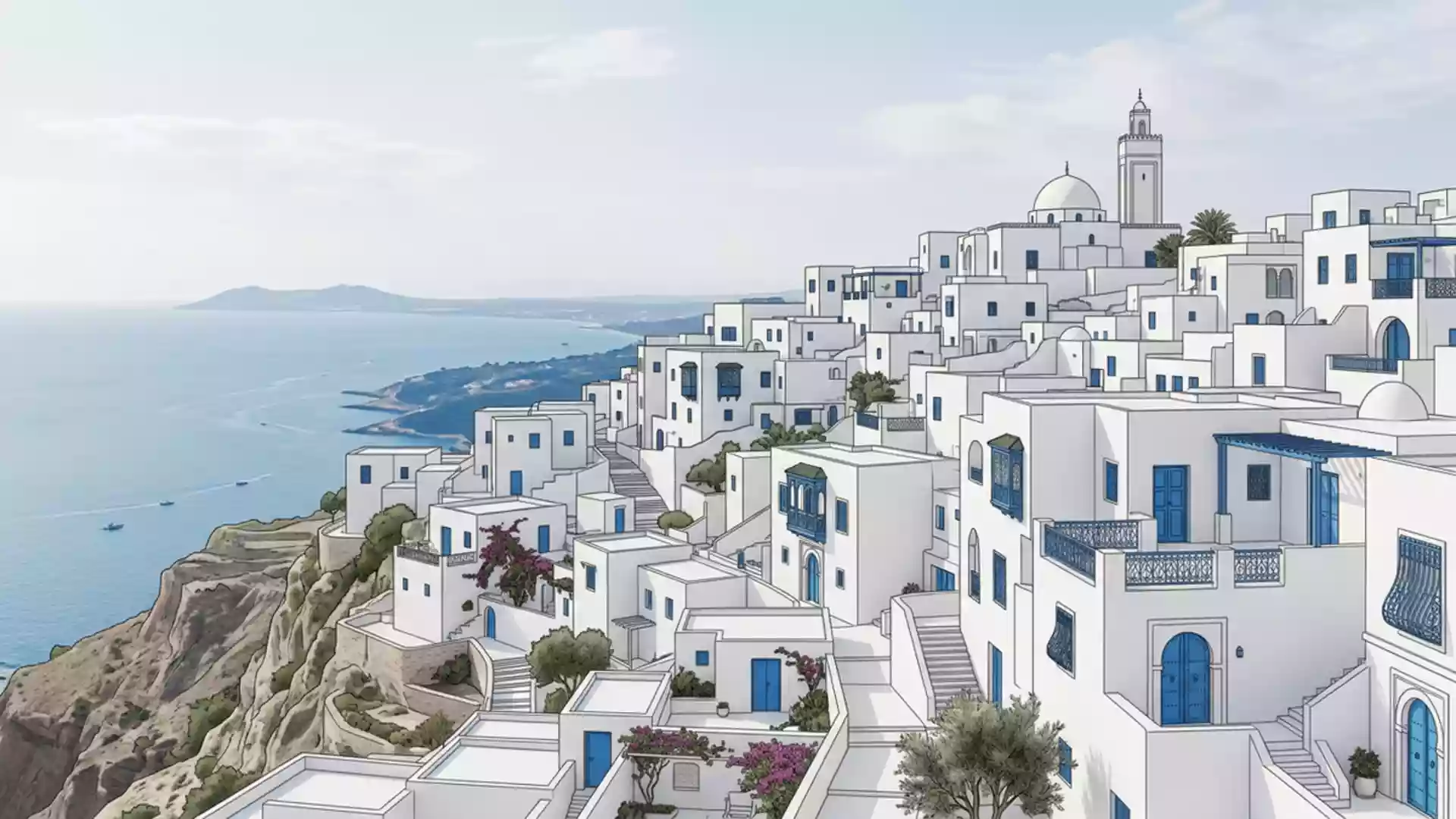
Sidi Bou Said, the blue and white hill village above Tunis
Published on 09/03/2026 at 20:18 | Editorial responsibility: Rafael Müller, Editor-in-Chief AD HOC NEWS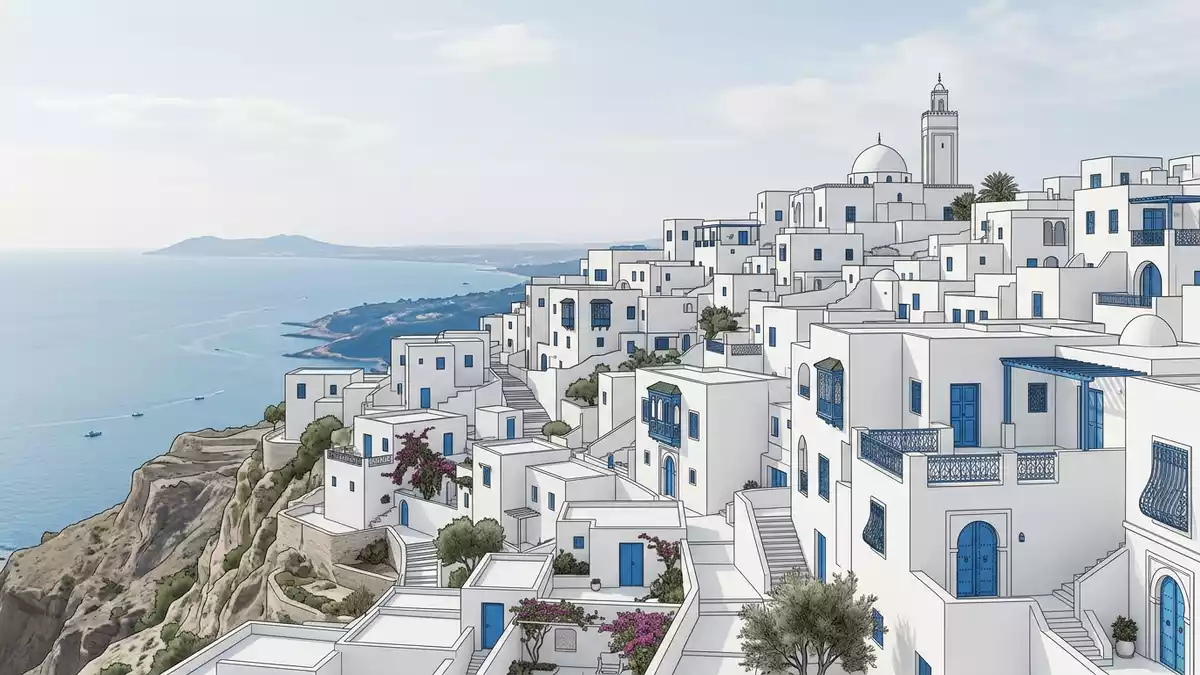
On a rocky hill north-east of Tunis, the village of Sidi Bou Said gathers whitewashed houses, vivid blue woodwork and Mediterranean light above the Gulf of Tunis. Perched on a coastal promontory overlooking Carthage and the bay, this Tunisian settlement carries a long association with the Sufi master Abu Said al-Baji and a distinctive architectural harmony that has drawn travellers and artists for more than a century.
Blue and white on a cliff above the Gulf of Tunis
Sidi Bou Said stands on a coastal headland above the Gulf of Tunis, forming part of the Carthage area in northern Tunisia.town in northern Tunisia The village occupies the upper slopes of the hill known as Djebel el-Menar, with streets climbing towards viewpoints over the sea and the archaeological sites of Carthage.rocky promontory overlooking Carthage and the Gulf of Tunis
The name Sidi Bou Said honours Abu Said al-Baji, an Islamic scholar and Sufi figure associated with the site in the thirteenth century.named after a thirteenth-century Sufi scholar His shrine and mosque stand close to the centre of the village, surrounded by lanes lined with white walls and blue-painted doors, shutters and ironwork that have become a defining feature of the settlement.white walls with blue doors and window grills
Architectural harmony and artistic life
The dominant impression in Sidi Bou Said is the repeated contrast of white plastered facades and strong blue timber and metalwork. Many houses follow a similar pattern, with projecting upper storeys, balconies enclosed by iron grilles and carved wooden doors picked out in blue, all set against the bright walls and stone-paved lanes.blue-and-white hill village overlooking Carthage and the Gulf of Tunis The village has been recognised for this architectural coherence, with its ensemble of buildings inscribed on the World Heritage List under the title “Village de Sidi Bou Saïd”.heritage designation Village de Sidi Bou Saïd
From the eighteenth century, members of the Tunisian elite built residences on the hill, turning Sidi Bou Said into a resort of summer houses and gardens.summer residences and palaces One of the best-known is Ennejma Ezzahra, associated with Baron Rodolphe d’Erlanger, whose palace and gardens form a cultural site dedicated to music.palace Ennejma Ezzahra The combination of traditional Tunisian forms, carefully controlled colour and the hillside setting has made the village a longstanding reference point for painters, photographers and writers exploring North African Mediterranean architecture.
Street life between Carthage and the sea
Walking through Sidi Bou Said means following steep streets and stairways that weave between houses, small squares and planted courtyards. The village is compact, and its lanes converge towards terraces with views over the Gulf of Tunis, the marina below and the ruins of ancient Carthage along the shore.perched on a cliff overlooking Carthage and the Gulf of Tunis Cafés and shops occupy ground floors along the main approaches, many set behind the characteristic blue doors and decorated with local ceramics and carved wood.
The settlement forms part of the wider urban area of Tunis yet retains the scale of a village, with a population recorded in the low thousands and a footprint of only a few square kilometres.area and population figures Its position above the shoreline gives broad vistas along the bay towards Cap Bon and the northern Tunisian coast, while the hill continues down to a marina and beaches that connect the clifftop streets with the water.situated on a coastal cliff near Tunis
Visiting Sidi Bou Said: what travellers from Western Europe should know
- Sidi Bou Said lies north-east of Tunis in the Carthage area, on a hill overlooking the Gulf of Tunis, and is reached by the TGM suburban railway linking Tunis with Carthage and La Marsa.
- The streets are steep and many approaches involve stairways, so a visit includes walking on inclines and stone steps between different levels of the village.
- The village stands on the southern shore of the Mediterranean close to the archaeological sites of Carthage, making it straightforward to combine the blue-and-white streets with a visit to Punic and Roman remains in the same area.
- The official language is Arabic and the currency is the Tunisian dinar.
- Entry requirements depend on your nationality; UK travellers can check the FCDO travel advice at gov.uk/foreign-travel-advice, Irish travellers the Department of Foreign Affairs at ireland.ie.
Searching for Sidi Bou Said on social platforms
These links open searches for Sidi Bou Said on each platform.Frequently asked questions about Sidi Bou Said
Where is Sidi Bou Said?
Sidi Bou Said is a hillside village in northern Tunisia, north-east of Tunis, overlooking the Gulf of Tunis and lying close to the archaeological sites of Carthage.
What can visitors expect in Sidi Bou Said?
Visitors encounter steep streets lined with white houses and blue woodwork, a compact clifftop layout, views over the bay and a mixture of cafés, residences and small shops.
What makes Sidi Bou Said distinctive?
The combination of blue-and-white architecture, the position on a coastal promontory above Carthage and the association with the Sufi figure Abu Said al-Baji gives the village a distinctive character.