
Stone Town and the coral-stone city shaped by trade
Published on 09/24/2026 at 11:57 | Editorial responsibility: Rafael Müller, Editor-in-Chief AD HOC NEWS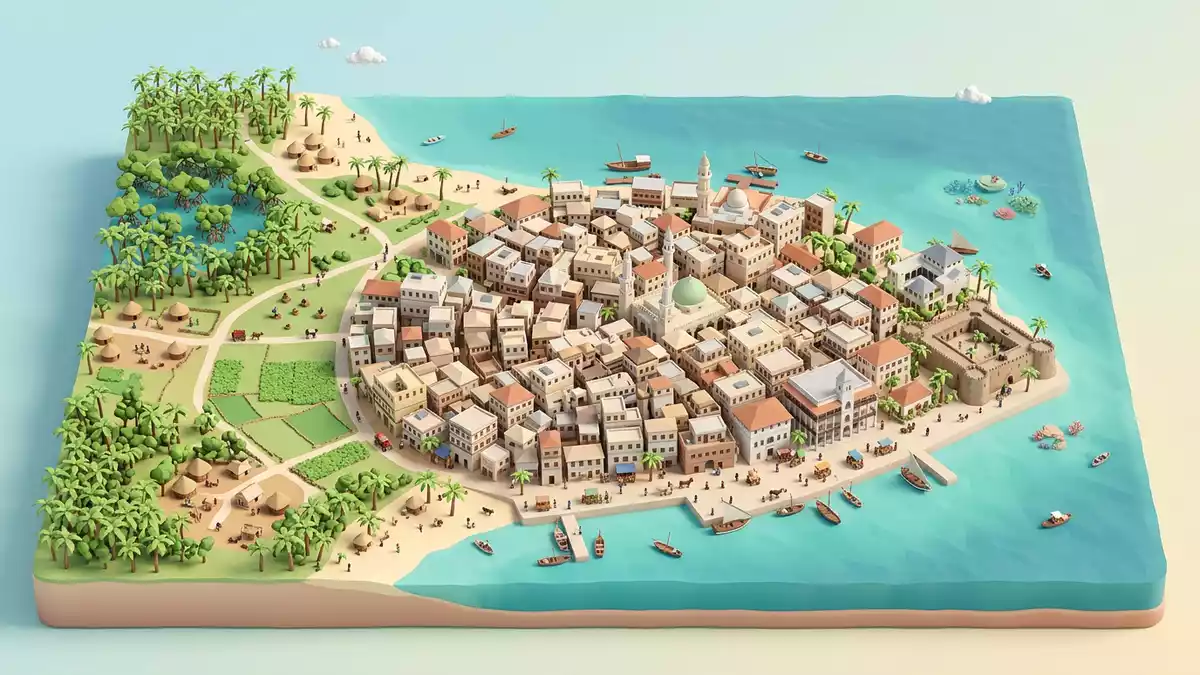
Stone Town is the historic quarter of Zanzibar City on Unguja Island, Tanzania. Coral-stone walls, carved wooden doors and narrow streets form an urban landscape shaped by Swahili, African, Arab, Indian and European traditions.
Coral stone, carved doors and a Swahili town plan
Stone Town’s buildings use coralline ragstone, mangrove timber, lime mortar and lime wash. The materials appear across houses, religious buildings, palaces and defensive structures, giving the district a consistent palette beside the Indian Ocean.
Carved wooden doors mark many entrances. Their frames carry geometric patterns, floral details and metal fittings, while balconies, verandas and projecting upper floors add variety to the streetscape. The town’s urban fabric remains closely associated with the Swahili coastal trading towns of East Africa. Stone Town’s World Heritage profile records the fusion of Swahili, Arab, Indian and European building traditions.
From the Sultanate of Oman to a World Heritage site
Stone Town developed as the capital of the Sultanate of Zanzibar and a major port in the western Indian Ocean. Its history is linked to maritime commerce involving the East African coast, Arabia, Persia and India, including the trade in spices, ivory and enslaved people.
The Old Fort began under Portuguese rule and took its present form under the Sultanate of Oman in the seventeenth century. Major buildings date from the eighteenth and nineteenth centuries, including the House of Wonders, the Old Dispensary, Christ Church Anglican Cathedral and St Joseph’s Roman Catholic Cathedral. Stone Town’s fortified history connects the Old Fort with the island’s changing political and trading powers.
The district became a UNESCO World Heritage property in 2000. Its designation covers both individual monuments and the wider townscape, including streets, building materials and the relationship between residential, religious, commercial and civic spaces. The historic urban landscape includes the Old Fort, the House of Wonders, Persian baths, mosques, cathedrals and former residences.
Buildings that hold several histories at once
Stone Town’s landmarks present different chapters of Zanzibar’s past within a compact historic district. The Old Fort is a substantial stone enclosure beside the waterfront. Nearby, the House of Wonders is a ceremonial palace associated with Sultan Barghash.
Christ Church Anglican Cathedral occupies a central place in the memory of the slave trade. The former slave market site and the cathedral belong to a difficult history that remains visible through monuments, buildings and public interpretation. Stone Town also contains the residence of the trader Tippu Tip, the Malindi Bamnara Mosque, the Jamat Khan and the Royal Cemetery.
These places are not isolated museum objects. Stone Town remains a residential and commercial quarter, with homes, shops, religious buildings and public routes sharing the same historic fabric. The combination of daily urban life and monuments gives the district its particular character. Stone Town’s documented history describes a town shaped by maritime exchange across many centuries.
Visiting Stone Town: what travellers from Western Europe should know
- Stone Town lies on the western coast of Unguja Island and forms the historic quarter of Zanzibar City. Zanzibar’s main airport is south of the city, while ferries connect the town with mainland Tanzania.
- The historic streets include narrow lanes, uneven paving, steps and shaded passages. Comfortable footwear is useful for walking between the waterfront, the Old Fort, cathedrals, mosques and residential streets.
- The official language is Swahili and the currency is the Tanzanian shilling.
- Entry requirements depend on your nationality; UK travellers can check the FCDO travel advice at gov.uk/foreign-travel-advice, Irish travellers the Department of Foreign Affairs at ireland.ie.
Searching for Stone Town on social platforms
These links open searches for Stone Town on each platform.
Frequently asked questions about Stone Town
Where is Stone Town?
Stone Town is the historic quarter of Zanzibar City on Unguja Island, part of Tanzania. It occupies the island’s western coast beside the Indian Ocean.
What can visitors expect in Stone Town?
Visitors find narrow streets, coral-stone buildings, carved wooden doors, mosques, cathedrals, palaces, forts and markets. The district remains a lived-in urban quarter rather than a collection of isolated monuments.
What makes Stone Town distinctive?
Its architecture combines Swahili, African, Arab, Indian and European influences in one historic townscape. Coral stone, mangrove timber, carved doors and maritime history appear together throughout the district.


