
Stone Town’s coral streets and carved doors in Sansibar
Published on 09/19/2026 at 22:34 | Editorial responsibility: Rafael Müller, Editor-in-Chief AD HOC NEWS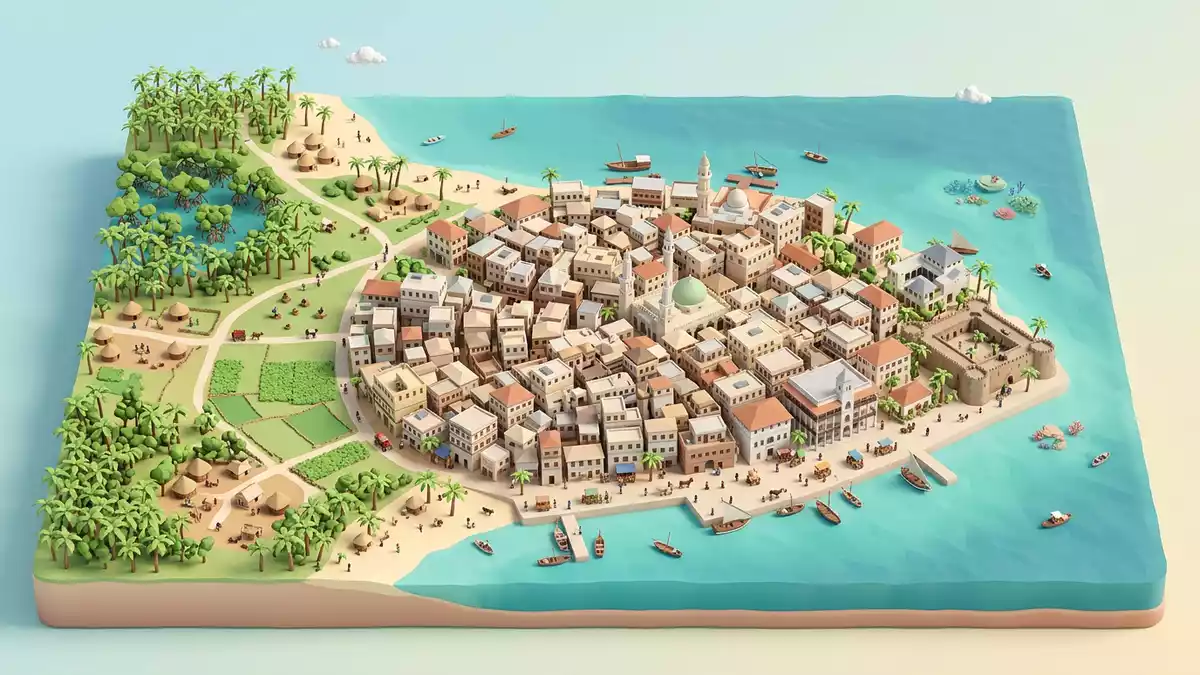
Stone Town in Sansibar is the historic core of Zanzibar City on Unguja Island, facing the Indian Ocean off the coast of Tanzania. Its coral-built houses, narrow streets and carved wooden doors form a dense Swahili townscape shaped over centuries of maritime trade.
Stone Town as a Swahili coastal trading town
Stone Town occupies the western shore of Unguja, the largest island in the Zanzibar archipelago, looking across a sheltered harbour towards the mainland of Tanzania. It developed as the main urban centre of Zanzibar City and as a port on the Indian Ocean routes linking East Africa with Arabia, Persia, India and Europe.Swahili coastal trading town For many centuries merchants used this harbour as a gateway between the African interior and overseas markets, moving spices, ivory and other goods through warehouses, counting houses and quays along the waterfront.
By the eighteenth and nineteenth centuries Stone Town had become the political and commercial capital of the Sultanate of Zanzibar, with its narrow streets lined by merchant houses, mosques, churches and palaces.eighteenth and nineteenth centuries The town’s importance on the Swahili coast is reflected in its inscription as the Stone Town of Zanzibar on the UNESCO World Heritage List in 2000, recognising its urban fabric as an outstanding example of cultural fusion and maritime mercantile interaction.UNESCO World Heritage Site in 2000
Coral ragstone, mangrove timber and Swahili architecture
The buildings of Stone Town are executed principally in coralline ragstone and mangrove timber, set in thick lime mortar, then plastered and lime-washed to form continuous walls and façades along the streets.coralline ragstone and mangrove timber This coral-based construction gives the town a pale, textured appearance and connects it physically with the reefs fringing the coasts north and south of Zanzibar City, where much of the stone was quarried.coral reefs north and south Many houses rise several storeys above the street, with projecting balconies, internal courtyards and flat roofs.
Stone Town’s architecture reflects a complex fusion of Swahili, Arab, Persian, Indian and European influences, visible in its plans, façades and street layout.fusion of influences The town is particularly associated with large, ornately carved wooden doors, some strengthened with metal studs, which mark the entrances to merchant houses and civic buildings.ornately carved wooden doors Along certain streets arcaded Indian storefronts face the lanes, while lattice screens and rooftop loggias reflect Arabian and Persian traditions adapted to the climate of the Swahili coast.
Monuments, faiths and memories in the coral labyrinth
Within the compact area of Stone Town stand monuments from the eighteenth and nineteenth centuries that trace the town’s role in regional politics and trade. Near the waterfront rises the Old Fort, also known as Ngome Kongwe, whose foundations date to the period of Portuguese control and whose present form reflects later Omani rule.Old Fort foundations and form Close by stands the House of Wonders, a ceremonial palace commissioned by Sultan Barghash in the nineteenth century, facing public spaces along the seafront.House of Wonders palace
The town’s streets also contain churches, mosques and former civic institutions that record the mingling of faiths and the history of the slave trade. St Joseph’s Roman Catholic Cathedral and Christ Church Anglican Cathedral rise above the surrounding houses, the latter built on the site of the island’s last slave market and associated with David Livingstone’s campaign against the trade.Christ Church Anglican Cathedral Nearby stand the Malindi Bamnara Mosque, the Jamat Khan built for the Ismaili community, the Old Dispensary with its decorated façade and the Hamamni and other Persian baths, each adding a layer to Stone Town’s coral labyrinth of streets and squares.Malindi Mosque and Hamamni baths
Visiting Stone Town: what travellers from Western Europe should know
- Stone Town forms the historic quarter of Zanzibar City on Unguja, on the west coast of the island, reached from mainland Tanzania by flights and ferries into the city’s port and airport.
- The historic streets are narrow and irregular, with many sections accessible only on foot, including passages with steps, uneven coral surfaces and occasional staircases inside older houses and towers.
- The town lies at sea level beside the Indian Ocean, and views over the harbour take in dhows, quays and the seafront buildings rising behind the waterfront promenade.
- The official languages are Swahili and English, and the currency is the Tanzanian shilling.
- Entry requirements depend on your nationality; UK travellers can check the FCDO travel advice at gov.uk/foreign-travel-advice, Irish travellers the Department of Foreign Affairs at ireland.ie.
Searching for Stone Town on social platforms
These links open searches for Stone Town on each platform.
Frequently asked questions about Stone Town
Where is Stone Town and what is its setting?
Stone Town is the historic quarter of Zanzibar City on Unguja Island in Sansibar, on the west coast of the island facing a sheltered Indian Ocean harbour.
What should visitors expect when walking through Stone Town?
Visitors encounter narrow coral-built streets lined with multi-storey houses, carved wooden doors, small squares, mosques, churches and historic civic buildings within a compact urban maze.
What makes Stone Town distinctive among Swahili towns?
Stone Town is distinctive for its coral ragstone construction, fusion of Swahili, Arab, Persian, Indian and European architectural elements and its formal recognition as a UNESCO World Heritage Site.


