
Su Nuraxi and the basalt towers of Barumini
Published on 09/23/2026 at 20:29 | Editorial responsibility: Rafael Müller, Editor-in-Chief AD HOC NEWS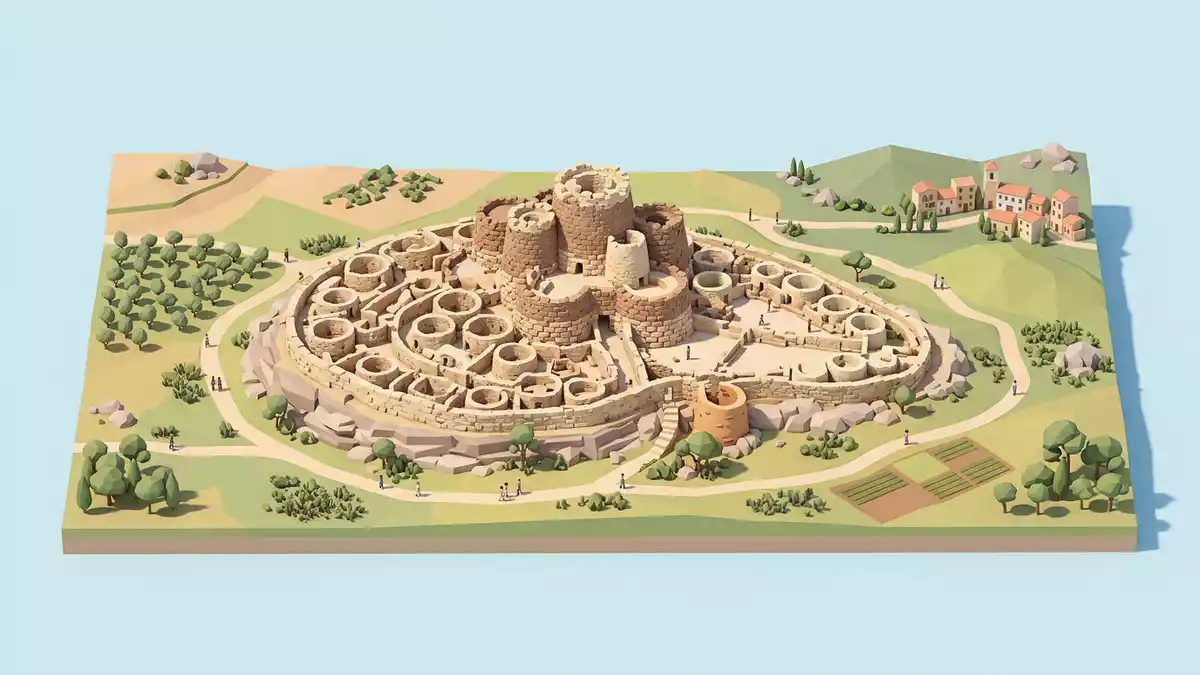
Su Nuraxi rises on a low hill near Barumini as a compact world of dark basalt towers, heavy walls and circular dwellings. Its central tower belongs to Sardinia’s Bronze Age, while the surrounding settlement records later phases of Nuragic life.
Su Nuraxi: a fortress built from basalt
The central tower, known as the mastio, forms the visual and architectural core of Su Nuraxi. Its oldest phase is traditionally dated to the seventeenth to thirteenth centuries BC, and the tower originally reached about 18.6 metres. Large basalt blocks form the walls, fitted without mortar into a tapering stone structure.
Basalt came from the volcanic landscape around the Giara, the plateau that rises near Barumini. Inside the mastio, chambers are arranged above one another beneath a roof that has not survived. Narrow passages, stairways and wall thicknesses remain visible within the complex, showing the scale of Nuragic masonry.
From central tower to Nuragic settlement
The central tower was joined by additional towers and a surrounding bastion. Connecting walls enclose an inner courtyard, while an outer defensive circuit surrounds the wider archaeological area. The arrangement gives Su Nuraxi a layered form, with the oldest tower at its centre and later masonry extending around it.
Beyond the bastion lies a village of circular huts. Their low stone walls mark rooms and shared spaces associated with the settlement. The village and towers belong to a long sequence of occupation, extending from the second millennium BC into the Roman period. UNESCO World Heritage listing records the site as a major example of Nuragic architecture in Sardinia.
Giovanni Lilliu and the archaeology of Barumini
Archaeologist Giovanni Lilliu led the principal excavations at Su Nuraxi between 1950 and 1957. The work revealed towers, bastions, courtyards and the extensive village beneath accumulated earth, bringing the full scale of the complex into view.
Su Nuraxi is associated with the Nuragic civilisation, whose stone monuments spread across Sardinia during the Bronze and Iron ages. Its importance lies in the relationship between the mastio, the surrounding towers and the settlement beyond the walls. The complex became a World Heritage site in 1997, placing Barumini within the international story of prehistoric Mediterranean architecture.
Visiting Su Nuraxi: what travellers from Western Europe should know
- Su Nuraxi lies near Barumini in central Sardinia. Roads from Cagliari and Oristano lead towards the town, and the archaeological area sits west of the settlement.
- The site combines uneven basalt masonry, narrow passages, steps and compact chambers. Movement through the central tower follows a confined archaeological route rather than an open level floor.
- The surrounding Marmilla landscape contains the Giara plateau and broad views across central Sardinia. The dark stone of the complex contrasts with the pale rural terrain.
- The official language is Italian and the currency is the euro.
Searching for Su Nuraxi on social platforms
These links open searches for Su Nuraxi on each platform.
Frequently asked questions about Su Nuraxi
Where is Su Nuraxi?
Su Nuraxi is near Barumini in central Sardinia, within the Marmilla region. The complex stands on a low rise west of the town.
What can visitors expect at Su Nuraxi?
The archaeological area contains a central basalt tower, connected defensive walls, courtyards and a village of circular huts. Narrow passages and steps form part of the central complex.
What makes Su Nuraxi distinctive?
Its central mastio, surrounding towers and settlement survive as a connected Nuragic complex. Basalt construction without mortar and the site’s 1997 World Heritage inscription define its identity.


