
Suchitoto, El Salvador: hillside colonial streets above Lake Suchitlán
Published on 09/19/2026 at 14:05 | Editorial responsibility: Rafael Müller, Editor-in-Chief AD HOC NEWS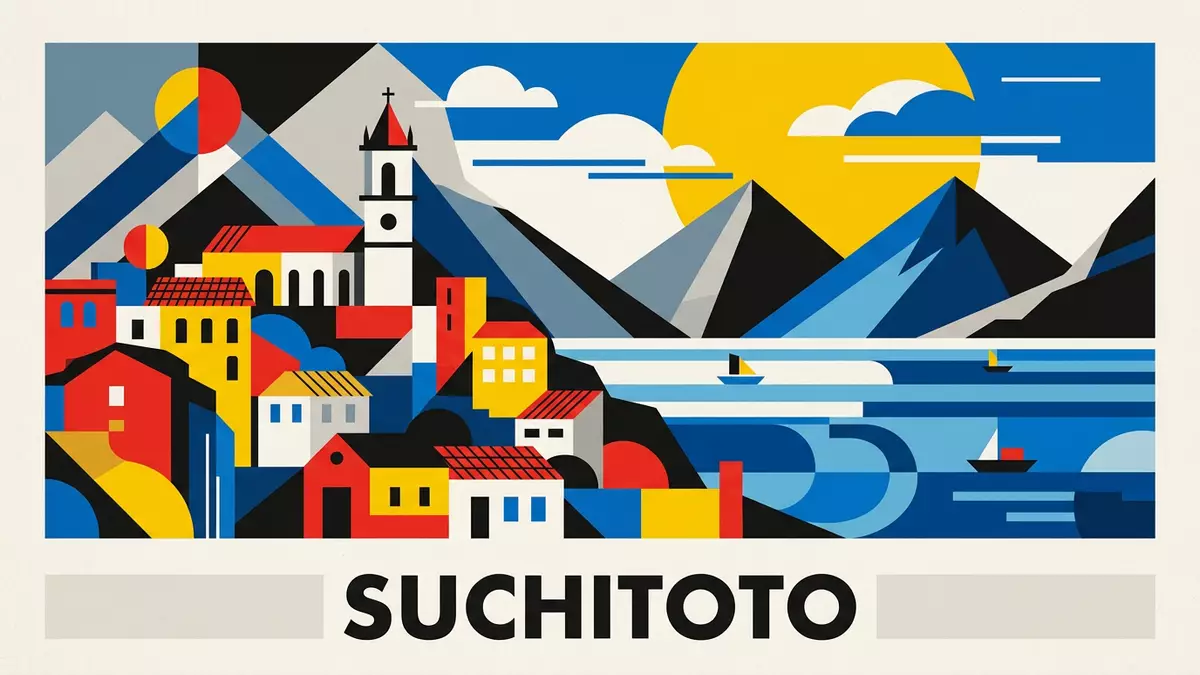
Suchitoto in central El Salvador is a colonial hillside town overlooking the broad waters of Lake Suchitlán, with straight cobblestone streets and whitewashed houses stepping down the slope towards the lake. Set in the Cuscatlán Department north-east of San Salvador, it has long been a regional centre whose historic core still follows the rectilinear street grid introduced under Spanish colonial rule.
Colonial grid and whitewashed streets above the lake
Suchitoto is a small city in the Cuscatlán Department of El Salvador, with a municipal territory that has been inhabited since pre-Columbian times and later took on its present colonial layout under Spanish rule.Suchitoto is a district The town centre occupies hillside terrain between the Guazapa volcano and the Lempa River, looking down towards the northern shore of Lake Suchitlán, a reservoir formed behind the Cerrón Grande hydroelectric dam on the Lempa in the 1970s.Lago Suchitlán formed behind the Cerrón Grande dam
The historic centre follows a straight-street grid, a pattern that takes the form of blocks meeting at right angles and converging on a central square that anchors everyday life.the town’s core follows a grid Along these cobblestone streets stand low houses with terracotta roofs and white or pastel façades, many with internal courtyards opening towards shaded arcades. The regular layout means that from several crossroads the view runs straight down towards the distant lake and the low hills beyond, making the geometry of the town and the surrounding landscape easy to read at a glance.
Santa Lucía church and Suchitoto’s colonial architecture
At the heart of Suchitoto stands the Santa Lucía church, a whitewashed building whose neoclassical façade with columns and belfries fronts the main square and has become the most recognisable architectural landmark in the town centre.Parroquia Santa Lucía The current church building is dated to the mid-nineteenth century, with an inauguration recorded for 1857, and it preserves a style described as baroque with rococo tendencies, visible in its decorative mouldings and the articulation of its façade.inaugurated in 1857
Around the square, colonial-era houses with tiled roofs frame the open space, and further streets carry similar architecture for several blocks, making Suchitoto one of El Salvador’s better-preserved colonial towns.colonial style architecture very well preserved Many buildings retain wooden doors opening directly onto the pavement, with interior rooms arranged around planted courtyards, a layout that reflects the adaptation of Iberian models to Central American climate and materials. The combination of the formal church façade, the regular street grid and the low domestic architecture gives the town centre a coherent visual character that is quickly apparent on a walk through the streets.
Lake Suchitlán and the surrounding landscape
One of the defining features of Suchitoto is its relationship with Lake Suchitlán, the largest lake in El Salvador, which spreads out below the town as a wide reservoir on the Lempa River.the country’s largest lake formed behind the Cerrón Grande hydroelectric dam Viewpoints at the edge of the historic centre look down over the water, taking in a scene of peninsulas, small islands and distant hills that contrasts with the regular geometry of the streets behind. From the town, roads and paths descend towards the lakeshore, where small piers and boat landings serve excursions onto the reservoir and across to rural communities on the opposite bank.
The wider municipality of Suchitoto covers a substantial area of hills and valleys, with both rural communities and patches of woodland lying beyond the compact urban grid.Suchitoto has a surface of 329.2 km² Within this territory, the Guazapa volcano rises to the west and the Lempa River forms part of the eastern boundary, placing the town in a landscape shaped by volcanic topography and river valleys.between the Guazapa volcano and the Lempa River The contrast between the orderly colonial grid and the surrounding terrain is one of the most striking aspects of Suchitoto’s setting.
Visiting Suchitoto: what travellers from Western Europe should know
- Suchitoto lies north-east of San Salvador in the Cuscatlán Department of central El Salvador, on hillside ground above the northern shore of Lake Suchitlán, and is reached by road from the capital.
- The historic centre is built on sloping terrain, so moving between the upper streets and viewpoints towards the lake involves walking along gradients and cobblestone surfaces.
- Suchitoto is in El Salvador, where the official language is Spanish and the currency is the United States dollar (USD).
- Entry requirements depend on your nationality; UK travellers can check the FCDO travel advice at gov.uk/foreign-travel-advice, Irish travellers the Department of Foreign Affairs at ireland.ie.
Searching for Suchitoto on social platforms
These links open searches for Suchitoto on each platform.
Frequently asked questions about Suchitoto
Where is Suchitoto in El Salvador?
Suchitoto is a small city and district in the Cuscatlán Department of central El Salvador, north-east of the capital San Salvador and above the northern shore of Lake Suchitlán.
What can visitors expect in Suchitoto’s town centre?
Visitors encounter a compact colonial centre with cobblestone streets laid out in a grid, low whitewashed houses with terracotta roofs and the prominent Santa Lucía church facing the main square.
What makes Suchitoto distinctive among Salvadoran towns?
Suchitoto stands out for the combination of its well-preserved colonial street pattern, the nineteenth-century Santa Lucía church and its hillside position overlooking the wide expanse of Lake Suchitlán.


