
Suwon Hwaseong: a late?Joseon fortress encircling Suwon
Published on 09/14/2026 at 16:30 | Editorial responsibility: Rafael Müller, Editor-in-Chief AD HOC NEWS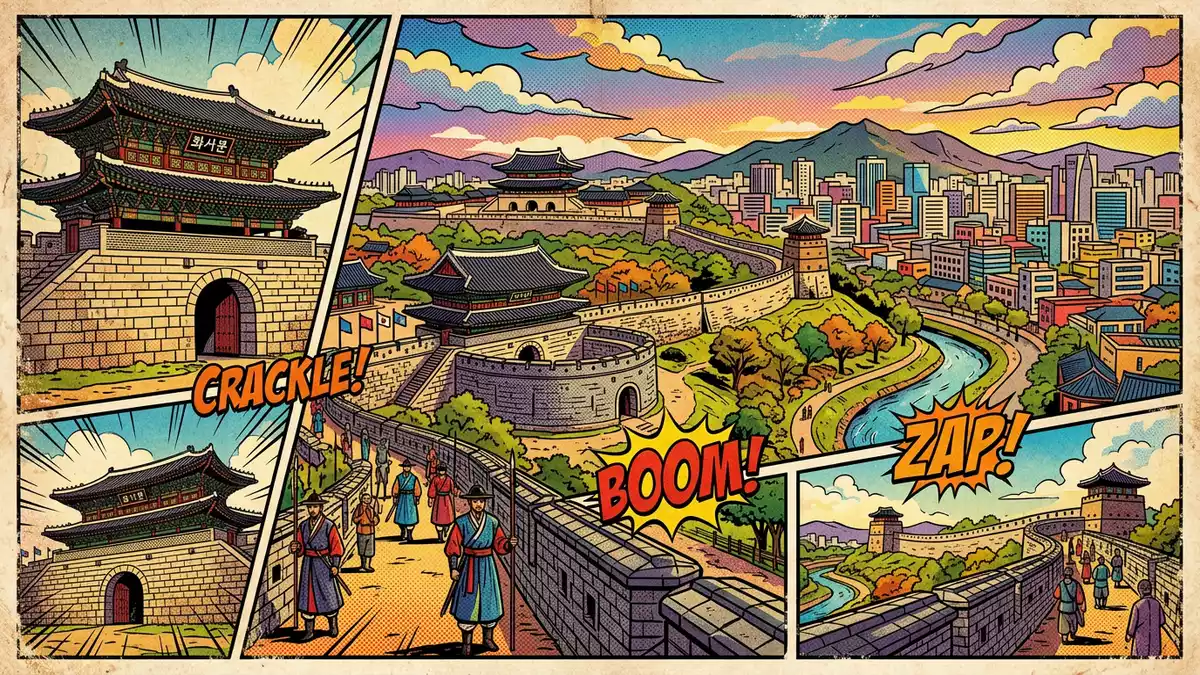
Suwon Hwaseong is a Korean fortress of stone and brick that surrounds the historic centre of Suwon in South Korea, a late?eighteenth?century stronghold of the Joseon dynasty built under King Jeongjo.
The walls that still shape Suwon
The defining experience of Suwon Hwaseong is the continuous line of fortification walls that loop around central Suwon, following ridges, slopes and low ground in a broad circuit. The fortress encloses an area of around 130 ha, with the Suwoncheon stream crossing its interior and Paldalsan Mountain rising near the middle of the circuit.The massive walls enclose an area of 130 ha The wall itself is built in piled stone and brick, a combination that gives it a distinctive texture among Korean fortifications and reflects late?Joseon experimentation with military architecture.Hwaseong is a piled-stone and brick fortress of the Joseon Dynasty
Walking along sections of the wall brings a sequence of defensive structures into view, from projecting turrets and bastions to enclosed towers and pavilions set at bends and high points. The circuit is punctuated by main gates at the cardinal points, each framed by a gatehouse that combines heavy masonry with timber superstructures and tiled roofs.Originally the fortress had main gates, watchtowers and pavilions distributed around its walls Inside the walls, the terrain alternates between the slopes of Paldalsan and flatter ground closer to the stream, giving different vantage points over Suwon’s streets and modern buildings.
A Joseon?dynasty project under King Jeongjo
Suwon Hwaseong belongs to the final century of the Joseon dynasty and to the reign of King Jeongjo, who ruled from the late 1770s into 1800.King Jeongjo, the 22nd king of Joseon, commissioned the fortress Construction began in January 1794 and was completed in September 1796, a short but intense building campaign documented in contemporary manuals on fortress technology.The fortress started to be constructed in January 1794 and was completed in September 1796 These dates place Suwon Hwaseong firmly within the late eighteenth century, at a moment when military engineers in Korea were studying fortification methods from both East Asian and European treatises.
The fortress surrounds Suwon’s centre in Gyeonggi Province, south of Seoul, and incorporates the temporary palace complex known as Hwaseong Haenggung within its perimeter.Hwaseong Fortress surrounds the centre of Suwon and includes a temporary palace Suwon was one of the main regional administrative centres of Joseon, and the new fortress created a distinct walled town with its own gates, guard posts and command facilities. Officially, the site is recognised under the name Hwaseong Fortress in Suwon and has been listed as a State?designated Cultural Heritage in South Korea.Hwaseong Fortress in Suwon has been designated as a state cultural heritage
UNESCO World Heritage and a walk through fortification history
Beyond its national designation, Suwon Hwaseong has carried UNESCO World Heritage status since 1997, reflecting its importance as an example of late?Joseon fortress planning and construction.Hwaseong Fortress was inscribed on the World Heritage List in 1997 The walls, around 5.7 km (3.5 mi) in length, form a near?complete circuit that visitors can follow on foot, with views over Suwon’s streets, the slopes of Paldalsan and the alignment of defensive platforms along the crest of the wall.The walls stretch for approximately 5.7 kilometres, with Paldalsan Mountain at the centre A trail connects the four main gates, including Janganmun in the north and Paldalmun in the south, linking guard platforms, command posts and beacon structures.
Inside the circuit, Suwon Hwaseong includes reconstructed palace buildings and pavilions, and the fortress functions as a large historic park embedded in the urban fabric of Suwon.Inside the walls stands the reconstructed Hwaseong Haenggung Palace Stone stairways climb from low ground up to the wall?top paths, and sections over Paldalsan involve sustained uphill walking on ramps and steps. Visitors moving along the circuit encounter the varied forms of Joseon defensive architecture in sequence: enclosed brick watchtowers, open artillery platforms, secret side gates and pavilions overlooking the stream and streets.
Visiting Suwon Hwaseong: what travellers from Western Europe should know
- Suwon Hwaseong surrounds central Suwon in Gyeonggi Province; main approaches by rail lead to Suwon Station, from where local buses and streets reach the fortress area.
- Exploring the walls involves sustained walking along paved paths, ramps and stairways, especially on the slopes of Paldalsan Mountain where the gradient is steep.
- The fortress lies in Suwon, in South Korea; the official language is Korean and the currency is the South Korean won.
- Apart from the walls themselves, notable nearby features within the circuit include the Suwoncheon stream, Paldalsan Mountain and the Hwaseong Haenggung palace complex.
Searching for Suwon Hwaseong on social platforms
These links open searches for Suwon Hwaseong on each platform.
Frequently asked questions about Suwon Hwaseong
Where is Suwon Hwaseong located?
Suwon Hwaseong surrounds the historic centre of Suwon, the provincial capital of Gyeonggi Province in South Korea, south of Seoul.
What can visitors expect when walking the fortress?
Visitors walk along stone and brick walls with gates, towers and pavilions, crossing both flat ground and the slopes of Paldalsan Mountain and seeing Suwon’s streets within the circuit.
What makes Suwon Hwaseong distinctive?
The fortress combines late?eighteenth?century piled?stone and brick construction, a complete walled circuit around a city centre and UNESCO World Heritage recognition for its Joseon?dynasty planning.


