
Taj Mahal: the white marble geometry of Agra
Published on 09/24/2026 at 12:17 | Editorial responsibility: Rafael Müller, Editor-in-Chief AD HOC NEWS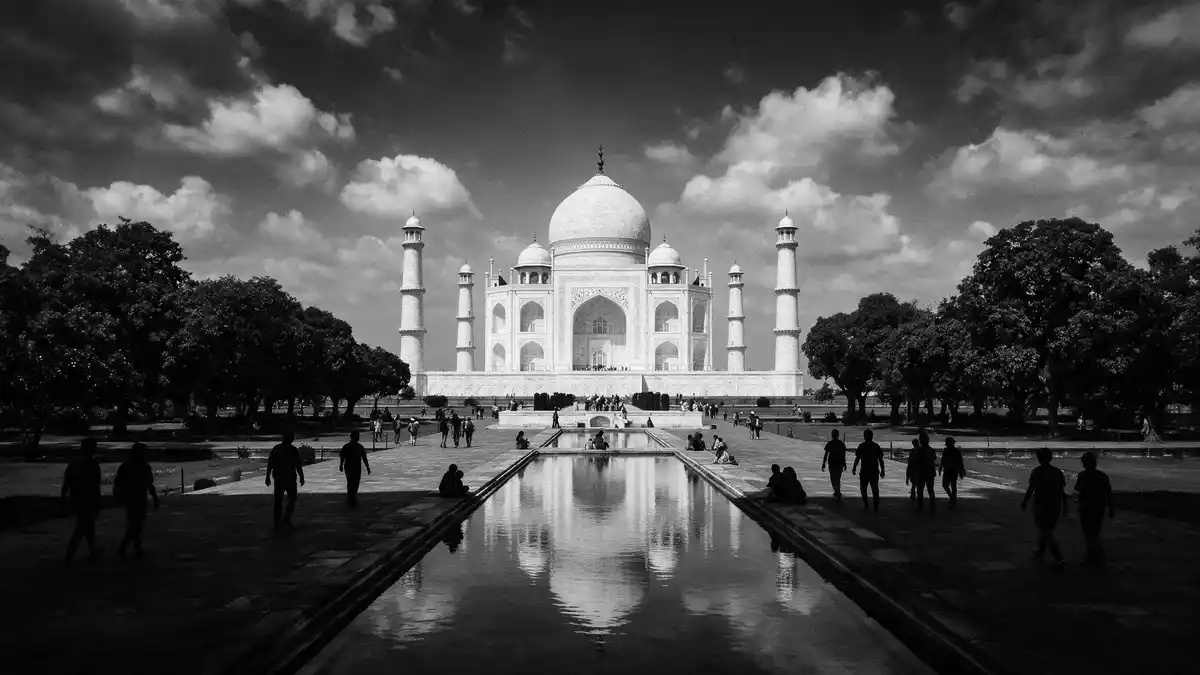
Taj Mahal is a white marble mausoleum on the southern bank of the Yamuna River in Agra. Its central dome, formal gardens, minarets and red sandstone buildings form a carefully balanced Mughal complex, completed in the seventeenth century.
White marble at the centre of Agra
The principal building rises from a high marble plinth, with a minaret at each corner. Four matching façades face the garden and river, each organised around a large central arch.
The mausoleum is made from ivory-white marble, with fine inlay using coloured and semiprecious stones. Carved marble screens enclose the cenotaphs of Mumtaz Mahal and Shah Jahan inside the central chamber. The actual graves lie beneath them.
The building’s surface combines polished stone, carved detail and calligraphic decoration. Its large double dome is accompanied by smaller domed kiosks, while the surrounding minarets establish a clear vertical rhythm. Mughal architectural detail is visible throughout the complex.
Shah Jahan and the Mughal mausoleum
The Mughal emperor Shah Jahan commissioned the mausoleum in memory of his wife Mumtaz Mahal, who died in 1631. Construction began around 1632, and the principal mausoleum was completed in 1648.
The wider complex includes a mosque, a matching guest building, a monumental southern gateway, courtyards and gardens. These elements were completed in stages, with work continuing across the grounds until 1653.
The design joins Indian, Persian and Islamic architectural traditions. Its plan places the mausoleum, gateway, water channels and planted avenues within a formal sequence. The Yamuna forms the northern edge of the complex, beyond the marble platform.
Shah Jahan was buried beside Mumtaz Mahal after his death. Their tombs occupy the central chamber, where the white marble screen separates the cenotaphs from the surrounding interior space. the UNESCO World Heritage listing records the complex as a major work of Muslim art in India.
Gardens, gateways and measured symmetry
The approach begins at the great southern gateway, built in red sandstone with marble details. Beyond it, a long garden axis leads towards the mausoleum and its raised platform.
Water channels divide the garden into formal sections, reflecting the architecture when viewed along the central approach. Cypresses and other planting occupy the garden beds, while paved paths connect the gateway, water features and marble terrace.
The mosque stands on one side of the mausoleum, with a matching building on the other side. Their red sandstone surfaces create a strong colour contrast with the central marble structure.
The complex received UNESCO World Heritage status in 1983. Its importance rests in the complete relationship between mausoleum, garden, gateway, mosque, river and decorative programme. the riverside marble monument remains tied to Agra’s Mughal history.
Visiting Taj Mahal: what travellers from Western Europe should know
- Taj Mahal stands on the southern bank of the Yamuna in Agra, Uttar Pradesh. Agra is connected with Delhi and other northern Indian cities by rail and road.
- The approach crosses the formal garden before reaching the raised marble platform. Steps lead from the platform towards the mausoleum and its interior chamber.
- The complex contains a mosque and a matching guest building in red sandstone. The southern gateway marks the principal approach through the gardens.
- The official language is Hindi and the currency is the Indian rupee.
- Entry requirements depend on your nationality; UK travellers can check the FCDO travel advice at gov.uk/foreign-travel-advice, Irish travellers the Department of Foreign Affairs at ireland.ie.
Searching for Taj Mahal on social platforms
These links open searches for Taj Mahal on each platform.Frequently asked questions about Taj Mahal
Where is Taj Mahal?
Taj Mahal is in Agra, in the northern Indian state of Uttar Pradesh. The complex occupies the southern bank of the Yamuna River.
What does a visit include?
The visit includes the gateway, formal gardens, water channels, marble platform, mausoleum and adjacent red sandstone buildings. The interior contains the cenotaphs of Mumtaz Mahal and Shah Jahan.
What makes Taj Mahal distinctive?
Its white marble mausoleum forms the centre of a larger Mughal complex. Symmetrical gardens, minarets, a mosque, a matching guest building and the Yamuna complete the setting.


