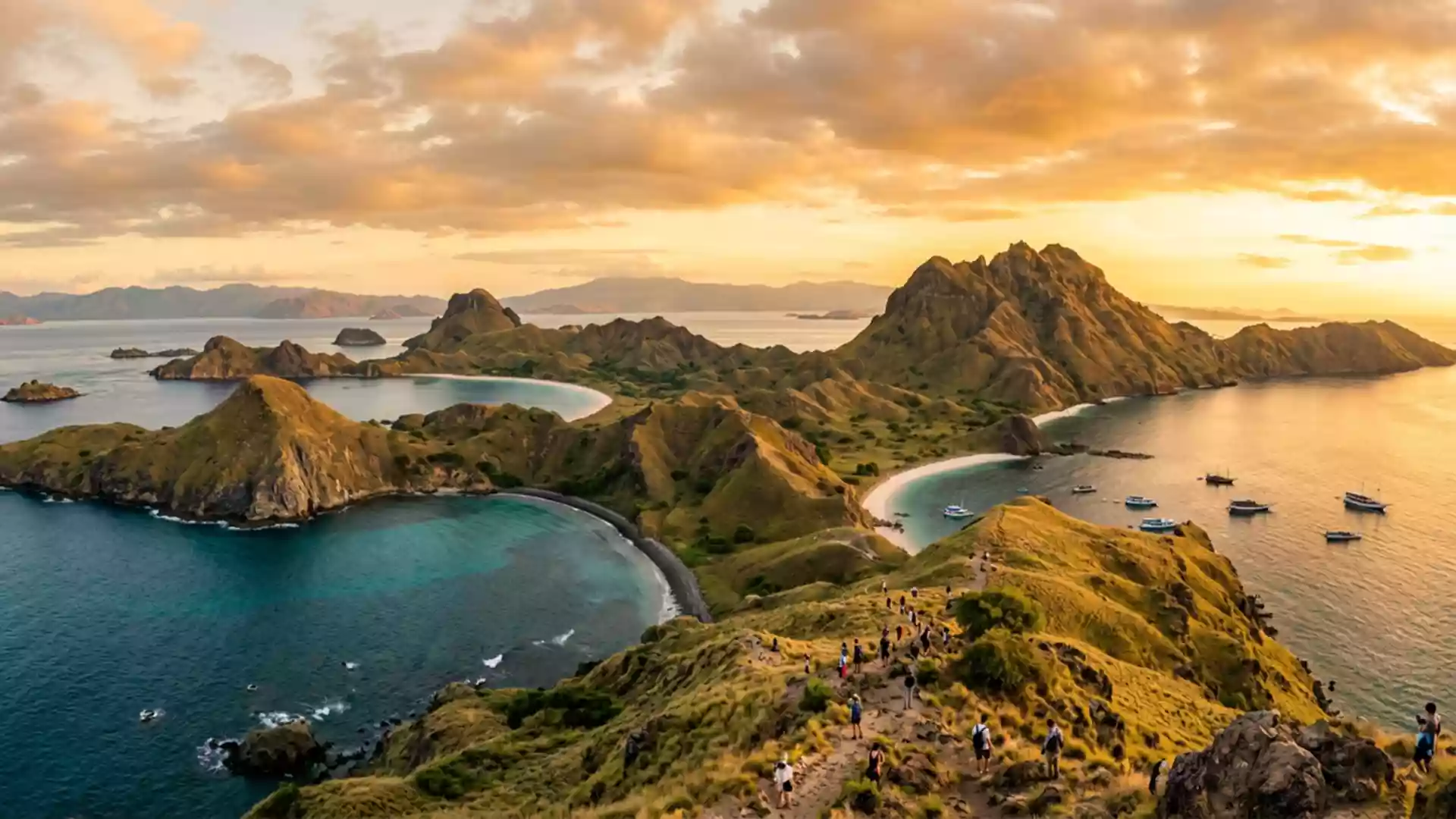
Taman Nasional Komodo and the volcanic seascapes of Labuan Bajo
Published on 09/18/2026 at 06:48 | Editorial responsibility: Rafael Müller, Editor-in-Chief AD HOC NEWS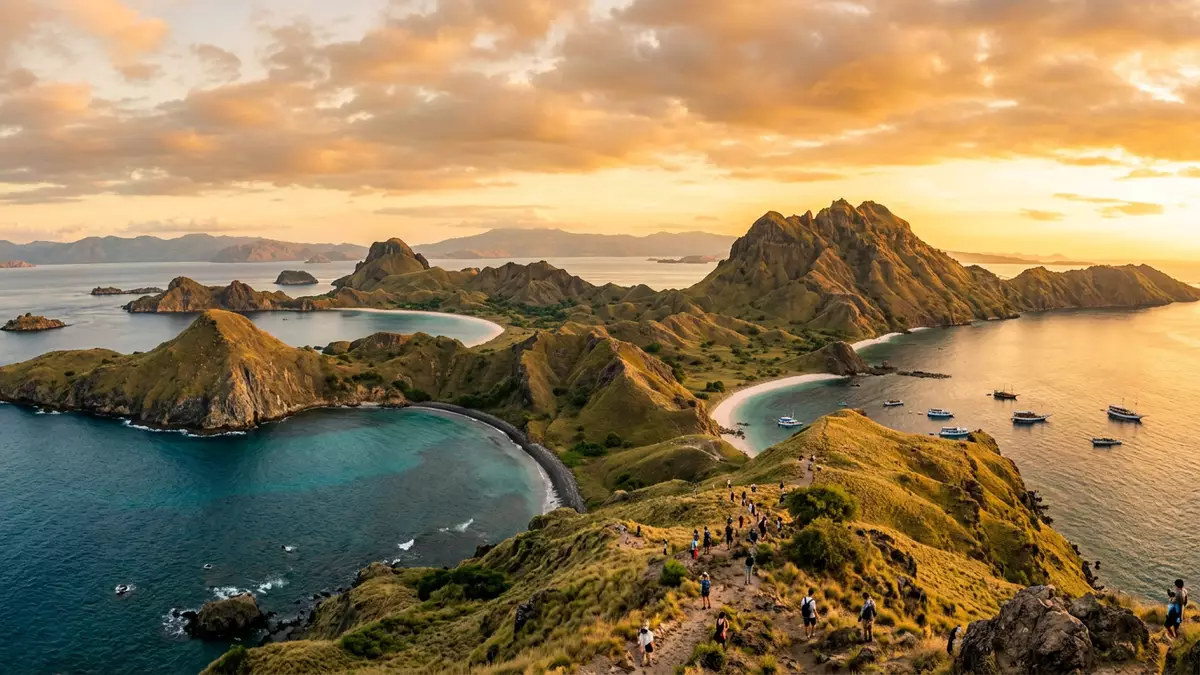
Taman Nasional Komodo, known internationally as Komodo National Park, stretches across volcanic islands and coral-rich seas west of Labuan Bajo in eastern Indonesia, with Komodo dragons living alongside tropical marine life in one protected landscape. The park was formally established as a national park in 1980 and inscribed as a UNESCO World Heritage Site in 1991, anchoring its status as a conservation area of global significance across both land and sea.
Volcanic islands in a protected seascape
Taman Nasional Komodo lies between the islands of Flores and Sumbawa in the Lesser Sunda chain, in the East Nusa Tenggara province of Indonesia. The park’s core is a group of rugged islands surrounded by warm tropical seas, with the largest landmasses formed by Komodo, Rinca and Padar, each rising from the water in steep ridges and valleys that reflect their volcanic origin.Komodo, Rinca and Padar Together with numerous smaller islands, these landforms create a broken ring of slopes and headlands framing bays, channels and inlets, giving the park its distinctive island-and-sea character.
The park was created by the Indonesian government as a protected area in 1980, defining a national park that combined savanna hillsides, coastal vegetation and surrounding waters in a single managed unit.designated as Taman Nasional Komodo on 6 March 1980 In 1991 it gained recognition beyond Indonesia when it was inscribed on the UNESCO World Heritage List for natural values under criteria (vii) and (x), reflecting both its volcanic landscapes and biodiversity. The World Heritage listing defines a protected area of around 219,000 ha that includes terrestrial zones on the islands and significant marine sections of surrounding sea.total surface area of 219,322 ha
Komodo dragons and savanna landscapes
Taman Nasional Komodo is closely associated with the Komodo dragon, the world’s largest living lizard, known scientifically as Varanus komodoensis.population of giant lizards called Komodo dragons The species occurs naturally on several islands within and around the park, including Komodo and Rinca, and forms one of its central conservation priorities. On these islands, dry slopes and open grasslands alternate with pockets of forest, creating habitats where the dragons can move between shade and open ground.
The savanna character of much of the landscape is emphasised by scattered trees and shrubs on otherwise open hills, with paths and trekking routes crossing ridges and descending into valleys where watercourses cut through the terrain. These landforms shape viewpoints over bays and channels and bring visitors into contact with the park’s terrestrial ecosystems, where wild populations of Komodo dragons, deer and other fauna can be observed at a distance in their natural setting.wild populations of Komodo dragons still exist
Coral reefs and tropical marine life
Beyond the islands themselves, Taman Nasional Komodo encompasses extensive marine areas within the Coral Triangle, a region recognised for high coral and fish diversity.marine biodiversity of the Coral Triangle waters Coral reefs fringe the coasts and form patch reefs and walls in the channels between islands, providing habitat for reef fish, invertebrates and larger species such as rays and sharks. These underwater systems stand alongside the terrestrial conservation work on Komodo dragons, making the park a combined land-and-sea reserve.
Marine protection in the park covers clear water around Komodo, Rinca, Padar and neighbouring islets, with boundaries that extend into surrounding straits. Within these waters, currents move through channels and past headlands, while coral slopes drop away into deeper sections. The park’s dual recognition as both a World Heritage Site and a Man and the Biosphere Reserve reflects this combination of terrestrial megafauna and complex marine ecosystems in a single protected region.declared a UNESCO World Heritage Site and a Man and Biosphere Reserve
Visiting Taman Nasional Komodo: what travellers from Western Europe should know
- Taman Nasional Komodo lies west of the town of Labuan Bajo on Flores in eastern Indonesia, and visits commonly begin from Labuan Bajo harbour by boat across the coastal straits.
- On land, approaches to viewpoints and ranger areas involve walking on uneven volcanic slopes and savanna paths, with sections of steps and inclines on the main islands.
- The official language is Indonesian and the currency is the Indonesian rupiah.
- Entry requirements depend on your nationality; UK travellers can check the FCDO travel advice at gov.uk/foreign-travel-advice, Irish travellers the Department of Foreign Affairs at ireland.ie.
Searching for Taman Nasional Komodo on social platforms
These links open searches for Taman Nasional Komodo on each platform.
Frequently asked questions about Taman Nasional Komodo
Where is Taman Nasional Komodo located?
Taman Nasional Komodo is in East Nusa Tenggara province in Indonesia, between the islands of Flores and Sumbawa, with Labuan Bajo acting as the main access town on the Flores side.
What can visitors expect on a visit to the park?
Visitors encounter volcanic islands with savanna slopes, coastal views over channels and bays, and guided access to areas where Komodo dragons and other wildlife live in protected habitats.
What makes Taman Nasional Komodo distinctive among Indonesia’s protected areas?
Taman Nasional Komodo combines conservation of the Komodo dragon with extensive coral reef and marine protection, and carries recognition as both a UNESCO World Heritage Site and a Man and the Biosphere Reserve.