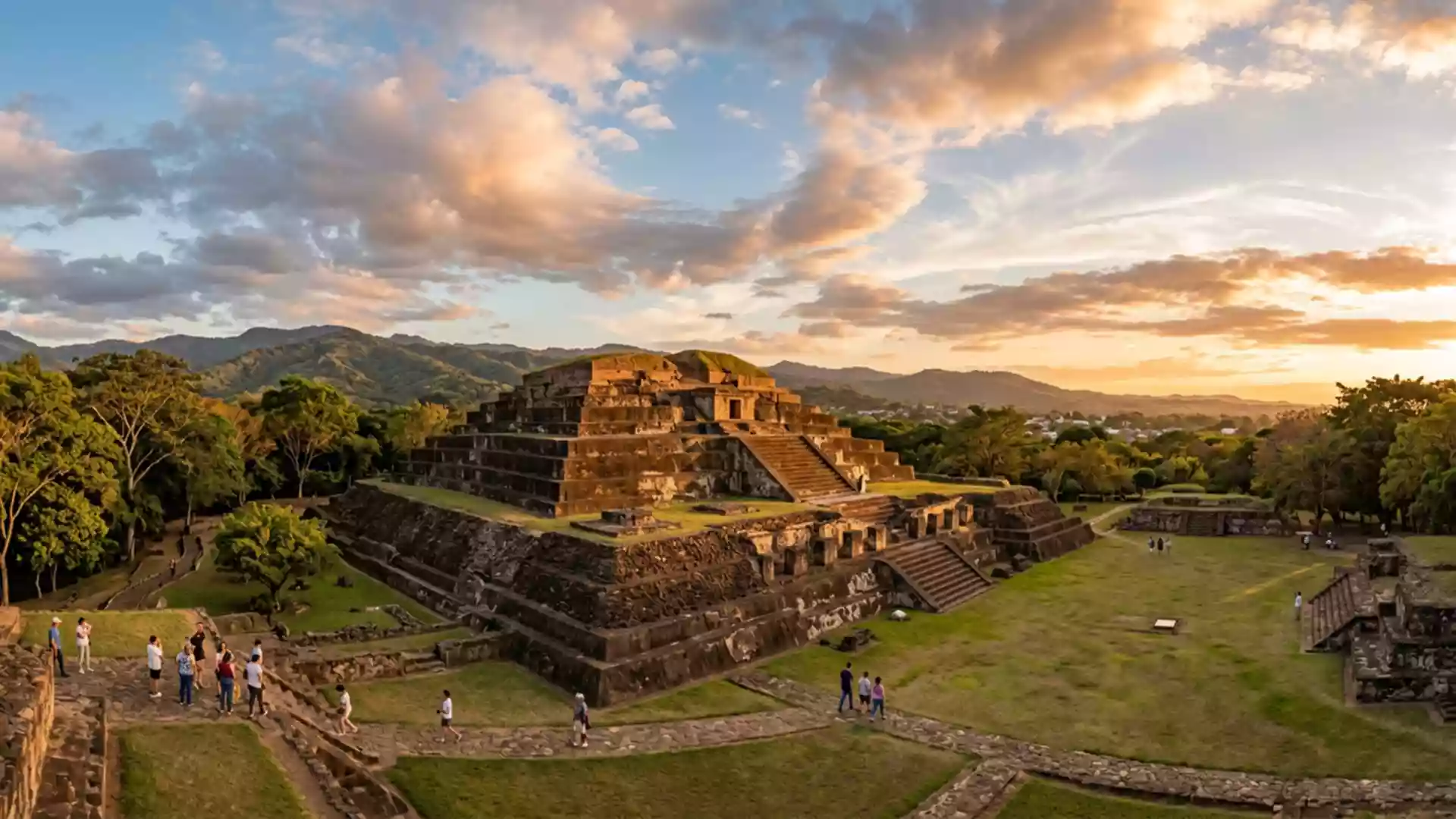
Tazumal: layered Maya pyramids in Chalchuapa
Published on 09/01/2026 at 15:14 | Editorial responsibility: Rafael Müller, Editor-in-Chief AD HOC NEWS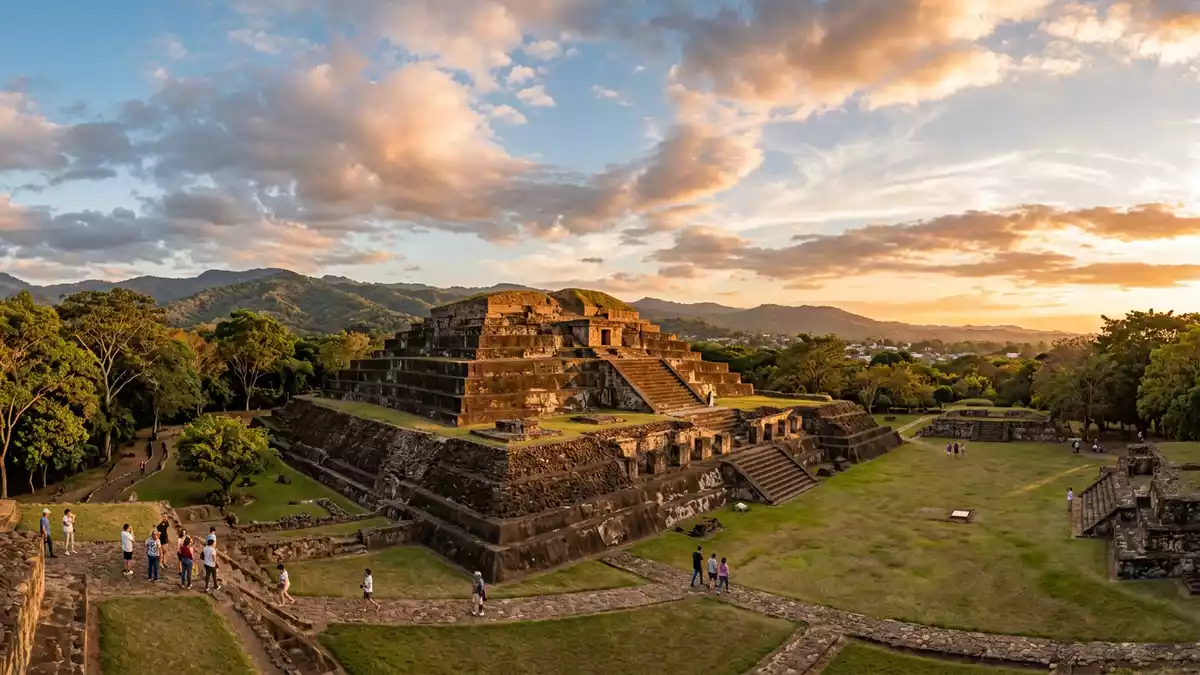
Tazumal in Chalchuapa, western El Salvador, is a compact Maya pyramid complex where stepped stone structures rise directly from a modern townscape. Set within the broader Chalchuapa archaeological zone, it concentrates centuries of ceremonial and residential life into a site that today feels both ancient and embedded in everyday urban streets.
A Maya centre within Chalchuapa
Tazumal forms part of the ancient city of Chalchuapa, in the present-day department of Santa Ana in western El Salvador.ancient city of Chalchuapa The archaeological group occupies the southern portion of this wider zone, surrounded by ordinary housing and local streets that emphasise how the ruins sit within a living town rather than an isolated landscape.southern portion of the Chalchuapa archaeological zone
The site lies within the Río Paz drainage basin at an altitude of about 720 m (2,360 ft), giving the pyramids a slightly raised position over the surrounding plain without placing them in high-mountain terrain.altitude of about 720 m Around Tazumal, other named sites such as Casa Blanca, El Trapiche and Las Victorias form a cluster of remains that together mark Chalchuapa as one of El Salvador’s key pre-Columbian centres.archaeological zone integrated by several recognised sites
Long occupation and stepped pyramids
Archaeological work places Tazumal’s occupation between the Late Preclassic and Early Postclassic periods, covering roughly the first thirteen centuries of the Common Era.Late Preclassic to Early Postclassic period The settlement developed most strongly in the Classic period, when monumental masonry platforms and pyramids were raised to form a ceremonial and residential core. The name Tazumal is linked to the K’iche’ language and has been rendered as “pyramid where the victims were burned”, reflecting the site’s association with ritual practice rather than calm domestic architecture.meaning “pyramid where the victims were burned”
Tazumal’s visible heart is a large stepped pyramid, often referred to as Structure 1, which rises on a broad platform of cut stone blocks.prominent mound of 24 metres identified as Estructura 1 Archaeological recording by the North American archaeologist Stanley Boggs in 1940 listed multiple structures at the site, from smaller platforms to this dominant pyramid, indicating a dense ceremonial ensemble rather than a single isolated temple.registered formally in 1940 by Stanley Boggs Around the main pyramid, terraces and low platforms form plazas that once framed processions, gatherings and domestic compounds.
National recognition and archaeological park
Tazumal received formal national protection in the mid-twentieth century, when it was declared a National Historic Monument by legislative decree in 1947.declared Monumento Histórico Nacional in 1947 In the following decade it became El Salvador’s first designated archaeological park, marking a shift from an excavated ruin to an organised heritage site with pathways, interpretive signage and a dedicated museum space.opened as the first archaeological park in the 1950s
Researchers have traced trading and cultural links from Tazumal to major centres across Mesoamerica, including Teotihuacan, Chichén Itzá, Tula and Copán.links to Teotihuacan, Chichen Itza, Tula, and Copán Finds such as sculpted stelae, ceramic vessels and imported obsidian illustrate how this western Salvadoran site participated in long-distance networks while maintaining a local architectural style based on stepped pyramids, platforms and broad plazas. Occupation appears to have ended around AD 1200, after which the area shifted towards the pattern of settlement that would lead to modern Chalchuapa.abandoned around AD 1200
Visiting Tazumal: what travellers from Western Europe should know
- Tazumal stands in the town of Chalchuapa in the department of Santa Ana in western El Salvador, along local streets that branch from the Pan-American Highway linking San Salvador and Santa Ana.present day town of Chalchuapa at the end of one of its main streets
- The terrain within the park is gently sloping, with grassy surfaces, masonry platforms and stairways climbing the main pyramid, so visiting involves walking on uneven ground and ascending stone steps.
- The wider Chalchuapa archaeological zone includes other named sites such as Casa Blanca and El Trapiche within short reach of Tazumal, offering additional ruins and small museums in the same town.sites such as Tazumal, Casa Blanca, El Trapiche
- The official language is Spanish and the currency is the United States dollar.
- Entry requirements depend on your nationality; UK travellers can check the FCDO travel advice at gov.uk/foreign-travel-advice, Irish travellers the Department of Foreign Affairs at ireland.ie.
Searching for Tazumal on social platforms
These links open searches for Tazumal on each platform.
Frequently asked questions about Tazumal
Where is Tazumal located?
Tazumal is in the municipality of Chalchuapa in the department of Santa Ana in western El Salvador, within the wider Chalchuapa archaeological zone.
What can visitors expect at the site?
Visitors encounter a compact archaeological park with a large stepped pyramid, smaller platforms, grassy plazas and a surrounding town that brings everyday life close to ancient masonry.
What makes Tazumal distinctive among Maya sites?
Tazumal combines a long sequence of occupation, strong architectural links to the Classic Maya world and trade connections across Mesoamerica, all concentrated into a site embedded in a modern town.