Te Puia unveils new waharoa on 21 October 2026
Published on 10/24/2026 at 11:39 | Editorial responsibility: Rafael Müller, Editor-in-Chief AD HOC NEWSWaharoa and centenary context
- The New Zealand Maori Arts and Crafts Institute unveiled the new gateway at Te Puia on 21 October 2026.
- Five pou and three wananga connect the entrance structure with Te Puia's carving, weaving and stone and bone schools.
- The Maori Arts and Crafts Act became law in 1926, establishing the centenary context for the new waharoa.
Te Puia unveiled a new waharoa at its Rotorua site on 21 October 2026, marking a century of the New Zealand Maori Arts and Crafts Institute and the Maori Arts and Crafts Act. The entrance gateway now forms part of the visitor route through the geothermal valley and craft schools.
Te Puia waharoa marks a centenary on 21 October
The new waharoa was unveiled at dawn at the New Zealand Maori Arts and Crafts Institute, which operates within Te Puia. The event marked 100 years since the Maori Arts and Crafts Act became law in 1926, creating a national framework for protecting and teaching Maori arts and crafts.
The entrance structure has five pou, or pillars, representing the foundational pillars of Te Puia NZMACI. Its forms incorporate the three wananga: the National School of Wood Carving, the Stone and Bone Carving School, and the National Weaving School. The institute’s centenary programme will continue over the next 12 months, according to the Rotorua Daily Post report.
The centre pou represents Pohutu Geyser, while surrounding figures refer to the people who have shaped the institute across generations, including tutors, students, staff, families and visitors. The gateway therefore links the 21 October unveiling directly with the schools and geothermal landscape encountered during a visit.
Five pou connect Te Puia with its living schools
The waharoa is designed as a physical narrative of the institute. Its sequence guides visitors towards the carving and weaving schools, while regional art styles from Ngapuhi, Mataatua and Te Arawa are incorporated into the figures.
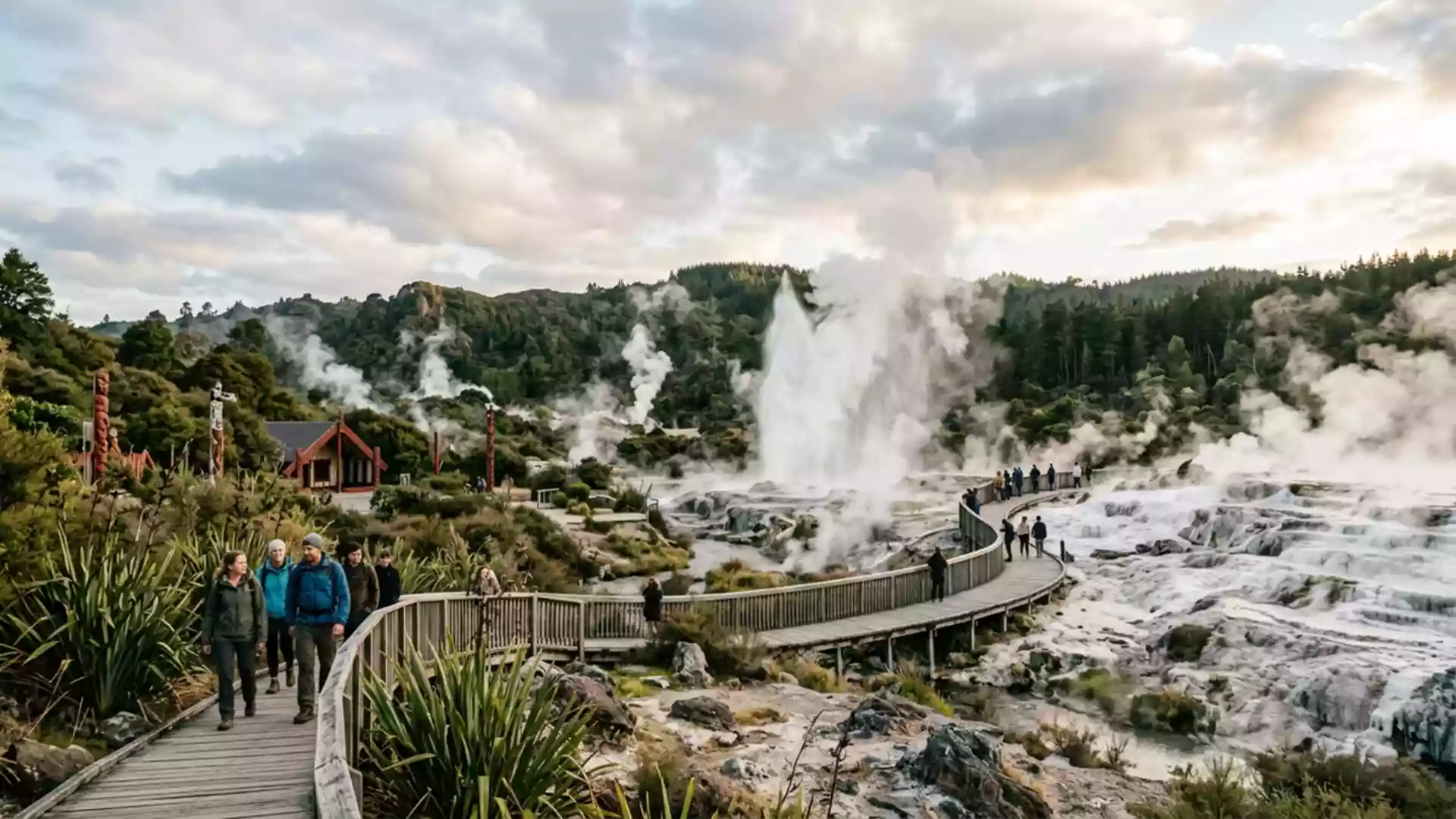
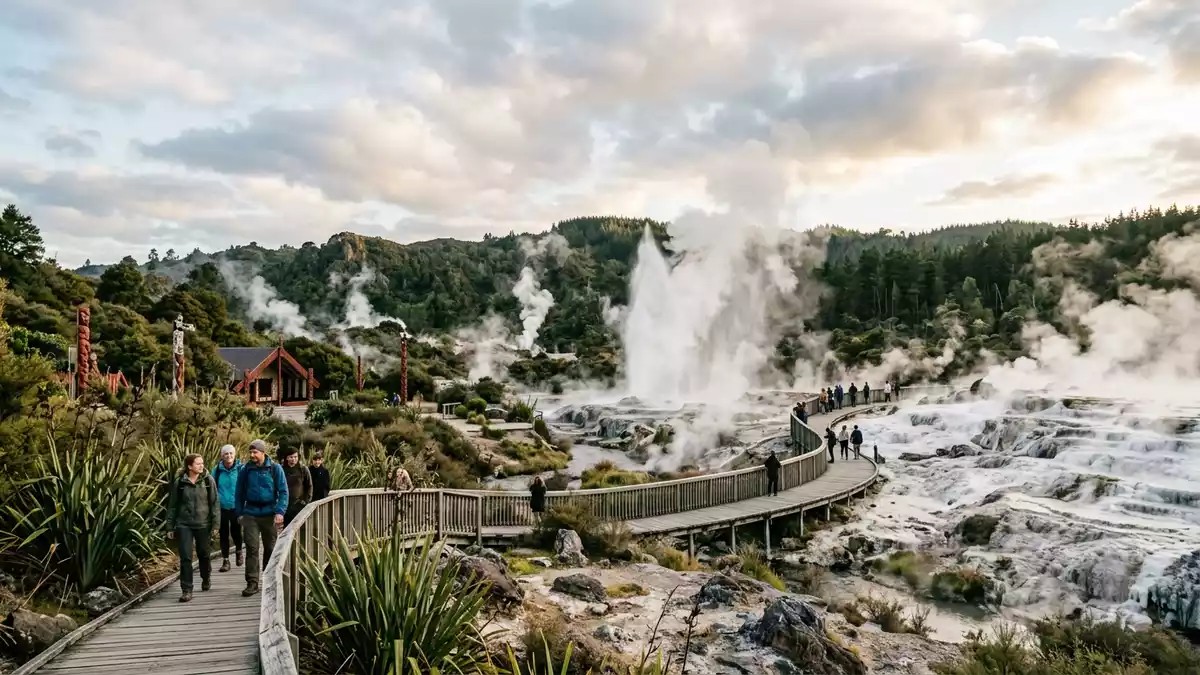
Te Puia spans 70 hectares in the historic Te Whakarewarewa Geothermal Valley on the edge of Rotorua. The site includes Pohutu Geyser, mud pools, hot springs, silica formations, native kiwi and national schools devoted to wood carving, weaving, and stone and bone carving. The operator describes these features and the valley setting on its visitor information page.
The centenary also places the new gateway within a longer institutional history. The 1926 law established the protection framework commemorated by the unveiling, while the NZMACI Vesting Act 2020 returned ownership from the Crown to mana whenua, as reported by Te Ao News.
Visiting Te Puia: what travellers from Western Europe should know
- The new waharoa was unveiled on 21 October 2026 at the New Zealand Maori Arts and Crafts Institute within Te Puia in Rotorua.
- The gateway is part of the institute’s entrance and visitor setting; the unveiling did not announce a closure or a changed admission route.
- The site is at 20 Hemo Road in Rotorua and can be reached by car, bus, taxi or on foot from the city area.
- The geothermal valley contains geysers, hot mud pools and boiling-water areas. Paths include steeper and unsealed sections, so suitable footwear is advised.
- Entry requirements depend on your nationality; UK travellers can check the FCDO travel advice at gov.uk/foreign-travel-advice, Irish travellers the Department of Foreign Affairs at ireland.ie.
The new entrance can be read alongside the working schools, geothermal features and cultural collections that define the Rotorua site.
Searching for Te Puia on social platforms
These links open searches for Te Puia on each platform.
Frequently asked questions about Te Puia
When was the new waharoa unveiled at Te Puia?
The new waharoa was unveiled at dawn on 21 October 2026 at the New Zealand Maori Arts and Crafts Institute within Te Puia.
What does the new waharoa represent?
Its five pou represent Te Puia NZMACI’s foundational pillars, while its forms connect the three wananga and the institute’s wider history.
Where is Te Puia and how do you get there?
Te Puia is at 20 Hemo Road in Rotorua, New Zealand. Visitors can reach the site by car, bus, taxi or on foot from the city area.