
Teatro Colon, Buenos Aires: a grand horseshoe of opera
Published on 08/21/2026 at 15:18 | Editorial responsibility: Rafael Müller, Editor-in-Chief AD HOC NEWS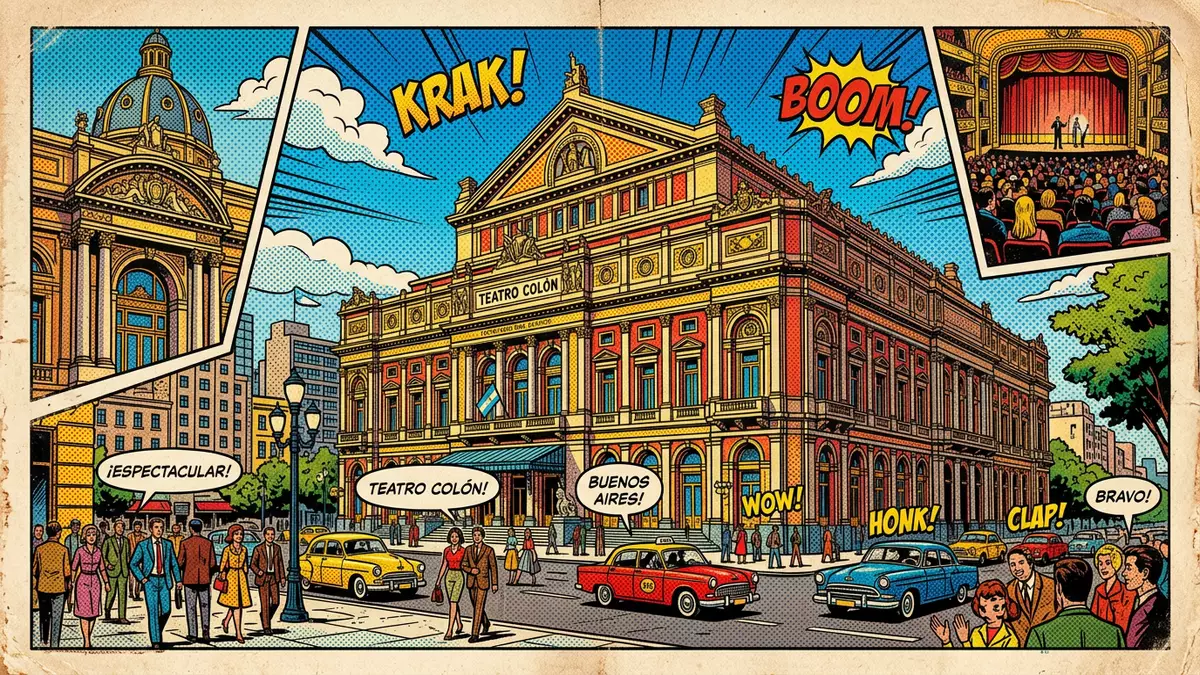
Teatro Colon in Buenos Aires is Argentina’s great opera house, a monumental building where a vast horseshoe-shaped auditorium, rich European-inspired decoration and a long performance tradition come together in one space. Completed in the early twentieth century, it remains a landmark of Argentina’s classical culture and architectural ambition.
An opera house shaped around a vast horseshoe
Teatro Colon is an opera house in central Buenos Aires, occupying a block near Plaza Lavalle on the broad avenue of Cerrito in the city centre. The present building took around two decades to construct and opened on 25 May 1908 with Giuseppe Verdi’s “Aida”, marking a major moment in Argentina’s cultural lifeopened on 25 May 1908. The theatre’s main space is a deep auditorium arranged in a horseshoe plan, a form long associated with classical opera houses in Europehorseshoe-shaped auditorium.
Inside the auditorium, tiers of boxes rise above the stalls, forming stacked galleries around the curve of the horseshoe. The plan follows the standards of late nineteenth-century French and Italian theatre design, with multiple levels of seating and standing spaces arranged to focus attention on the stageFrench and Italian classical theatre. Decorative boxes with balustrades and draped curtains line the sides, while an ornate ceiling rises high above the audience, framing the central chandelier and painted surfaces.
Eclectic architecture with European influences
The present Teatro Colon was designed and built under three successive European architects, beginning with the Italian architect Francesco Tamburini and continuing with the architect Víctor Meano before completion by the Belgian architect Jules DormalFrancesco Tamburini, Victor Meano and Jules Dormal. Construction began in the late nineteenth century and extended into the early twentieth century, reflecting an era when Buenos Aires was transforming under strong European architectural influenceconstructed between 1885 and 1908. The result is an eclectic building that combines elements of Italian Renaissance revival, French decorative style and German-influenced planning.
From the outside, the theatre presents a grand classical façade with ordered windows, pilasters and cornices. The massing is horizontal and elongated, occupying the block with a sequence of elevations along the surrounding streets. Inside, foyers and staircases continue the eclectic style: marble surfaces, sculpted details and gilded ornament frame the circulation spaces, while patterned floors and mirrors extend the sense of depth. Workshop and rehearsal areas were added later, and these spaces were incorporated in ways that respected the original architectural character of the buildingworkshop and rehearsal spaces.
From nineteenth-century origins to a national monument
The history of Teatro Colon is closely linked to the development of Buenos Aires as a nineteenth-century capital. The name originally belonged to a theatre that opened in 1857 near Plaza de Mayo and operated until 1888, when that earlier building closedthe original theatre opened in 1857. The present theatre then rose in front of Plaza Lavalle, with work on the new building continuing for around twenty years before its inauguration in 1908process of twenty years.
In the twentieth century Teatro Colon became one of Argentina’s recognised historic monuments; the building was declared a National Historic Monument, underscoring its significance in the country’s architectural and cultural heritageNational Historic Monument. Over time, rehearsal rooms and technical areas expanded the complex, while conservation work and modernisation projects preserved the auditorium and foyers. The theatre has hosted leading conductors, singers and dancers from across the twentieth century, linking Buenos Aires to international opera and ballet circuitshost some of the most important conductors.
Visiting Teatro Colon: what travellers from Western Europe should know
- Teatro Colon stands in central Buenos Aires on Cerrito Street near Plaza Lavalle, a short walk from the Obelisk along Avenida 9 de Julio.
- The building’s interior includes staircases, foyers and the main auditorium, so a visit involves walking through several levels with steps and long corridors.
- The official language is Spanish and the currency is the Argentine peso.
- Entry requirements depend on your nationality; UK travellers can check the FCDO travel advice at gov.uk/foreign-travel-advice, Irish travellers the Department of Foreign Affairs at ireland.ie.
Searching for Teatro Colon on social platforms
These links open searches for Teatro Colon on each platform.
Frequently asked questions about Teatro Colon
Where is Teatro Colon located in Buenos Aires?
Teatro Colon stands in central Buenos Aires on Cerrito Street near Plaza Lavalle, close to the major thoroughfare of Avenida 9 de Julio.
What can visitors expect inside Teatro Colon?
Visitors encounter grand foyers, staircases and the large horseshoe-shaped auditorium, with tiers of boxes, ornate decoration and a high ceiling over the main seating area.
What makes Teatro Colon distinctive among opera houses?
Its combination of a vast horseshoe auditorium, eclectic European-influenced architecture and its role as Argentina’s main historic opera house makes Teatro Colon distinctive.


