
Temple of Edfu and its monumental sandstone enclosure
Published on 09/10/2026 at 06:59 | Editorial responsibility: Rafael Müller, Editor-in-Chief AD HOC NEWS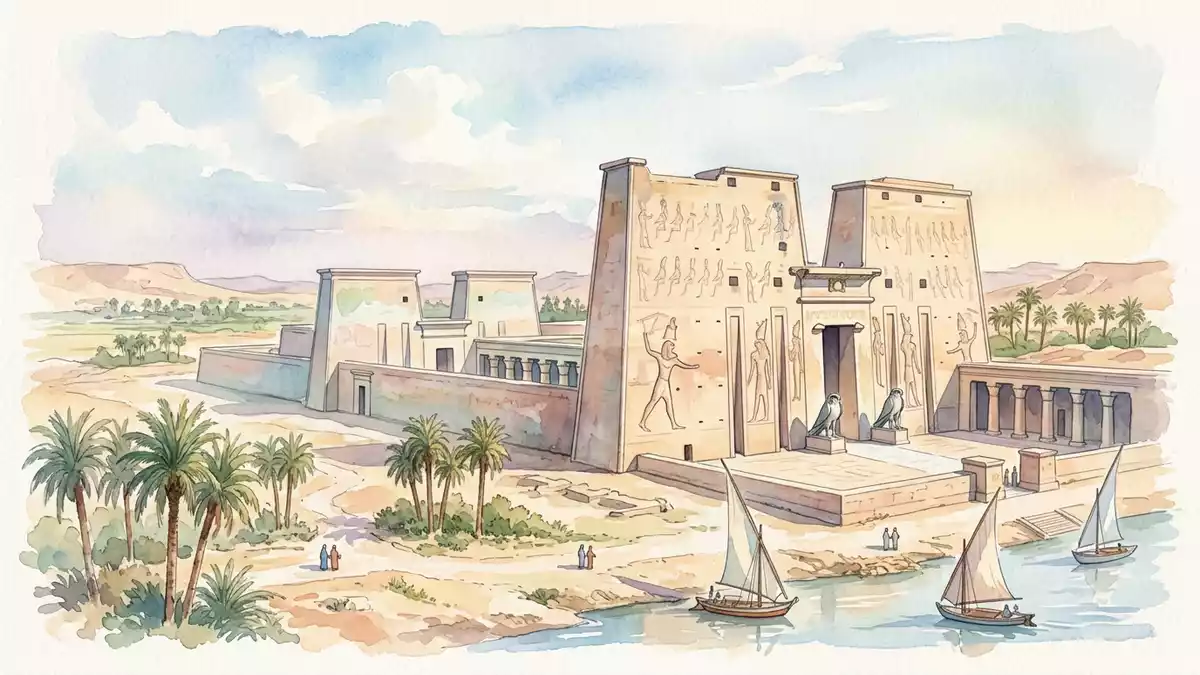
Temple of Edfu, the great sanctuary of Horus at Edfu in southern Egypt, is a vast sandstone enclosure from the Ptolemaic period whose walls preserve an almost complete Egyptian temple plan. Built between 237 BC and 57 BC under rulers such as Ptolemy III Euergetes and Ptolemy XII Auletes, it offers a rare chance to walk through a pharaonic cult complex with its courtyards, halls and sanctuary still intact.
Sandstone architecture on the Nile’s west bank
Temple of Edfu stands on the west bank of the Nile, in the town of Edfu between Luxor and Aswan, and is dedicated to the falcon god Horus.Situated on the western bank of the Nile the complex follows the traditional axial layout of Egyptian ceremonial temples, with successive spaces leading towards the innermost sanctuary.Egyptian ceremonial temple typology The entire structure is built mainly in sandstone, giving the pylons, walls and colonnades a warm, uniform colour that changes with the angle of the sun.
Approaching Temple of Edfu, travellers first encounter its monumental twin-tower pylon, which forms the formal entrance to the sacred precinct.The main gateway composed by two twin towers Beyond this gateway lies a large open courtyard edged with columned porticoes, leading in turn to hypostyle halls and finally to the sanctuary of Horus. The complex is oriented broadly north–south, and its alignment and symmetry are key aspects of its architectural character.
Ptolemaic building phases and historical context
The temple belongs to the Ptolemaic Kingdom, a Greek dynasty that ruled Egypt from the late fourth century BC while adopting and extending Egyptian temple traditions.Built in the Ptolemaic Kingdom between 237 and 57 BC Construction of the present building began on 23 August 237 BC in the reign of Ptolemy III Euergetes and continued under several successors.Begun by Ptolemy III on 23 August 237 BC Work on the core temple and inner chambers came first, followed by the outer hypostyle hall, peristyle court and entrance pylons in stages.
The building programme extended over roughly 180 years, with final architectural touches recorded in 57 BC under Ptolemy XII Auletes.In total, it took 180 years to complete The temple therefore encapsulates the later phases of Egyptian temple design while remaining firmly rooted in older religious and architectural canon. Inscriptions at Edfu refer back to earlier sanctuaries on the same site, linking the Ptolemaic structure with a long local tradition of Horus worship.
Courtyards, halls and hieroglyphic walls
Inside Temple of Edfu the visitor moves through a sequence of spaces that reflect the ceremonial processions once carried out there. The open court, surrounded by colonnades, gives way to a grand hypostyle hall whose roof is carried on dense rows of columns. A passage runs around the sanctuary, providing access to chapels where offerings and cult objects were kept.Passage surrounding the sanctuary with chapels This layout, with its gradual transition from open to enclosed, is characteristic of major temples of the period.
The sandstone walls and columns are covered in reliefs and hieroglyphic texts, recording rituals, myths and royal dedications connected with Horus of Behdet. Many of these inscriptions preserve information about temple construction and the religious calendar, contributing to the site’s reputation as one of the most informative temple complexes in Egypt.Best-preserved example of Ptolemaic temple architecture Together, the architecture and decoration make Temple of Edfu a key place for understanding how large cult temples functioned in the late pharaonic and Greco-Roman periods.
Visiting Temple of Edfu: what travellers from Western Europe should know
- Temple of Edfu stands in the town of Edfu on the west bank of the Nile in southern Egypt, between Luxor and Aswan, and is reached by road and river travel.
- The temple complex consists of large paved courts, stone floors and roofed halls; moving through it involves walking over uneven sandstone surfaces and climbing steps at gateways and between levels.
- The official language is Arabic and the currency is the Egyptian pound.
- Entry requirements depend on your nationality; UK travellers can check the FCDO travel advice at gov.uk/foreign-travel-advice, Irish travellers the Department of Foreign Affairs at ireland.ie.
Searching for Temple of Edfu on social platforms
These links open searches for Temple of Edfu on each platform.
Frequently asked questions about Temple of Edfu
Where is Temple of Edfu located?
Temple of Edfu stands on the west bank of the Nile in the town of Edfu in southern Egypt, between the major centres of Luxor and Aswan.
What can visitors expect at Temple of Edfu?
Visitors encounter a complete sandstone temple complex with a monumental pylon, open courtyards, hypostyle halls and a sanctuary whose walls are covered in reliefs and hieroglyphs.
What makes Temple of Edfu distinctive among Egyptian temples?
Its Ptolemaic construction between 237 BC and 57 BC, coupled with its well-preserved layout and dense inscriptions, makes Temple of Edfu a key example of large-scale Egyptian temple architecture.


