Templo de A-Ma and Macau’s granite hillside shrine
Published on 08/06/2026 at 20:23 | Editorial responsibility: Rafael Müller, Editor-in-Chief AD HOC NEWS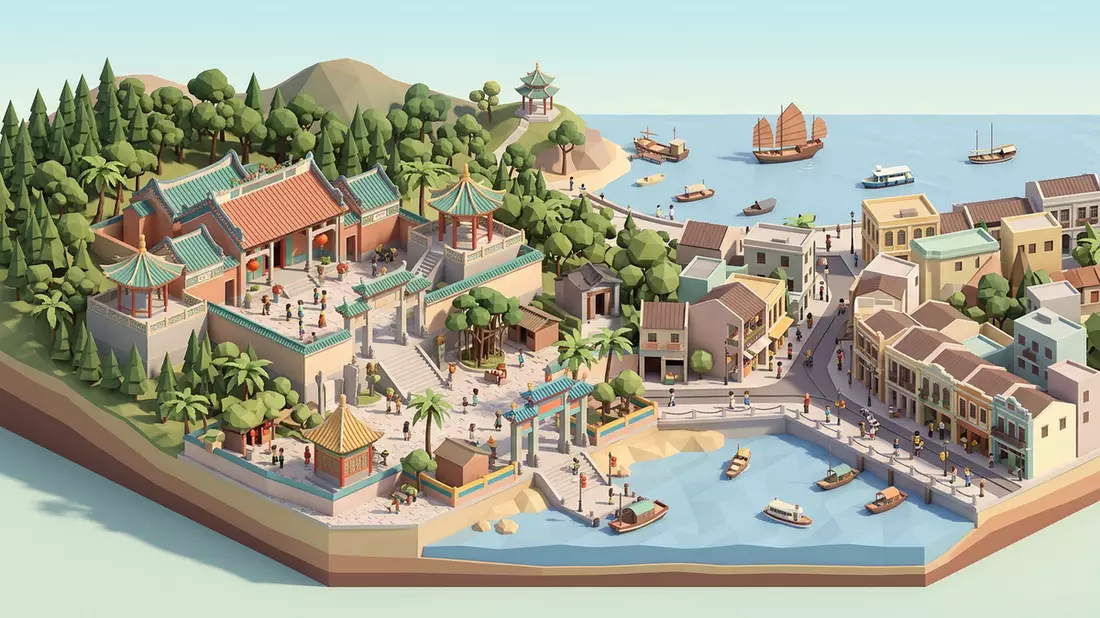
Templo de A-Ma in Macau is a compact hillside temple complex of granite pavilions, courtyards and incense burners. Dedicated to Mazu, the sea goddess venerated in Chinese folk religion, it is among Macau’s oldest religious sites and a clear survivor of the city’s early coastal settlement.
Granite steps and layered pavilions
The temple climbs a slope in a sequence of levels rather than a single enclosed hall. Rooflines, stone balustrades and small courtyards give it a measured, stepped profile against the hill.
Its fabric is largely granite, with painted timber and tiled roofs adding colour to the grey stone. The result is less a single monument than a chain of shrine spaces linked by paths, thresholds and platforms.
A shrine for Mazu in Macau
A-Ma Temple is closely tied to the cult of Mazu, the protectress of sailors and coastal communities. That connection fits Macau’s long maritime history, where sea travel and ritual protection belonged to the same cultural landscape.
The name Templo de A-Ma preserves the Portuguese form used in Macau, while the Chinese religious setting remains central. Incense coils, altars and stone inscriptions give the place its devotional character as much as its architecture does.
Stone, smoke and the memory of older Macau
The temple’s setting on a rocky slope gives it an unusually direct relationship with the terrain. Paths bend around the hill, and the shrines appear at different heights, with the sea and harbour district below.
That vertical arrangement makes the complex read as both sanctuary and landmark. It is a place where worship, local memory and the physical shape of Macau meet in a small area of stone and painted wood.
Visiting Templo de A-Ma: what travellers from Western Europe should know
- The temple is in Macau, reached from the city by road and on foot through the surrounding shrine area.
- Admission arrangements and opening hours are set by the site's operator and change with the season; the official website is the only binding source.
- Late afternoon brings softer light on the stone and roofs, while morning visits can feel calmer around the courtyards.
- The site has steps, uneven stone surfaces and a hillside approach, so sturdy footwear is sensible.
- Portuguese and Chinese forms may both appear in Macau, and cash payment may be useful for small purchases nearby.
- Entry requirements depend on your nationality. UK travellers should check the FCDO travel advice at gov.uk/foreign-travel-advice; Irish travellers the Department of Foreign Affairs at ireland.ie; EU and EEA citizens their own national foreign ministry.
Searching for Templo de A-Ma on social platforms
These links open searches for Templo de A-Ma on each platform.
Frequently asked questions about Templo de A-Ma
Where is Templo de A-Ma?
It is in Macau, on a hillside shrine complex close to the city’s older urban fabric. The temple forms part of the cultural landscape associated with Macau’s maritime past.
What should visitors expect?
Expect granite steps, small courtyards, incense, painted shrine elements and a short uphill walk through the complex. The site is compact, but the levels and stone surfaces matter.
What makes it distinctive?
Its mixture of granite architecture, hillside setting and devotion to Mazu gives it a strong local character. The temple is one of Macau’s clearest links between religion, stone construction and the sea.