
Templo de A-Ma and Macau’s terraced sea goddess shrine
Published on 09/10/2026 at 06:18 | Editorial responsibility: Rafael Müller, Editor-in-Chief AD HOC NEWS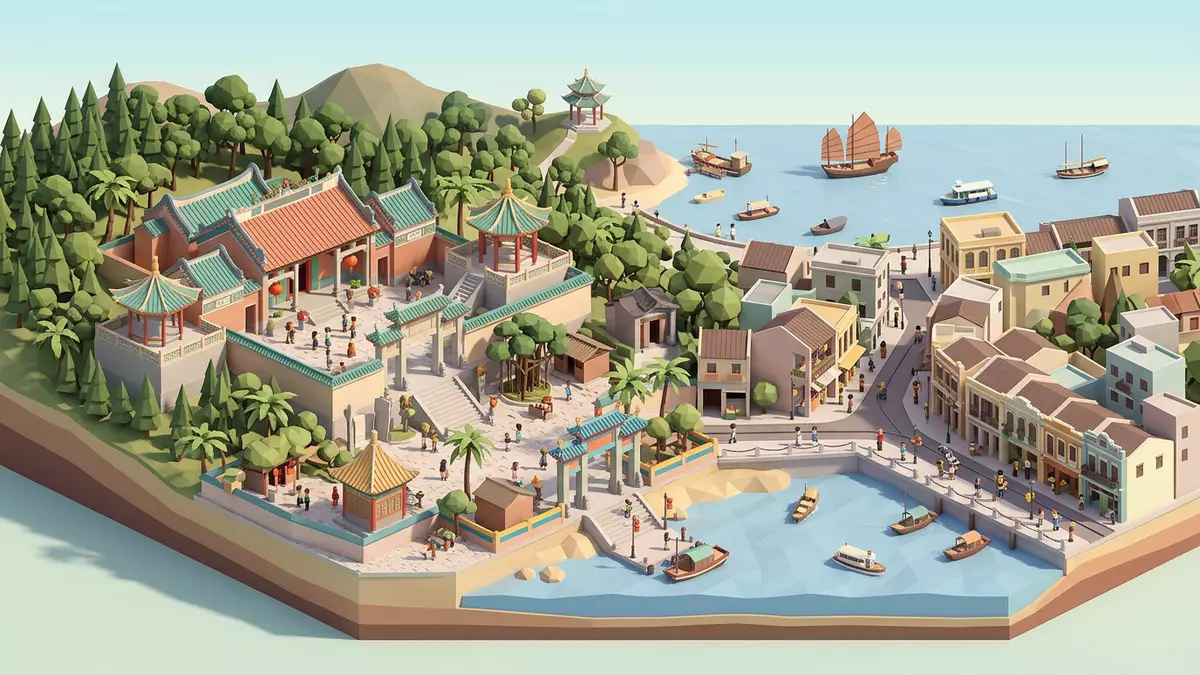
On the south-western tip of Macau Peninsula, Templo de A-Ma rises in terraces against the rocky slope of Barra Hill, a hillside temple dedicated to the sea goddess Mazu and framed by views towards the water. Built in the late fifteenth century during the Ming dynasty and later folded into Macau’s UNESCO-listed Historic Centre, it is one of the city’s oldest surviving religious complexes and closely associated with the origin of the name “Macau”.
Hillside layout between rock and harbour
Templo de A-Ma, also known as Barra Temple, occupies the western flank of Barra Hill above the Inner Harbour, with its entrance near Barra Square and the waterfront embankment. The complex steps up the slope in a sequence of courtyards, halls and pavilions built against exposed rock, so that masonry structures stand beside natural boulders and outcrops that form part of the composition. The overall arrangement follows the hillside, with terraces aligned along the incline rather than on a single level, giving the temple a layered presence between town and hill.built against a cliffside of Barra Hill The forecourt and lower structures face towards the harbour, while upper platforms extend further into the slope, with granite paving and stone balustrades marking the edges.
The site’s position near the water is closely intertwined with Macau’s maritime history. The temple stands near the area where Portuguese sailors landed in the mid-sixteenth century, at a time when the bay in front of Barra Hill was known as “A-Ma Gau”, or Bay of A-Ma. The association between the coastal sanctuary and the harbour helped shape the Portuguese rendering of the name “Macau”, so that the toponym itself carries the imprint of the sea goddess and the community that worshipped her.linked to the origin of Macau’s name From the lower terraces, the temple looks out towards the Inner Harbour, placing altars, incense burners and granite walls in visual dialogue with anchored vessels and waterfront streets.
A Ming dynasty temple expanded over centuries
The origins of Templo de A-Ma reach back to 1488, when the earliest hall was constructed during the Ming dynasty as a place of worship for Mazu, the protector of seafarers. The oldest part of the complex, known as the Hall of Benevolence, dates from that year and reflects the early phase of the sanctuary as a modest structure beside the sea.the Hall of Benevolence dates to 1488 Further halls and courtyards were added between the late sixteenth and early seventeenth centuries, including a prayer hall and a space dedicated to Guanyin, the Buddhist goddess of mercy. These additions strengthened the temple’s role as a layered religious site that brought different strands of Chinese belief into one hillside complex.
A significant restoration took place in 1828, during the Qing dynasty, when new structures were built and earlier elements renewed, giving the temple much of its present scale and architectural character.a major restoration in 1828 Across the site, inscriptions, stone tablets and ornamental details record donations and dedications over centuries, bearing witness to the fishing and trading communities that supported the temple. The complex later became part of the Historic Centre of Macau, which was inscribed as a UNESCO World Heritage site in 2005, recognising the ensemble of Chinese and Portuguese-built structures on and around the peninsula.included in the Historic Centre of Macau World Heritage listing
Architectural details and the cult of Mazu
Architecturally, Templo de A-Ma combines Taoist, Buddhist and folk elements in a compact series of halls, gateways and open platforms. The entrance pavilion carries traditional rooflines with upturned eaves and ceramic decorations, while stone lions guard thresholds and sculpted panels depict waves, clouds and mythological scenes. Incense burners and elaborate altars stand at the centre of paved courtyards, with red-painted timber framing interior spaces behind carved doors and latticework windows. Throughout the complex, the buildings are positioned to engage with the contours of Barra Hill, so that narrow stairways, retaining walls and shaded alcoves follow the granite slope.architecture shaped over centuries by different influences
The temple honours Mazu, also known locally as A-Ma or Tin Hau, a deity associated with the protection of seafarers and coastal communities. Above the altars dedicated to her, reliefs and calligraphic panels refer to voyages, safe returns and maritime prosperity, embedding the cult of the sea goddess into the physical fabric of the site.Mazu worshipped as protector of seafarers Other halls within the complex house images of Guanyin and additional deities, reflecting the layered nature of religious practice in southern China. The combination of carved stone, tiled roofs, painted timber and the raw surfaces of Barra Hill gives the sanctuary a distinct character, with religious structures appearing to emerge from the rock rather than simply sit upon it.
Visiting Templo de A-Ma: what travellers from Western Europe should know
- Templo de A-Ma stands on the south-western tip of the Macau Peninsula in the São Lourenço district, near Barra Square and the Inner Harbour, reached by city bus routes that serve Largo da Barra.
- The complex climbs the slope of Barra Hill, with stone staircases, uneven granite paving and terraces on different levels; visiting involves walking up and down multiple flights of steps.
- The temple forms part of the Historic Centre of Macau, and streets with a mix of Chinese and Portuguese-influenced buildings extend around Barra Square and along the nearby waterfront.
- The official language is Chinese and the currency is the Macanese pataca.
- Entry requirements depend on your nationality; UK travellers can check the FCDO travel advice at gov.uk/foreign-travel-advice, Irish travellers the Department of Foreign Affairs at ireland.ie.
Searching for Templo de A-Ma on social platforms
These links open searches for Templo de A-Ma on each platform.
Frequently asked questions about Templo de A-Ma
Where is Templo de A-Ma located in Macau?
Templo de A-Ma stands on the south-western tip of the Macau Peninsula, on the western slope of Barra Hill near Barra Square and the Inner Harbour.
What should visitors expect when exploring the temple?
Visitors encounter a terraced complex of courtyards, halls and pavilions, with stone staircases climbing the hillside, incense-filled altars and views towards the harbour from granite platforms.
What makes Templo de A-Ma distinctive among Macau’s religious sites?
Its fifteenth-century origins, hillside layout blending architecture with exposed rock, dedication to the sea goddess Mazu and inclusion in the Historic Centre World Heritage listing give the temple a distinctive profile.


