
Tongariro National Park’s volcanic heart of the North Island
Published on 09/22/2026 at 00:50 | Editorial responsibility: Rafael Müller, Editor-in-Chief AD HOC NEWS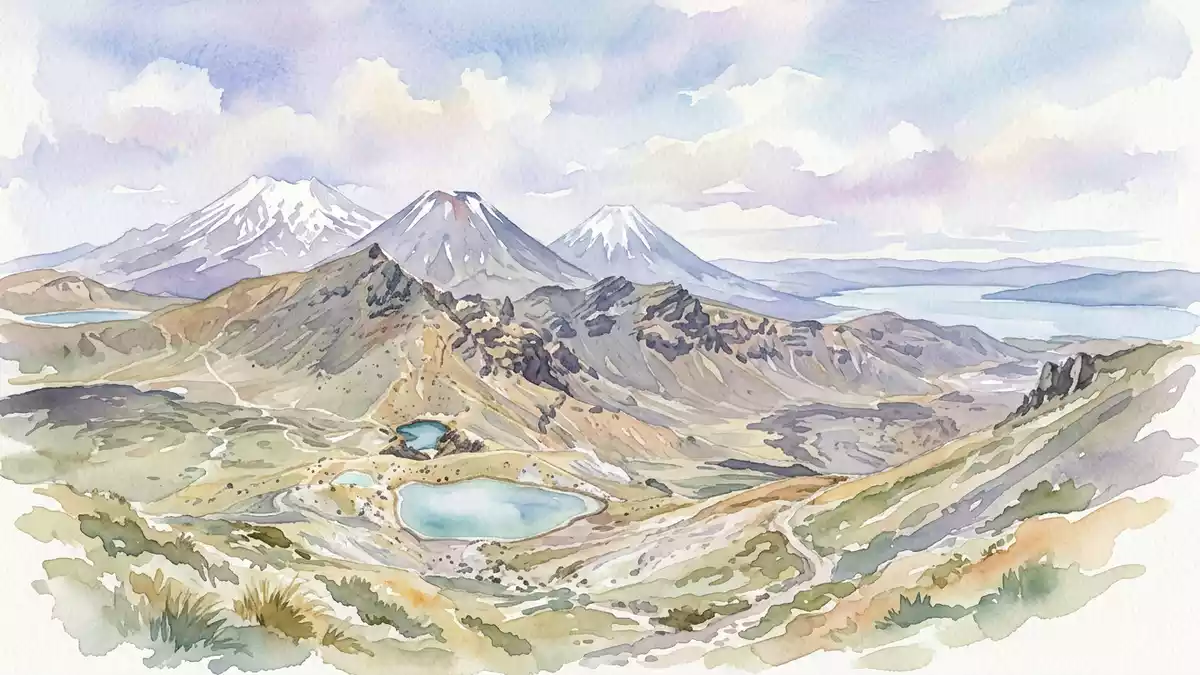
Tongariro National Park on New Zealand’s central North Island brings together a chain of volcanoes, high plateaux and M?ori heritage in a single protected landscape. It is recognised as New Zealand’s oldest national park and carries dual World Heritage status for both natural and cultural values anchored around its mountain massif.
Volcanoes shaping a highland landscape
The core of Tongariro National Park is a group of andesitic volcanoes rising above the surrounding central plateau of the North Island. The mountains Tongariro, Ngauruhoe and Ruapehu form the southern limit of the Taup? Volcanic Zone, a tectonically active region that runs across the island.three andesitic volcanoes Their slopes and summits carry craters, lava domes, solidified flows and areas of loose ash, with scattered alpine vegetation gripping to the volcanic ground.
Ruapehu stands as the highest mountain on the North Island, with a summit area marked by a crater lake surrounded by ridges shaped by eruptions and glacial erosion.Ruapehu, Ngauruhoe and Tongariro Nearby Ngauruhoe rises as a steep cone with deeply incised gullies, while Tongariro spreads across multiple vents and craters. Together they create a broad, elevated volcanic landscape where snow, bare rock and dark lava sit beside mineral-rich tarns and small lakes.
World Heritage recognition and M?ori connections
Tongariro National Park holds a place on the UNESCO World Heritage List, first inscribed in 1990 for its natural values as a volcanic landscape and then extended in 1993 to recognise its cultural significance. It became the first property worldwide to be recognised as a cultural landscape under revised World Heritage criteria, reflecting how the mountains are bound to the traditions of local M?ori communities.dual World Heritage status The designation links geological processes with long-standing spiritual associations rather than focusing solely on built heritage.
The park’s volcanic massif, including Tongariro and its neighbours, is closely tied to M?ori narratives that connect peaks, valleys and lakes with ancestral figures and customary practices.important M?ori cultural and spiritual associations This relationship between landforms and indigenous culture underpins the park’s recognition as a cultural landscape, standing alongside its scientific interest as a site where active and extinct volcanoes, glacial features and diverse ecosystems meet.
Location within the central North Island
Tongariro National Park lies between Lake Taup? and the stretch of highway known as the Desert Road, in the Ruapehu District of the central North Island.between Lake Taup? and the Desert Road This position places the park within reach of major North Island routes linking Auckland and Wellington, while still feeling distinct from the surrounding lowland farmland and lake shores. Approaches by road rise gradually towards the volcanic plateau, with views opening out to the prominent cones of Ngauruhoe and Ruapehu.
The park covers a broad area around the three main volcanoes and includes further high ground and associated reserves such as the Pihanga Scenic Reserve, which contains Lake Rotopounamu and adjacent peaks.Tongariro National Park expands around Within this setting, terrain varies from weathered lava fields and loose scoria slopes to alpine herbfields and patches of forest, offering contrasting views over the volcanic chain and towards the wider central North Island.
Visiting Tongariro National Park: what travellers from Western Europe should know
- Tongariro National Park sits in the central part of New Zealand’s North Island, between Lake Taup? and the Desert Road, reached by road from surrounding towns and cities.
- The high volcanic terrain includes steep slopes, uneven lava deposits and sections of loose ash, so walking routes cross ground that can feel rough underfoot and exposed to alpine weather.
- The mountains rise well above the surrounding plateau, and higher areas can be affected by rapid changes in visibility, temperature and wind, making layered clothing and sturdy footwear important.
- English is the official language and the currency is the New Zealand dollar.
- Entry requirements depend on your nationality; UK travellers can check the FCDO travel advice at gov.uk/foreign-travel-advice, Irish travellers the Department of Foreign Affairs at ireland.ie.
Searching for Tongariro National Park on social platforms
These links open searches for Tongariro National Park on each platform.
Frequently asked questions about Tongariro National Park
Where is Tongariro National Park located in New Zealand?
Tongariro National Park lies in the Ruapehu District of the central North Island, between Lake Taup? and the Desert Road and within reach of major road routes.
What should visitors expect from the landscape on a first visit?
Visitors encounter a high volcanic plateau dominated by the mountains Ruapehu, Ngauruhoe and Tongariro, with craters, lava flows, small lakes and alpine vegetation spread across the park.
What makes Tongariro National Park distinctive among New Zealand’s protected areas?
The park combines a chain of active and extinct volcanoes with strong M?ori cultural connections and dual UNESCO World Heritage recognition, linking natural processes and cultural landscapes in one setting.


