
Tour Eiffel: an iron lattice landmark above the Champ de Mars
Published on 09/10/2026 at 08:50 | Editorial responsibility: Rafael Müller, Editor-in-Chief AD HOC NEWS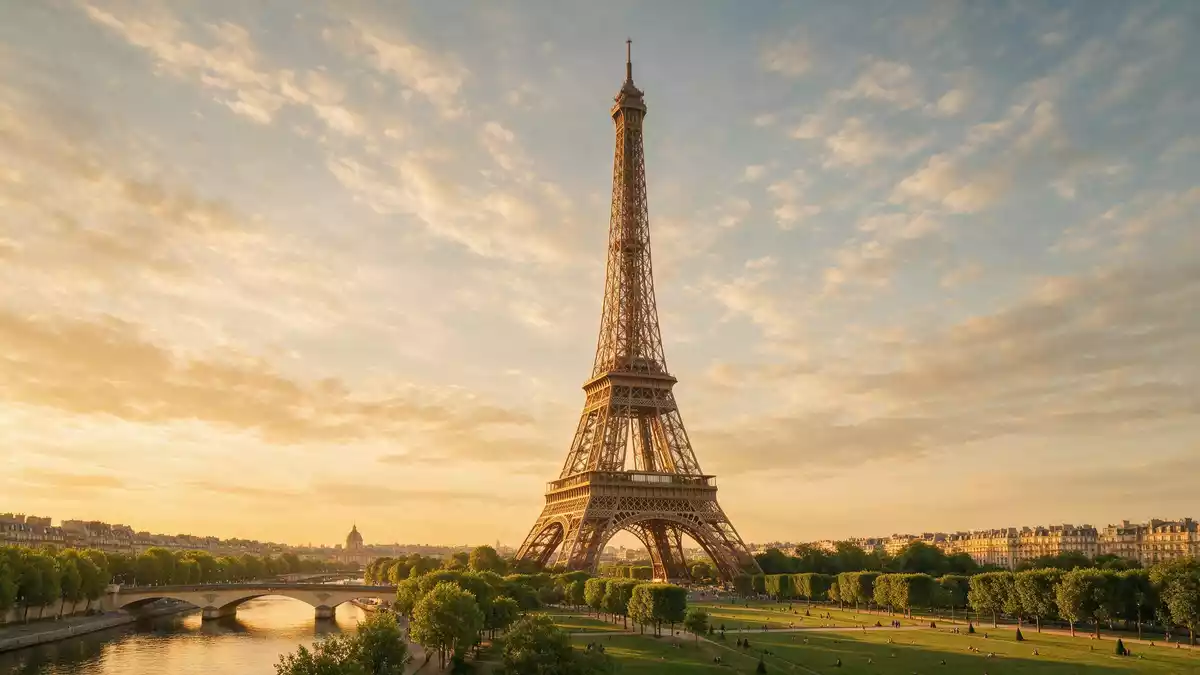
Tour Eiffel is the iron lattice tower that rises above the Champ de Mars in Paris, built for the Exposition Universelle of 1889 and named for engineer Gustave Eiffel.Exposition Universelle of 1889 Its tiered platforms and exposed ironwork give Paris one of its most recognisable silhouettes, with the tower reaching about 330 m (1,083 ft) including antennas.about 330 m (1,083 ft)
An iron tower shaped by late nineteenth-century engineering
Constructed between 1887 and 1889, Tour Eiffel was completed on 31 March 1889 after just over two years of work, an achievement in late nineteenth-century iron engineering.completed on 31 March 1889 Gustave Eiffel’s company created a lattice structure of puddled iron, framed by four great legs that spread outwards at the base before converging towards the summit.Gustave Eiffel’s company
The tower’s form is divided into ascending levels, with broad platforms on the lower storeys supporting restaurants and viewing areas and narrower decks higher up reserved for panoramic observation. Riveted iron pieces, many prefabricated off site, are assembled into a grid that remains visible from almost every angle, making the structure itself part of the experience of climbing or ascending. Above the highest publicly accessible platform, a slender framework continues to the top, now carrying broadcasting antennas that extend the overall height beyond its original 300 m (984 ft) figure.original 300 m (984 ft) figure
Champ de Mars and the tower’s place in Paris
Tour Eiffel stands on the Champ de Mars in the 7th arrondissement, close to the left bank of the Seine and facing the Trocadéro area across the river.Champ de Mars in the 7th arrondissement The official address, 5 Avenue Anatole France, 75007 Paris, places the tower within a broad park that was laid out as a parade ground and now forms a long lawn stretching southwards.5 Avenue Anatole France
From the base of Tour Eiffel, paths lead through the Champ de Mars towards the École Militaire, while the Pont d’Iéna crosses the Seine directly to the forecourt of the Palais de Chaillot at Trocadéro.Pont d’Iéna crosses the Seine The tower’s feet straddle roadways and landscaped areas, with ticketed entrances and security zones incorporated around the legs but the wider park remaining open as an urban green space. At night, the structure is illuminated, its iron framework standing out against the darker sky and the river below, while by day its darker material contrasts with the pale façades of neighbouring Haussmann-era buildings.
Experiencing the height: platforms, stairs and lifts
A visit to Tour Eiffel centres on its sequence of platforms, each offering different perspectives over Paris and different encounters with the ironwork that supports them. The first level holds indoor and outdoor spaces on a wide deck set within the legs, where the criss-cross of girders forms a kind of iron ceiling above terraces and galleries. Higher up, the second platform sits at roughly mid-height, a ring of walkways where the river bends, the avenues radiate and the city’s landmarks such as the Arc de Triomphe and the Louvre come into view in relation to the tower.
Access between levels combines lifts and staircases, with long flights of steps enclosed within the tower’s legs and mechanical lifts climbing within shafts formed by structural members. The ascent reveals how the lattice pattern tightens as the tower narrows, and how beams and braces shift direction to carry loads towards the core. On the upper platform, which lies near the base of the summit framework, glazed interiors alternate with open galleries, giving contrasting experiences of height and exposure even within a relatively compact space.
Visiting Tour Eiffel: what travellers from Western Europe should know
- Tour Eiffel stands on the Champ de Mars in Paris’s 7th arrondissement, near the left bank of the Seine, with the Pont d’Iéna linking it to Trocadéro across the river.
- The forecourt and approaches involve outdoor walking on paved surfaces, and reaching the higher levels on foot means climbing long flights of stairs within the iron structure.
- Tour Eiffel is within central Paris, with several Métro and RER stations in the surrounding district providing rail access to the area.
- The official language is French and the currency is the euro.
Searching for Tour Eiffel on social platforms
These links open searches for Tour Eiffel on each platform.Frequently asked questions about Tour Eiffel
Where is Tour Eiffel in Paris?
Tour Eiffel is in the 7th arrondissement on the Champ de Mars, at 5 Avenue Anatole France beside the Seine.
What should visitors expect during a visit?
Visitors encounter tiered platforms linked by lifts and stairs within an exposed iron lattice, with open-air decks and indoor spaces overlooking Paris.
What makes Tour Eiffel distinctive among city landmarks?
Tour Eiffel combines an extraordinary iron height of around 330 m (1,083 ft) with a lattice structure that remains visible throughout, framing views over Paris from multiple levels.


