
Traku salos pilis: a red?brick island fortress on Lake Galv?
Published on 09/21/2026 at 07:46 | Editorial responsibility: Rafael Müller, Editor-in-Chief AD HOC NEWS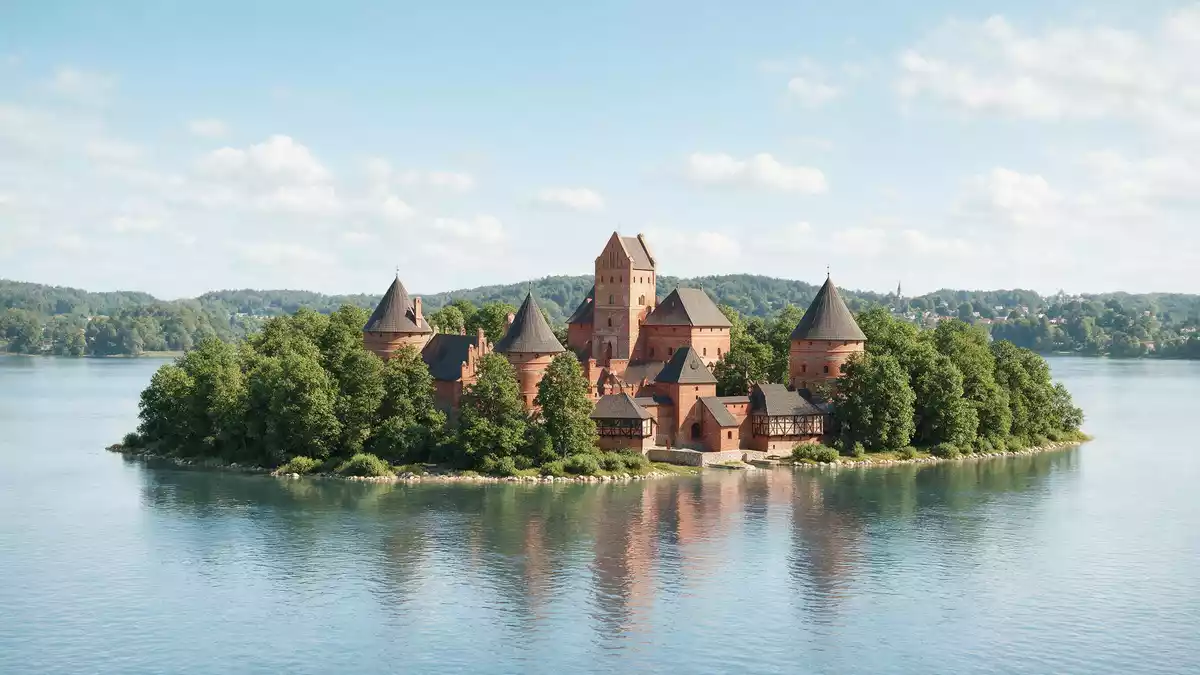
Traku salos pilis, known in English as Trakai Island Castle, is a red?brick Gothic fortress set on a small island in Lake Galv? at Trakai in southern Lithuania. Built in the late fourteenth and early fifteenth centuries as a residence of the Grand Dukes of Lithuania, and rebuilt in the twentieth century, it now houses the Trakai History Museum within its enclosed courtyards and towers.Built in the 14th and 15th centuries
Gothic brickwork surrounded by water
The defining experience of Traku salos pilis is its relationship with water: the castle occupies an island within Lake Galv?, reached from Trakai by a sequence of wooden bridges that carry visitors over narrow channels to the outer walls.An island castle in Lake Galv? Seen from the shore, the compact mass of towers, curtain walls and the central palace rises directly above the lake surface, with brick battlements mirrored in the water and tree?lined banks framing the scene.
The architecture belongs to late medieval brick Gothic, a style closely associated with the Grand Duchy of Lithuania and neighbouring regions.Gothic architecture on an island Within the outer fortifications stands the quadrangular ducal palace, organised around an inner courtyard with timber galleries running along the walls.A ducal palace with an inner courtyard The red brick surfaces are punctuated by narrow pointed openings and simple decorative bands, while the towers give vertical emphasis to a structure otherwise tightly contained within the limits of the island.
A grand ducal residence reborn as a museum
Construction of Traku salos pilis began under Grand Duke K?stutis in the late fourteenth century and continued under his son Vytautas the Great, reflecting the rise of Trakai as a political centre within the Grand Duchy of Lithuania.Begun under K?stutis and completed under Vytautas In this period the castle served as a residence and stronghold for the grand ducal court, its island location combining representation with defence. Later, in the sixteenth century, parts of the complex were adapted in Renaissance style as a summer residence under Sigismund the Old and Sigismund Augustus, adding another architectural layer to the medieval core.Adapted as a Renaissance residence
Military conflicts in the seventeenth century left the castle damaged and largely abandoned, and for centuries its walls decayed above the lake before extensive twentieth?century restoration returned the complex to something close to its fifteenth?century appearance.Restoration in the 1950s and 1960s Work to reconstruct the Island Castle began in the 1950s, with the central palace rebuilt in 1962 and the main phases of restoration completed in the 1980s.Central palace rebuilt in 1962 Since 1962 the castle has housed the Trakai History Museum, its halls and chambers displaying archaeological finds, historical documents and objects that trace the story of Trakai and the wider Lithuanian state.Home of the Trakai History Museum
Experiencing Traku salos pilis and its lakeside setting
A visit to Traku salos pilis begins in the historic town of Trakai, which stands about 28 km west of Vilnius on the shores of Lake Galv?.Historic town west of Vilnius From the town centre, the route to the island leads along Karaim? Street towards the water, where the first wooden bridge crosses to a smaller island and a second spans the channel to the castle itself.Access via Karaim? Street and bridges Approaching on foot, the sequence of crossings gives changing views of the castle’s towers and walls, with Lake Galv? opening out to either side.
Inside the outer gate, stone and brick surfaces enclose a sequence of courtyards, galleries and rooms that illustrate the castle’s defensive and residential functions. In the main courtyard, timber balconies run along the walls of the ducal palace, linking exhibition rooms that occupy several levels around the enclosed space.Red?brick towers and galleries The setting remains defined by water: wherever gaps open in the fortifications, Lake Galv? appears beyond, and from the higher levels the visitor sees a landscape of small islands and peninsulas radiating away from the castle.
Visiting Traku salos pilis: what travellers from Western Europe should know
- Traku salos pilis stands on Pilies Island in Lake Galv? at Trakai in southern Lithuania, reached by road or rail from Vilnius and then on foot along Karaim? Street and across wooden bridges from the town waterfront.On an island near Trakai
- The approach from Trakai involves a level walk through the town and across two wooden bridges; within the castle complex, staircases and galleries include flights of steps between floors and up into the towers.
- Trakai lies within Lithuania’s lake district, with Lake Galv? surrounding the island on all sides; other historic sites, including the Trakai Peninsular Castle, stand nearby on adjacent land projecting into the lake.Island and peninsular castles
- The official language is Lithuanian and the currency is the euro.
Searching for Traku salos pilis on social platforms
These links open searches for Traku salos pilis on each platform.
Frequently asked questions about Traku salos pilis
Where is Traku salos pilis located?
Traku salos pilis stands on a small island in Lake Galv? at Trakai in southern Lithuania, about 28 km west of Vilnius in the country’s historic lake region.
What can visitors expect at the castle?
Visitors cross wooden bridges from Trakai to reach a brick Gothic castle with courtyards, towers and galleries that house the Trakai History Museum and displays on Lithuanian history.
What makes Traku salos pilis distinctive?
The castle combines a late medieval grand ducal residence with a striking island setting, its red?brick Gothic walls encircled by Lake Galv? and approached entirely across water.


