
Transfagarasan, the high mountain road above Curtea de Arges
Published on 09/14/2026 at 13:08 | Editorial responsibility: Rafael Müller, Editor-in-Chief AD HOC NEWS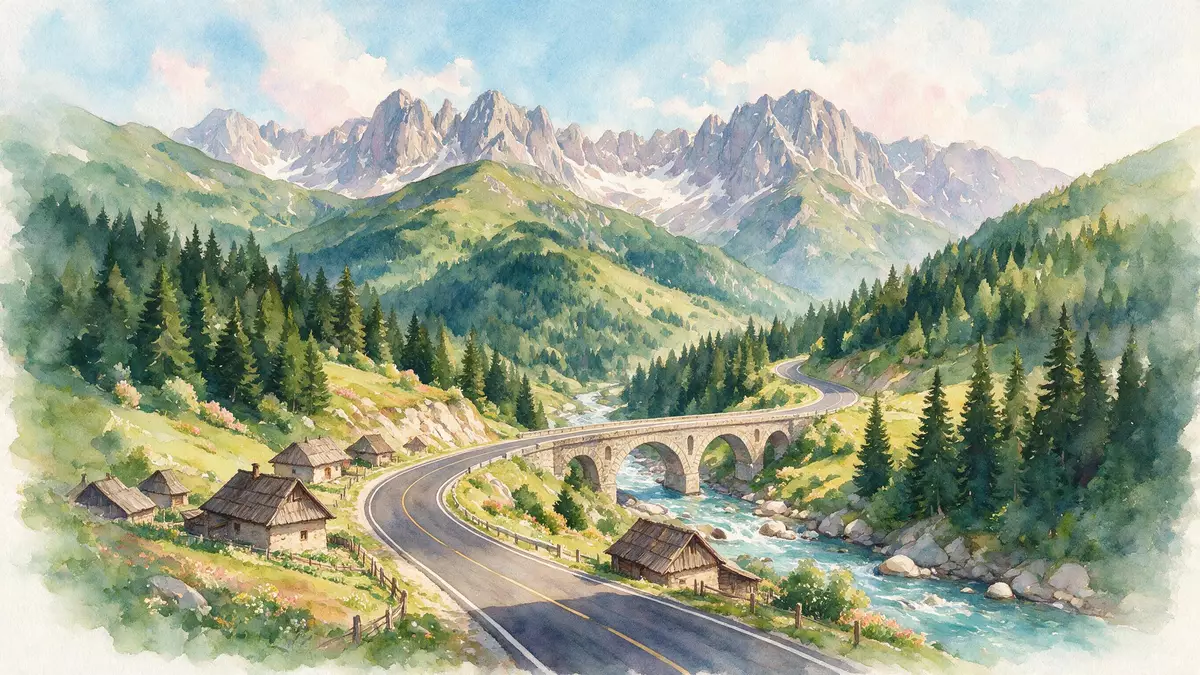
High above Curtea de Arges in central Romania, Transfagarasan climbs through the Fagaras Mountains as a dramatic high-altitude road linking Muntenia in the south with Transylvania in the north. Designated DN7C, it runs across the southern section of the Carpathian Mountains and reaches altitudes of over 2,000 m (6,562 ft) near Lake Balea, turning a strategic mountain crossing into one of Romania’s most striking drives.DN7C across the southern Carpathians
A road carved across the Fagaras range
Transfagarasan crosses the Fagaras Mountains, the highest range in Romania and part of the greater Carpathian arc, linking the historical region of Wallachia around Curtea de Arges with Transylvania towards Sibiu.Fagaras Mountains, the highest range in Romania The road begins near the village of Bascov in Arges County, close to Pitesti, then passes north of Curtea de Arges before climbing into the high ridges and descending again towards Cartisoara in Sibiu County.from Bascov towards Cartisoara
Over a length of about 151 km (94 mi), DN7C threads from the lowlands of Muntenia through dense forest, past hydroelectric infrastructure and reservoir waters, and into high alpine terrain above the tree line.road length of about 151 km The alignment brings road travellers close to the highest peaks in the country, including Moldoveanu and Negoiu, and at its highest point near Lake Balea the carriageway passes through a tunnel more than 2,000 m (6,562 ft) above sea level.highest point near Lake Balea
From strategic project to scenic mountain drive
Transfagarasan took shape as a strategic road project during the leadership of Nicolae Ceau?escu in the early 1970s, built to carry traffic across the central Carpathians between 1970 and 1974.built between 1970 and 1974 Officially opened in 1974, the road added a north–south link between Curtea de Arges and the northern slopes around Cartisoara, supplementing existing passes and increasing connectivity between the southern plains and Transylvania.official opening in 1974
Engineers and road crews laid DN7C over demanding terrain, crossing rivers and side valleys on bridges and viaducts and cutting into steep mountain slopes to maintain a continuous carriageway. The route is paved throughout and incorporates numerous artificial structures, including hundreds of bridges and dozens of viaducts, to carry traffic across the broken surface of the Fagaras range.bridges and viaducts on DN7C In the higher section close to Lake Balea, the tunnel through the ridge provides a protected passage beneath the crest, connecting the southern and northern approaches at more than 2,000 m (6,562 ft).
Curves, reservoirs and high-altitude views
For travellers approaching from Curtea de Arges, the character of Transfagarasan changes as the road gains height: gentle curves through forest give way to more intense sequences of hairpin bends, cut into the mountainsides above the hydroelectric installations and reservoir waters of Vidraru Dam.stretch past Vidraru Dam Higher up, near Lake Balea, the scenery shifts again to open alpine slopes, rock faces and views across the main Fagaras ridge, with the road threading in tight curves towards the tunnel beneath the crest.
North of the tunnel, DN7C descends towards Cartisoara and the Transylvanian plateau, still full of bends but gradually dropping back below the tree line and into pastoral valleys and villages. Across its extent the road combines infrastructure and landscape: engineered curves, retaining structures and tunnels coexist with reservoirs, waterfalls such as Balea Cascada and the broader backdrop of the Carpathian mountains.route between Curtea de Arges and Cartisoara
Visiting Transfagarasan: what travellers from Western Europe should know
- Transfagarasan runs between Bascov in Arges County and the junction with DN1 near Cartisoara in Sibiu County, with Curtea de Arges on its southern approach. Road access is by car or other private vehicle along DN7C.
- The road climbs through mountain terrain, with extensive bends, significant gradients and sections at over 2,000 m (6,562 ft) near Lake Balea. Travellers should expect sustained driving on winding carriageways and weather that can change quickly at altitude.
- Transfagarasan lies in Romania, where the official language is Romanian and the currency is the leu (RON).
- Entry requirements depend on your nationality; UK travellers can check the FCDO travel advice at gov.uk/foreign-travel-advice, Irish travellers the Department of Foreign Affairs at ireland.ie.
Searching for Transfagarasan on social platforms
These links open searches for Transfagarasan on each platform.
Frequently asked questions about Transfagarasan
Where is Transfagarasan in relation to Curtea de Arges?
Transfagarasan begins near Bascov in Arges County, passes north of Curtea de Arges and then climbs into the Fagaras Mountains towards Cartisoara in Sibiu County.
What can travellers expect when driving Transfagarasan?
Travellers encounter a paved mountain road with sustained bends, gradients and high-altitude sections above the tree line, including a tunnel near Lake Balea at over 2,000 m (6,562 ft).
What makes Transfagarasan distinctive among Romanian roads?
Its combination of length, altitude and setting in the Fagaras range, together with its early 1970s construction as DN7C linking Muntenia with Transylvania, gives Transfagarasan a character that stands out within Romania’s network.


