
Valley of the Queens and the painted tombs of Luxor
Published on 09/23/2026 at 21:22 | Editorial responsibility: Rafael Müller, Editor-in-Chief AD HOC NEWS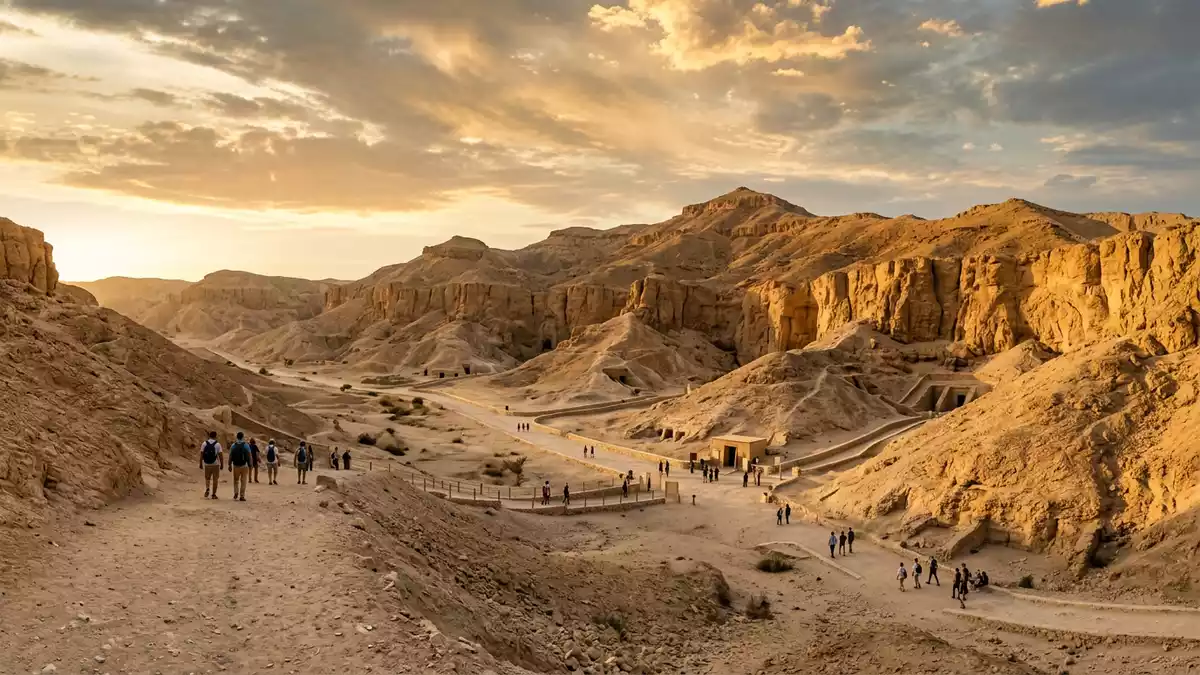
Valley of the Queens lies in the hills west of the Nile at Luxor, where a dry valley contains rock-cut tombs from ancient Egypt’s New Kingdom. Its most celebrated chamber belonged to Queen Nefertari, while the wider necropolis preserves burials associated with queens, princes, princesses and members of the royal elite.
Valley of the Queens: a necropolis inside the limestone hills
The site formed part of ancient Thebes, the great settlement and ceremonial centre on the Nile’s western bank. The valley served as a burial ground during the nineteenth and twentieth dynasties, dated from 1292 to 1075 BC. More than 90 tombs are known across the necropolis, although their decoration, size and state of preservation differ.
The tombs are cut into limestone, marl, clay, chalk and shale within the Theban hills. Their layouts generally contain an entrance passage, short halls and a burial chamber. These spaces are architectural interiors rather than freestanding monuments, with painted surfaces carried into rooms beneath the rock. Ancient Egyptian funerary writing, figures and ritual scenes remain central to the character of the place. The wider Theban burial ground includes the Valley of the Queens, the Valley of the Kings and other sites around Luxor.
Nefertari’s tomb and the art of the Ramesside period
Queen Nefertari’s tomb is identified as QV66. Its wall paintings show the queen in scenes connected with the gods and the afterlife, using colour, hieroglyphic text and carefully ordered figures. The decoration belongs to the Ramesside world of the nineteenth dynasty, when royal burial practices were developed across the Theban necropolis.
Nefertari was the principal wife of Ramesses II, whose reign belongs to the nineteenth dynasty. Her tomb gives the Valley of the Queens a particularly direct connection with the royal court of the period. The name of Ramesses II also links the site to temples, inscriptions and monuments elsewhere in Egypt, but the valley’s identity rests on its underground chambers and painted funerary spaces.
Other tombs belonged to royal children and women connected with the ruling families. The necropolis therefore records more than the burial of queens alone. The people represented in its chambers include princes, princesses and other high-ranking figures associated with the New Kingdom. The surviving rooms present a concentrated record of Egyptian beliefs, artistic conventions and royal genealogy.
From New Kingdom burials to a World Heritage landscape
The Valley of the Queens belongs to the larger archaeological landscape of ancient Thebes. The Nile, the western cliffs and the neighbouring valleys form a connected setting of temples, processional routes and rock-cut cemeteries. Valley of the Queens is one part of this landscape, with its own concentration of royal and elite tombs.
The New Kingdom period extends broadly from the sixteenth to the eleventh century BC. The principal burial use of the valley is associated with this period, while the known tombs reflect changing patterns of royal commemoration. The New Kingdom necropolis contains tombs connected with royal women, princes and members of the elite.
In 1979, the Valley of the Queens became part of the UNESCO World Heritage inscription for Ancient Thebes with its Necropolis. The designation also includes the Valley of the Kings, Karnak, Luxor Temple and other Theban monuments. Its formal status reflects the relationship between individual tombs and the wider funerary landscape around Luxor.
The ancient name Ta-Set-Neferu is associated with the valley and is translated as “the Place of Beauty”. The modern English name directs attention to the queens, yet the archaeological record is broader. Tombs of children and other members of the royal sphere stand alongside those of royal women, making the valley a compact archive of New Kingdom society.
Visiting Valley of the Queens: what travellers from Western Europe should know
- Valley of the Queens is on Luxor’s West Bank, west of the Nile. The site belongs to the Theban Necropolis and is reached across the river from Luxor’s eastern bank.
- The visit takes place among limestone hills and rock-cut chambers. Uneven ground, exposed rock and underground passages form part of the setting.
- The tombs are enclosed spaces with entrances, corridors, halls and burial chambers. Painted walls and hieroglyphic decoration are encountered inside the rock rather than on open-air façades.
- The official language is Arabic and the currency is the Egyptian pound.
- Entry requirements depend on your nationality; UK travellers can check the FCDO travel advice at gov.uk/foreign-travel-advice, Irish travellers the Department of Foreign Affairs at ireland.ie.
Searching for Valley of the Queens on social platforms
These links open searches for Valley of the Queens on each platform.Frequently asked questions about Valley of the Queens
Where is Valley of the Queens?
Valley of the Queens is on Luxor’s West Bank in Upper Egypt, within the hills of the ancient Theban Necropolis.
What can visitors expect to see?
Visitors encounter rock-cut tombs with passages, halls and burial chambers. Painted scenes, hieroglyphic inscriptions and limestone interiors define the experience.
What makes the valley distinctive?
Its tombs connect royal women with princes, princesses and elite members of the New Kingdom. Queen Nefertari’s decorated tomb is its best-known individual monument.


