
Valparaiso’s painted hills and historic port cityscape
Published on 08/29/2026 at 10:37 | Editorial responsibility: Rafael Müller, Editor-in-Chief AD HOC NEWS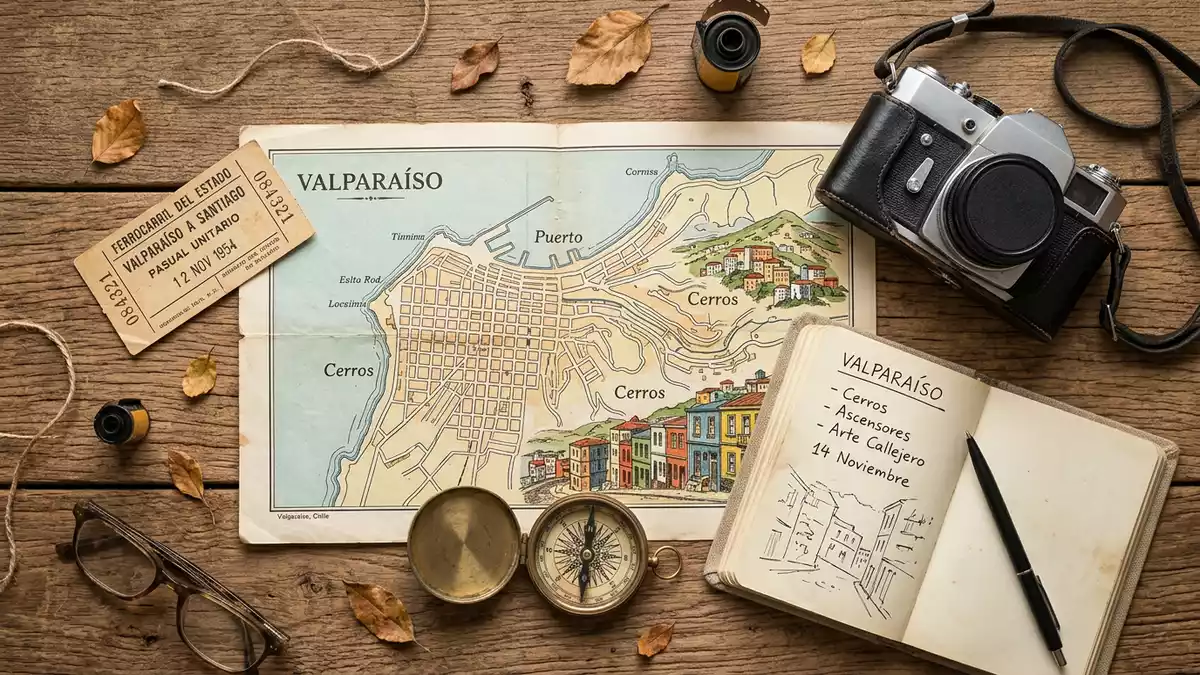
Valparaiso on Chile’s Pacific coast is a port city that climbs from a flat waterfront into steep hills covered in multi-coloured houses, threaded with stairways and funicular railways. In 2003, the Historic Quarter of Valparaiso was inscribed as a UNESCO World Heritage Site, recognising a cityscape shaped in the late nineteenth and early twentieth centuries by global maritime trade and immigrant communities. The contrast between the geometrical streets by the harbour and the maze-like hillside neighbourhoods is the defining experience of the Valparaiso historic quarter.
Harbour plain and amphitheatre of hills
Valparaiso occupies a natural bay on central Chile’s Pacific coastline, with the oldest part of the city pressed between the water and the slopes rising behind it. The flat area by the harbour was largely formed as a narrow coastal plain reclaimed from the sea, creating space for port facilities, streets and public squares laid out in a more regular grid.Its narrow flat part is fronted by docks and warehouses that recall Valparaiso’s emergence as a leading merchant port in the late nineteenth century.
Behind this band of streets the hills rise sharply, forming an urban amphitheatre of slopes and deep ravines with houses, stairways and alleyways climbing in successive tiers.Steep hills with deep ravines define how the city is experienced: viewpoints look over the port and Pacific, streets twist around the terrain, and staircases link levels where conventional streets would be difficult to build. This amphitheatre form makes the hillside neighbourhoods visually dominant even though the active harbour lies below.
The UNESCO historic quarter and immigrant hills
The Historic Quarter of the Seaport City of Valparaiso, encompassing parts of the harbour plain and the adjacent slopes, was inscribed on the World Heritage List in 2003 as a cultural site.Historic Quarter of the Seaport City of Valparaíso is described as an outstanding example of industrial-age urban heritage linked to international sea trade in the late nineteenth and early twentieth centuries. The protected area comprises interconnected neighbourhoods with public squares, commercial streets and residential districts linked across the change from flat port to hills.
Within this UNESCO-listed zone, the twin hills of Cerro Alegre and Cerro Concepción stand out for their late nineteenth-century houses and promenades developed largely by British and German immigrants.The Alegre and Concepción hills contain viewing terraces overlooking the bay, narrow streets lined with timber and masonry houses, and squares at the top stations of funiculars. This mixture of immigrant domestic architecture, hillside topology and harbour views gives the area its specific character within the wider city.
Funicular ascensores and painted hillside streets
One of the most recognisable features of Valparaiso’s hills is the network of ascensores, the funicular railways that climb from the lower city to the residential slopes above. The first of these hillside elevators began operating in the late nineteenth century to tackle gradients too steep for ordinary vehicles, and by the early twentieth century there were around thirty in use at various points along the bay.ascensores que a partir de 1883 funcionaron linked street-level stations near the harbour with upper platforms beside promenades and neighbourhood streets. Sixteen ascensores survive and have been declared National Historic Monuments, preserving their timber cars, rails and distinctive trackside structures as part of the city’s working heritage.
Among these hillside lines, the Ascensor Concepción connects Calle Prat in the lower city with Paseo Gervasoni on Cerro Concepción, and the Reina Victoria ascensor links a square near Plaza Sotomayor with an upper promenade on Cerro Alegre.Concepción connects Calle Prat with Paseo GervasoniReina Victoria was inaugurated in 1903 and named in honour of the British monarch Victoria. Street art and painted façades now line many of the narrow streets near these upper stations, adding murals and colour to the older houses and making the climbs feel like part of the visual life of the hills.
Visiting Valparaiso: what travellers from Western Europe should know
- Valparaiso lies on Chile’s central Pacific coast west of Santiago, and is reached overland via main highways and rail or bus routes linking the capital with the port city.
- The historic quarter extends from the harbour’s flat streets up steep hills with long staircases and alleyways, so walking between levels involves sustained climbs and descents.
- Several ascensores, including lines serving Cerro Alegre and Cerro Concepción, provide mechanical links between the lower port district and the hillside promenades above.
- The official language is Spanish and the currency is the Chilean peso.
- Entry requirements depend on your nationality; UK travellers can check the FCDO travel advice at gov.uk/foreign-travel-advice, Irish travellers the Department of Foreign Affairs at ireland.ie.
Searching for Valparaiso on social platforms
These links open searches for Valparaiso on each platform.
Frequently asked questions about Valparaiso
Where is Valparaiso and what kind of place is it?
Valparaiso is a seaport city on Chile’s central Pacific coast, combining a working harbour on a narrow coastal plain with steep surrounding hills covered in houses and stairways.
What should visitors expect when exploring Valparaiso’s historic quarter?
Visitors encounter dense streets by the port, public squares and commercial areas, then climb into hillside neighbourhoods connected by staircases and funiculars, with promenades offering views over the bay and Pacific.
What makes Valparaiso distinctive among coastal cities?
Valparaiso’s combination of UNESCO-listed historic quarter, funicular ascensores declared National Historic Monuments, and multi-coloured houses clinging to steep hills above an active Pacific port gives it a character closely tied to its terrain and maritime history.


