
Victoria & Alfred Waterfront, Cape Town’s harbour quarter shaped by two historic basins
Published on 09/02/2026 at 20:17 | Editorial responsibility: Rafael Müller, Editor-in-Chief AD HOC NEWS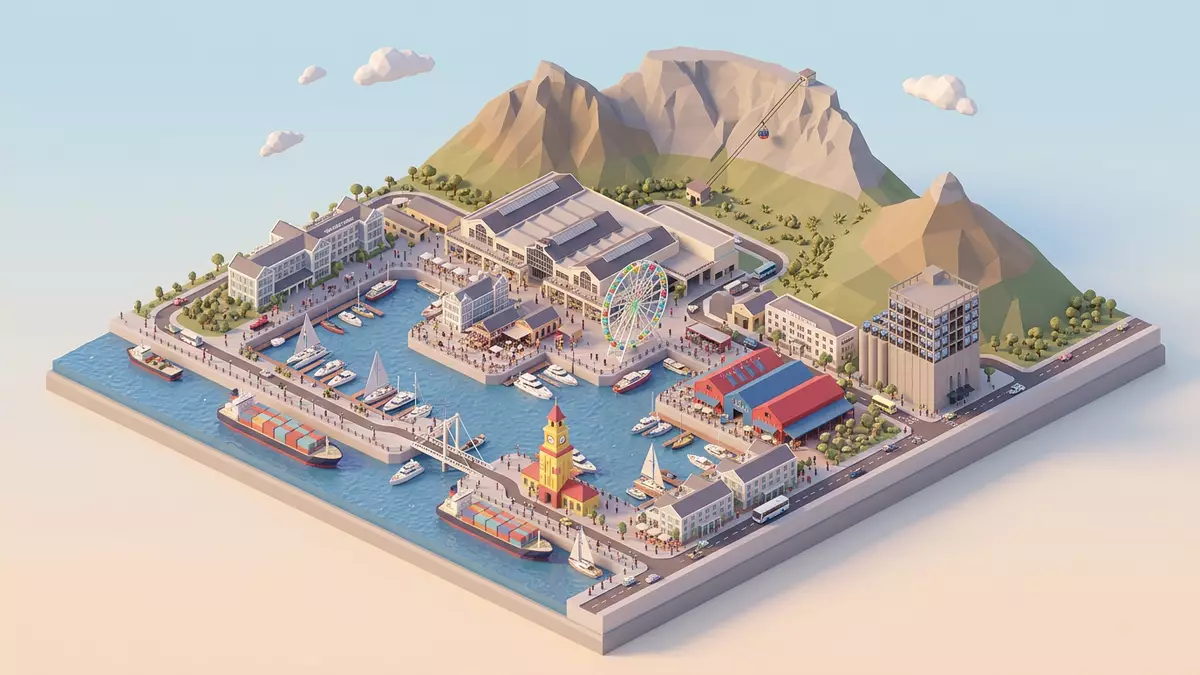
Victoria & Alfred Waterfront in Kapstadt is a harbour quarter where nineteenth-century dock basins, maritime engineering and contemporary city life meet around the water of Table Bay. Set on the Atlantic shore below Table Mountain, it takes its name from two historic basins, Alfred and Victoria, and has grown into a mixed-use district built around a working harbour.
From royal breakwater to named harbour basins
The story of Victoria & Alfred Waterfront centres on the creation of enclosed harbour basins along Table Bay in the nineteenth century, when Cape Town’s anchorage was reshaped into a sheltered port. In September 1860, Prince Alfred, the second son of Queen Victoria, tipped the first load of stone into the bay as a young midshipman in the Royal Navy, marking the start of a substantial breakwater for Cape Town’s modern harbour works.Prince Alfred’s 1860 breakwater The first enclosed harbour basin, later known as the Alfred Basin, followed in the decades after that ceremonial tipping and gave the emerging port a sheltered inner dock reached from Table Bay.the Alfred Basin was constructed from 1860
As maritime traffic increased and steam-powered vessels demanded more capacity along the sea route between Europe and Asia, a second enclosed harbour basin was added on the city side of Table Bay.the Victoria Basin was commissioned in 1905 Named in honour of Queen Victoria, it extended the sheltered waters and, together with the Alfred Basin, fixed the British royal family into Cape Town’s geography and gave the district its present name.the Waterfront was named after the Alfred Basin and the Victoria Basin For decades, these basins formed Cape Town’s primary commercial port, lined with quays, wharves and port structures serving ocean-going ships.
Dockland architecture and the working harbour landscape
Victoria & Alfred Waterfront is built around the stone-edged basins, quay walls and maritime infrastructure of Cape Town’s historic harbour. Bollards, mooring points and engineering structures from the age of sail and early steam remain in place along the water, and former coal stores and customs warehouses stand close to modern hotels and arcades.a former coal store and baggage warehouse now houses the Victoria & Alfred Hotel The district’s architecture records shifts in harbour use, with masonry dock buildings adapted for contemporary purposes and new structures introduced alongside them.
For much of the twentieth century, the basins around Victoria & Alfred Waterfront functioned as Cape Town’s working harbour, with coal stores, customs sheds, cranes and dry docks arranged around the water to serve cargo and passenger vessels.for much of the twentieth century the basins formed Cape Town’s working harbour The surrounding engineering landscape includes breakwaters, dock basins and railway-linked quays, reflecting Cape Town’s development as a maritime hub on the Atlantic route. With Table Mountain rising inland and Robben Island lying offshore in Table Bay, the harbour quarter sits within a wider coastal setting that is visible from many points along the waterfront.
Redevelopment into a mixed-use waterfront district
A turning point in the area’s story came in November 1988, when Victoria and Alfred Waterfront (Pty) Ltd was established to redevelop the historic docklands around the Alfred and Victoria basins as a mixed-use urban quarter that would coexist with the functioning port.Victoria and Alfred Waterfront (Pty) Ltd was established in November 1988 Backed by funding from South African Transport Services, later Transnet, it began a long-term programme of phased development that retained maritime operations while introducing new urban functions.initial funding for redevelopment was provided by South African Transport Services
Since redevelopment began, warehouses have been converted into hotels and shopping arcades, new buildings have risen around existing dock structures, and public promenades have been laid out along the quays. Shops, eateries and cultural venues share space with maritime facilities, reflecting the district’s dual identity as harbour and urban quarter.warehouses have been converted and promenades laid out along the quays With its mix of retail, leisure, offices, residential buildings and hotels distributed across more than 100 hectares, Victoria & Alfred Waterfront has become an important destination within Cape Town while remaining closely tied to the water and working harbour activities.the V&A Waterfront is a large mixed-use development
Visiting Victoria & Alfred Waterfront: what travellers from Western Europe should know
- Victoria & Alfred Waterfront lies on the edge of Table Bay in Kapstadt, between the central business district and the Atlantic shore, and is reached by urban road networks and city transport services serving the harbour quarter.
- The district’s terrain is essentially level dockland, with paved promenades along the water, quays beside the basins and steps or ramps within some converted warehouses and hotel buildings.
- Within South Africa, the official language status covers several languages, including Afrikaans and English, and the currency is the South African rand.
- Entry requirements depend on your nationality; UK travellers can check the FCDO travel advice at gov.uk/foreign-travel-advice, Irish travellers the Department of Foreign Affairs at ireland.ie.
Searching for Victoria & Alfred Waterfront on social platforms
These links open searches for Victoria & Alfred Waterfront on each platform.
Frequently asked questions about Victoria & Alfred Waterfront
Where is Victoria & Alfred Waterfront located within Kapstadt?
Victoria & Alfred Waterfront occupies historic docklands on the edge of Table Bay, between Kapstadt’s central business district and the Atlantic coastline below Table Mountain.
What can visitors expect when walking through the Waterfront?
Visitors encounter a mix of preserved harbour basins, quay walls, maritime equipment, adapted dock buildings and newer structures housing shops, hotels, eateries and cultural spaces along paved promenades.
What makes Victoria & Alfred Waterfront distinctive among harbour districts?
Its character arises from the pairing of the Alfred and Victoria basins, their nineteenth-century breakwaters and dock architecture, and the way these historic harbour elements continue to shape a working waterfront integrated with urban functions.


