
Vizcaya Museum and Gardens: a European villa in Miami
Published on 09/24/2026 at 03:09 | Editorial responsibility: Rafael Müller, Editor-in-Chief AD HOC NEWS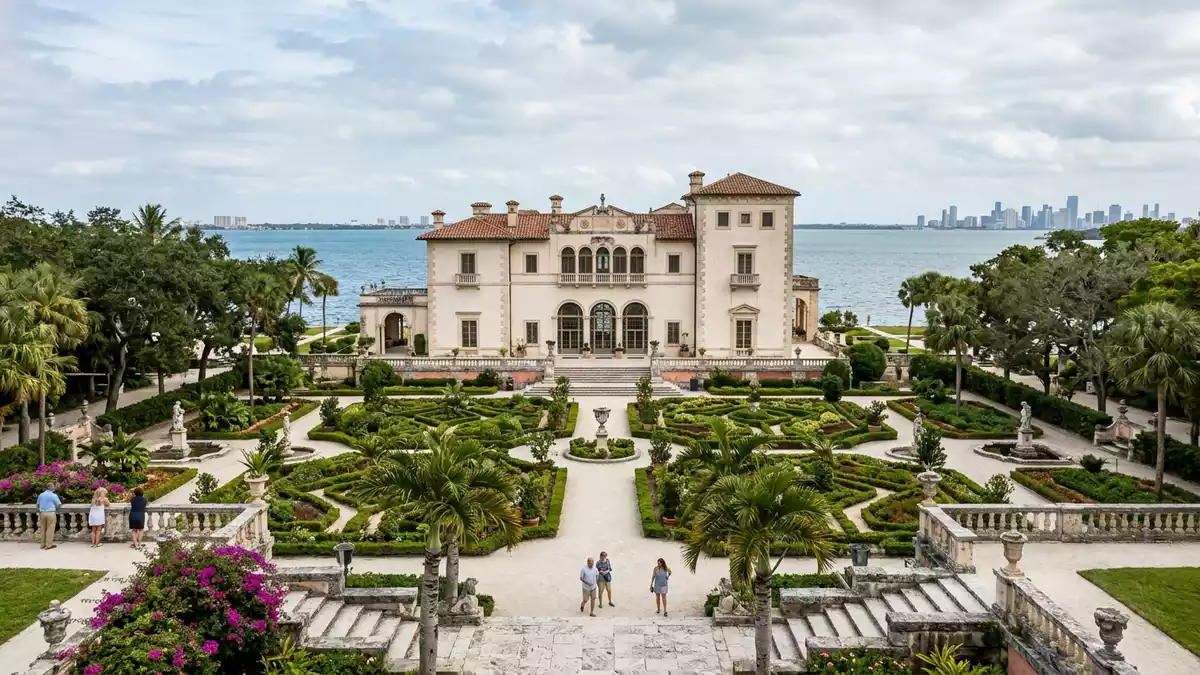
Vizcaya Museum and Gardens places an Italianate villa, formal gardens and Biscayne Bay within one historic estate in Miami. The Main House was built for James Deering between 1914 and 1916, while the gardens extend the European vocabulary into South Florida’s subtropical landscape.
Vizcaya’s Main House and its layered European language
James Deering was an industrialist and a vice-president of International Harvester. Vizcaya became his winter residence, with its first private use beginning in 1916. The house entered public museum use in 1953.
Architect F. Burrall Hoffman developed the Main House, while Paul Chalfin directed the decorative programme. Their work combines Mediterranean Revival architecture with references to Italian Renaissance and eighteenth-century villas. Rooms contain carved wood, painted ceilings, stone details and decorative arts assembled for the estate.
The building faces Biscayne Bay and forms the architectural centre of the property. Its interiors contain a mixture of period-inspired rooms and collected objects, creating a sequence of domestic spaces rather than a single ceremonial hall. F. Burrall Hoffman is recorded as the architect of record.
Diego Suarez and the formal gardens
The ten-acre gardens were designed by Colombian-born landscape architect Diego Suarez between 1914 and 1917, with completion recorded in 1922. Their vocabulary draws on Italian and French Renaissance and Baroque gardens, translated into Miami’s climate and vegetation.
Stone paths, clipped planting, terraces, fountains, sculptures and architectural garden rooms organise the grounds. The arrangement includes a central axis, enclosed spaces and views towards the bay. Plant material gives the formal design a South Florida setting without removing its European references.
Suarez had studied at Villa la Pietra outside Florence. At Vizcaya, his work is visible in the balance between planted areas, masonry and water. Sculptural elements include historic pieces and works made for the estate, linking the gardens with the collections inside the Main House. the ten-acre gardens remain a defining part of the museum landscape.
A historic estate beside Biscayne Bay
Vizcaya occupies part of Miami’s Coconut Grove area, at 3251 South Miami Avenue beside Biscayne Bay. The estate is a National Historic Landmark, a designation connected with its architecture, landscape design and cultural history.
The property presents several layers together: a private winter residence, a decorative arts museum, a formal garden and a coastal landscape. Its history belongs to the early twentieth-century growth of Miami, while its visual language reaches back to European country houses and garden traditions.
The Main House and gardens are the principal elements, with wooded areas and waterfront edges adding a less formal setting around them. The contrast between ordered terraces and the bay’s open horizon is visible across the grounds. National Historic Landmark status places Vizcaya among the formally recognised historic sites of the United States.
Visiting Vizcaya Museum and Gardens: what travellers from Western Europe should know
- Vizcaya Museum and Gardens is at 3251 South Miami Avenue in Miami’s Coconut Grove area, beside Biscayne Bay. The site is reached by road and Miami’s public transport network.
- The estate combines indoor rooms, paved garden routes, steps, terraces and waterfront edges. Comfortable walking footwear suits the varied surfaces.
- The official language is English and the currency is the US dollar.
Searching for Vizcaya Museum and Gardens on social platforms
These links open searches for Vizcaya Museum and Gardens on each platform.
Frequently asked questions about Vizcaya Museum and Gardens
Where is Vizcaya Museum and Gardens?
Vizcaya Museum and Gardens is at 3251 South Miami Avenue in Miami’s Coconut Grove area, beside Biscayne Bay.
What can visitors see there?
The estate contains the Main House, decorative arts, formal gardens, sculptures, terraces, planted areas and waterfront views.
What makes Vizcaya distinctive?
Its Italianate villa and formal gardens combine European architectural references with the subtropical landscape of South Florida.


