
Volcan Irazu and its high-altitude crater landscape
Published on 09/24/2026 at 08:16 | Editorial responsibility: Rafael Müller, Editor-in-Chief AD HOC NEWS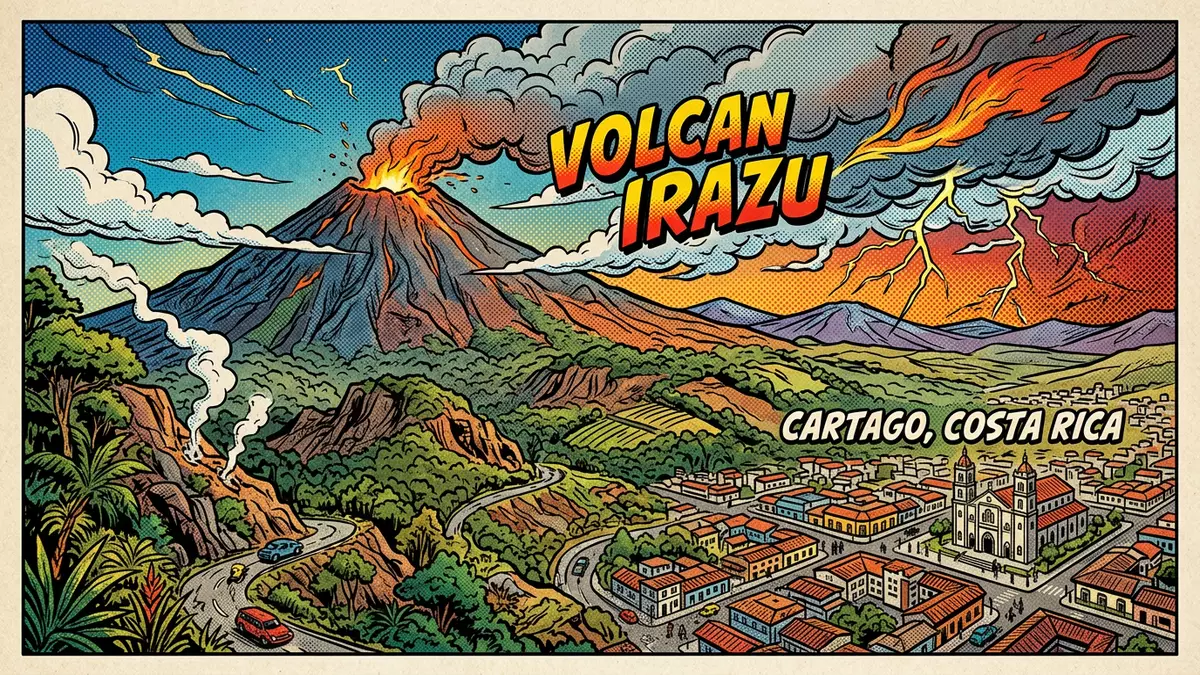
Volcan Irazu rises above Cartago in Costa Rica’s Cordillera Central, where a broad volcanic summit opens into craters, ash slopes and a highland landscape. At 3,432 m (11,260 ft), it is Costa Rica’s highest volcano, and its exposed upper terrain forms the centre of Volcan Irazu National Park.
Volcan Irazu: a summit shaped by craters
The mountain is an active volcano with an irregular sub-conical form. Its summit contains volcanic depressions, crater walls, ash-covered ground and a crater lake whose colour contrasts with the surrounding dark earth. The landscape changes visibly across short stretches, from open volcanic ground to vegetation associated with high elevations.
Volcan Irazu belongs to the Central Volcanic Cordillera, a mountain chain running through central Costa Rica. The volcano stands north-east of Cartago and reaches above the Central Valley, while its slopes extend towards the Caribbean side of the country. The National Seismological Network places the summit 30 km north-east of Cartago and records an elevation of 3,432 metres above sea level.
Andesite, ash and the Central Volcanic Cordillera
Volcan Irazu is an andesitic volcanic structure formed from lava flows, volcanic ash and pyroclastic material. Andesite is a volcanic rock associated with magma of intermediate composition, and it appears in the deposits that make up the mountain. The summit’s irregular outline reflects a landscape of cones, craters and eroded volcanic surfaces.
The volcano is part of a wider chain created by volcanic activity in Central America. Its upper slopes contain exposed material, while lower areas connect with forest and highland vegetation. A scientific description of the national park records craters, crater lakes, cones and subalpine páramo species among the principal features of the summit landscape. The same study identifies the park within the Cordillera Volcanica Central Conservation Area, which received Biosphere Reserve designation in 1988.
The summit is part of a protected landscape rather than an isolated geological viewpoint. Volcan Irazu National Park was created in 1955 and includes volcanic terrain around the mountain. The park’s protected status links the summit’s open craters with the forests and upland habitats on its surrounding slopes.
Cartago, eruptions and a protected mountain
Volcan Irazu has a documented eruption history reaching back to the eighteenth century. Activity recorded in 1723 is associated with Diego de la Haya Fernández, governor of the Province of Cartago. A sustained eruptive phase from 1963 to 1965 sent ash across Cartago and affected agricultural land in the surrounding region.
The 1963–1965 eruption is closely connected with the modern history of Cartago. Ash reached the city and damaged coffee crops, while volcanic deposits affected drainage in the area. The episode remains part of the mountain’s identity, alongside its summit craters and high elevation. The 1963–1965 eruptions are among the best-recorded events in the volcano’s history.
Volcan Irazu’s name comes from an Indigenous word associated with thunder. Its height, geological form and connection with Cartago place it within both Costa Rica’s volcanic geography and the cultural landscape of the province. The mountain is also identified as the highest volcano in Costa Rica by the country’s tourism authority.
Visiting Volcan Irazu: what travellers from Western Europe should know
- Volcan Irazu lies in Cartago Province, north-east of Cartago, within Costa Rica’s Cordillera Central. The summit area is reached by road from Cartago through the highlands.
- The approach leads into high-altitude volcanic terrain. The summit landscape includes exposed ash, crater rims, uneven ground and slopes with limited tree cover.
- The upper park contains craters, a crater lake, volcanic cones and vegetation associated with subalpine páramo environments.
- The official language is Spanish and the currency is the Costa Rican colón.
Searching for Volcan Irazu on social platforms
These links open searches for Volcan Irazu on each platform.Frequently asked questions about Volcan Irazu
Where is Volcan Irazu?
Volcan Irazu is in Cartago Province, north-east of the city of Cartago, within Costa Rica’s Cordillera Central. Its summit lies inside Volcan Irazu National Park.
What can visitors expect at the summit?
The summit contains craters, volcanic ash, uneven ground, a crater lake and highland vegetation. The setting is an exposed volcanic landscape at 3,432 m (11,260 ft).
What makes Volcan Irazu distinctive?
Its combination of national-park protection, crater scenery and elevation gives Volcan Irazu a clearly defined place in Costa Rica’s landscape. It is the country’s highest volcano and has a documented eruption history linked with Cartago.


