
Wai-O-Tapu: colour and steam in Rotorua’s geothermal basin
Published on 09/22/2026 at 00:15 | Editorial responsibility: Rafael Müller, Editor-in-Chief AD HOC NEWS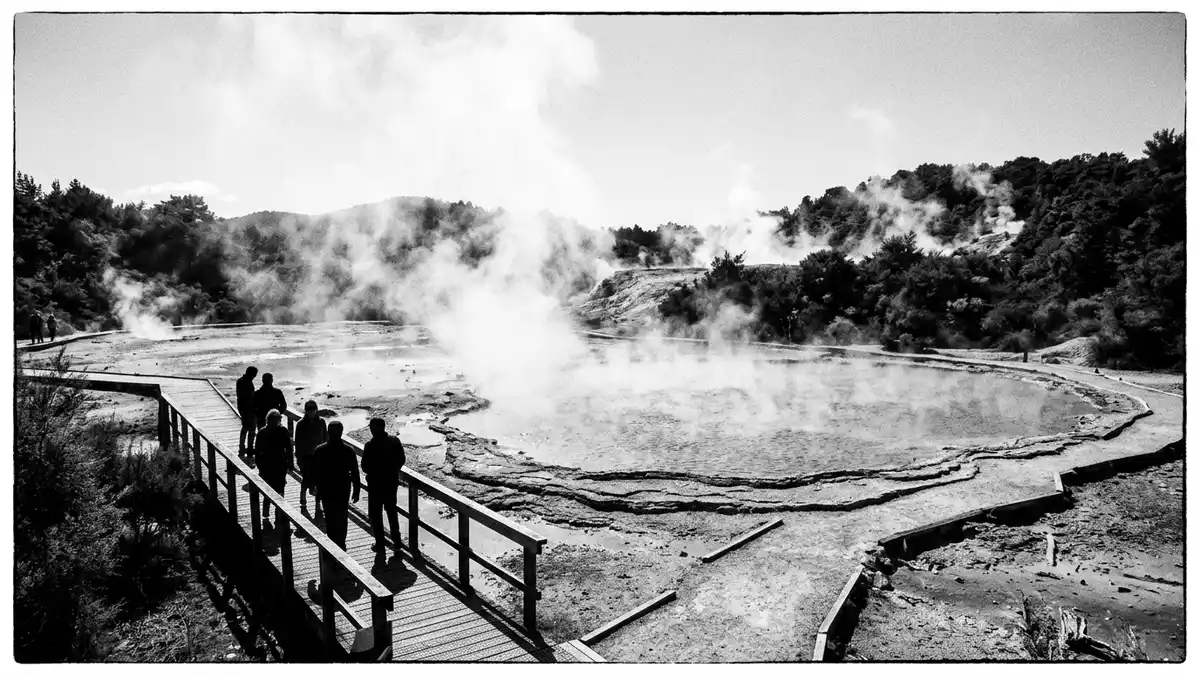
South of Rotorua on New Zealand’s North Island, Wai-O-Tapu is an active geothermal area where vividly coloured pools, steaming vents and collapsed craters share one compact landscape. In the Taup? Volcanic Zone, this field of hot springs and mud pools forms a natural amphitheatre of mineral-laden water and rising steam. The name Waiotapu, meaning “sacred waters” in M?ori, hints at a long-standing awareness of the unusual conditions beneath the ground.
A geothermal field shaped by water and mineral
Wai-O-Tapu sits at the southern end of the Okataina Volcanic Centre, just north of the Reporoa depression that marks one of the major caldera structures on the North Island. Beneath the surface, geothermal fluids circulate through fractured rock, emerging at the ground in pools and vents that carry dissolved minerals up with them.an active geothermal area The result is a patchwork of terraces, basins and mud fields where different chemical compositions and temperatures produce contrasting colours and textures.
The geothermal area covers around 18 square kilometres, though the visitor walking routes concentrate on a smaller sector where features lie close together.the 18 km² geothermalgebiet Across this terrain, collapsed craters expose steaming walls, fumaroles vent gas, and pools of hot and cold water occupy shallow basins. Minerals precipitate around the edges of basins and on terrace surfaces, building sinter formations that contrast with the darker volcanic soil between them.
Champagne Pool, Artist’s Palette and the colour spectrum
The most recognisable feature within the visitor area is Champagne Pool, a large hot spring occupying a volcanic explosion crater. Its water holds at high temperatures, saturated with dissolved minerals that form colourful deposits around the rim.the Champagne Pool basin Gases, including carbon dioxide, escape through the water and rise continuously as streams of bubbles, giving the pool its name by analogy with sparkling wine.
Around Champagne Pool spreads the feature known as the Artist’s Palette, a broad terrace where overflow from the spring spreads out and cools. As water moves across the sinter surface and loses heat, different minerals precipitate, creating patches of orange, yellow and green against pale silica. Nearby, Primrose Terrace forms another sinter formation, with cascades of small basins stepping down the slope.Primrose Terrace and sinter formations In other parts of the park, pools such as Devil’s Bath show intense green water where mineral content and suspended particles interact with sunlight.
Lady Knox Geyser and the wider Rotorua volcanic setting
Just outside the main walking circuits, Lady Knox Geyser is one of the best-known geothermal features associated with Wai-O-Tapu. It rises from a natural vent in the ground within the same geothermal system and erupts to a considerable height when a surfactant is introduced into the opening, disrupting the surface tension of the hot water and triggering an eruption sequence.Lady Knox Geyser in Wai-O-Tapu The geyser’s setting among low hills and scrub, with steam plumes drifting across the surrounding clearings, reinforces the impression of a broad geothermal field rather than a single isolated spring.
Wai-O-Tapu forms part of the Taup? Volcanic Zone, a geological corridor that runs across the central North Island and includes Rotorua’s other geothermal areas. Within this zone, volcanic centres such as Okataina have produced calderas, lava domes and widespread ignimbrite deposits over thousands of years.Rotorua’s geothermal attractions Hot water and steam moving through these volcanic rocks feed fields like Wai-O-Tapu, where the surface expressions of that heat are concentrated enough to be traced along boardwalks and paths.
Visiting Wai-O-Tapu: what travellers from Western Europe should know
- Wai-O-Tapu lies south of Rotorua on New Zealand’s North Island, along State Highway 5 heading towards Taup?. Access for visitors is via Waiotapu Loop Road, which leads to the Thermal Wonderland entrance.
- The main visitor area is laid out as a sequence of walking tracks over gently undulating ground, with boardwalks crossing fragile terrace surfaces and paths running beside craters and pools. Sturdy footwear is useful on gravel sections and near the mud pools.
- Mud pools and steaming vents lie close to the paths in places, and the ground surface is thin over hot water in some sections, so visitors are kept to marked walkways and viewing platforms.
- The official language is English and the currency is the New Zealand dollar.
Searching for Wai-O-Tapu on social platforms
These links open searches for Wai-O-Tapu on each platform.
Frequently asked questions about Wai-O-Tapu
Where is Wai-O-Tapu?
Wai-O-Tapu is in the Rotorua region on New Zealand’s North Island, within the Taup? Volcanic Zone south of the city along State Highway 5.
What should visitors expect on a visit?
Visitors walk on signposted tracks and boardwalks through a geothermal landscape of hot springs, sinter terraces, craters, mud pools and steam vents, with viewpoints over Champagne Pool and other features.
What makes Wai-O-Tapu distinctive among geothermal areas?
Wai-O-Tapu combines an extensive concentration of geothermal features with intense mineral colours, including the orange-rimmed Champagne Pool, the broad Artist’s Palette terrace and green pools such as Devil’s Bath.


