
Yiheyuan and the landscape of imperial Beijing
Published on 09/24/2026 at 12:56 | Editorial responsibility: Rafael Müller, Editor-in-Chief AD HOC NEWS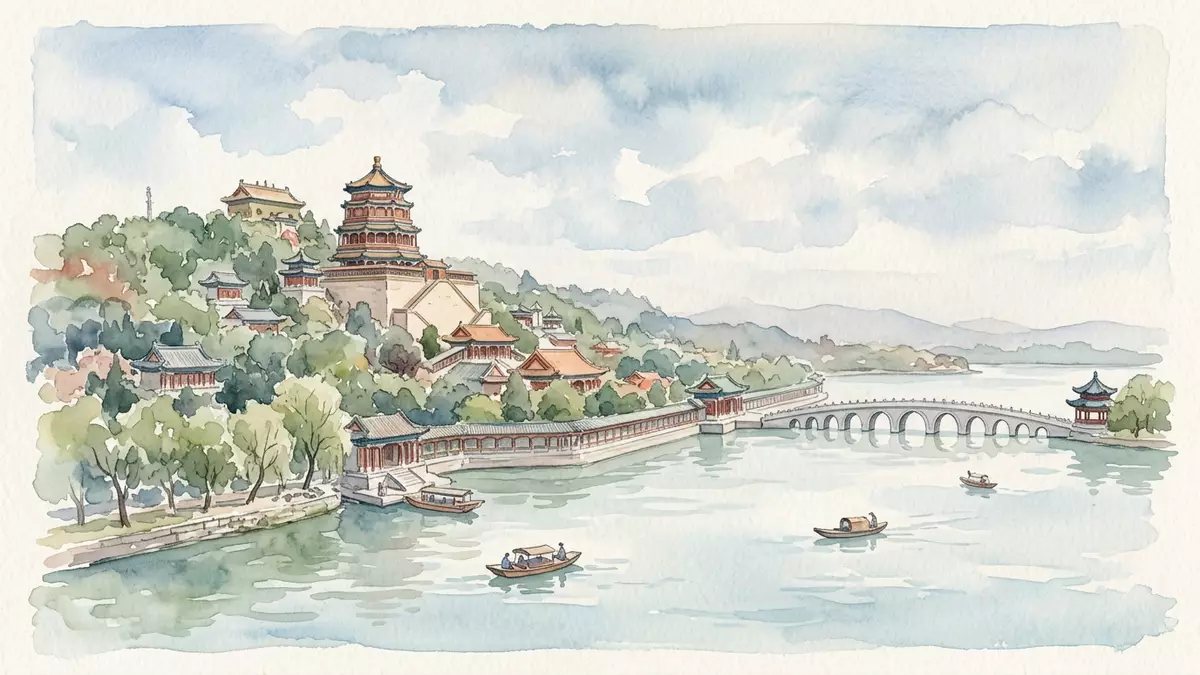
Yiheyuan is a large imperial garden in north-western Peking, arranged around Kunming Lake and Longevity Hill. Water, wooded slopes, halls, bridges and covered walkways form a landscape in which architecture occupies both shore and hillside.
Yiheyuan between lake and hill
Kunming Lake occupies much of the garden, while Longevity Hill rises along its northern side. The relationship between water and elevated ground gives Yiheyuan its clearest visual order. Pavilions, temples, galleries and palace buildings appear as separate elements within the wider landscape.
The garden covers about 290 hectares, with water making up roughly three quarters of the area. Its layout belongs to the tradition of Chinese imperial landscape gardening, where buildings, planting, rock and water are arranged as a connected composition. Kunming Lake and Longevity Hill provide the principal geographic framework.
Qianlong’s Qing dynasty garden
Construction began in 1750 under the Qianlong emperor of the Qing dynasty and was completed in 1764. The garden was first known as Qingyiyuan, or Garden of Clear Ripples, before the name Yiheyuan became established.
Yiheyuan served as an imperial retreat and garden during the Qing period. Its buildings combine formal halls with scenic structures, including Tibetan-style architecture on Longevity Hill and a traditional commercial street known as Suzhou Market Street. Kunming Lake also reflects the visual language of West Lake in Hangzhou. Qianlong’s 1750 commission places the surviving ensemble within the eighteenth-century Qing court.
From imperial retreat to World Heritage garden
The garden suffered major destruction in 1860 and 1900. Empress Dowager Cixi directed reconstruction in the late nineteenth century, and the name Yiheyuan became associated with the restored imperial resort.
After the 1911 revolution, the grounds opened as a public site, and Yiheyuan became a park in 1924. UNESCO inscribed the Summer Palace on its World Heritage List in 1998. The designation covers the relationship between the palace buildings, Kunming Lake, Longevity Hill and the wider garden composition. the 1998 World Heritage inscription records its place within the recognised heritage of imperial Chinese garden design.
Visiting Yiheyuan: what travellers from Western Europe should know
- Yiheyuan lies in Haidian District, north-west of central Peking. Beijing’s urban rail and bus networks serve the district, with entrances around the garden perimeter.
- The grounds combine level lakeside paths with slopes on Longevity Hill. Movement between the lake and hill therefore includes gradients and stairways.
- The garden’s principal landmarks include Kunming Lake, Longevity Hill, the Long Corridor, the Hall of Benevolence and Longevity, and the Tower of Buddhist Incense.
- The official language is Mandarin Chinese and the currency is the renminbi.
Searching for Yiheyuan on social platforms
These links open searches for Yiheyuan on each platform.
Frequently asked questions about Yiheyuan
Where is Yiheyuan?
Yiheyuan is in Haidian District in north-western Peking, China. The garden lies around Kunming Lake and Longevity Hill.
What can visitors expect at Yiheyuan?
The grounds contain lakeside paths, hillside routes, palace halls, pavilions, bridges, temples and covered galleries. The landscape includes both formal architecture and broad areas of water and planting.
What makes Yiheyuan distinctive?
Its defining feature is the combination of a large lake, a wooded hill and Qing dynasty imperial architecture. The ensemble began in 1750, reached completion in 1764 and entered the World Heritage List in 1998.


