
Zion National Park’s sandstone labyrinth in Springdale
Published on 09/15/2026 at 07:00 | Editorial responsibility: Rafael Müller, Editor-in-Chief AD HOC NEWS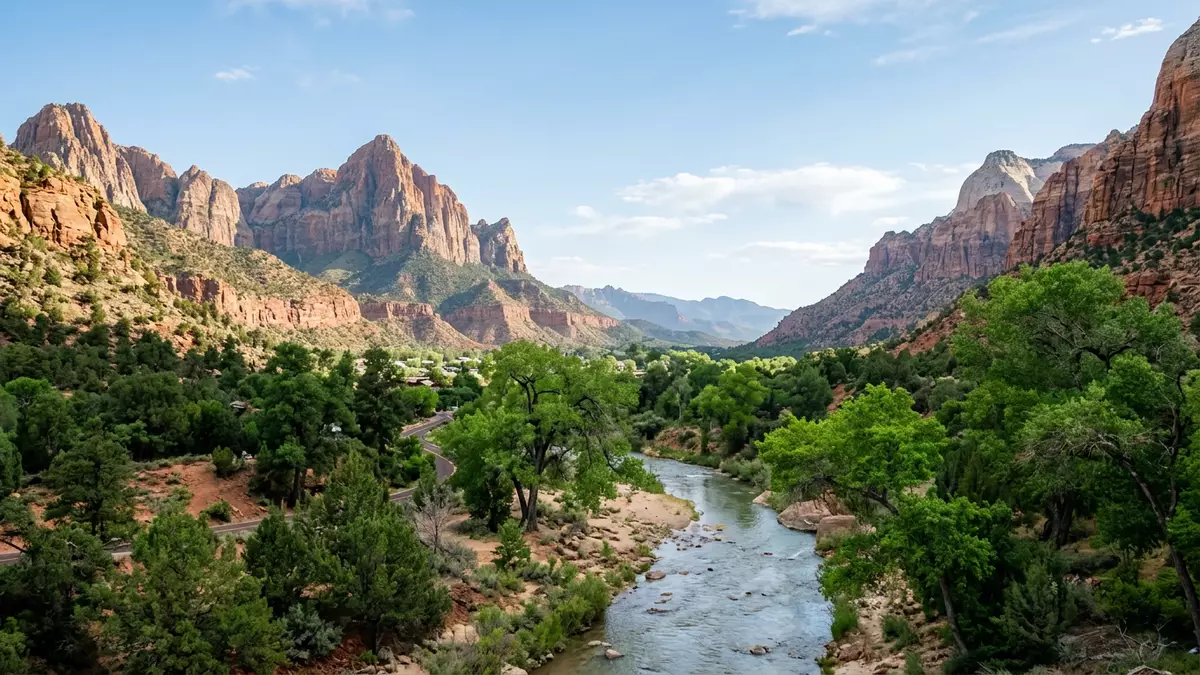
Zion National Park in Utah sits above the small town of Springdale, where the Virgin River has carved a deep sandstone canyon into the edge of the Colorado Plateau. Its cliffs, formed from stacked sedimentary layers laid down over millions of years, give the park a distinctive character among the canyon landscapes of the American Southwest. Established as a national park in 1919, Zion combines dramatic geology with a compact valley that visitors experience at close quarters.
Sandstone walls and the story of deep time
The most striking feature of Zion National Park is the sheer sandstone canyon that runs along the North Fork of the Virgin River, with walls that rise far above the valley floor in near-vertical cliffs. These walls are largely made from Navajo Sandstone, a Jurassic rock unit formed from lithified sand dunes that once covered this region in a vast desert; in Zion this sandstone reaches a thickness of around 2,200 ft and forms the rounded domes and cliff faces that define the skyline.Navajo Sandstone in Zion Beneath the Navajo layer lies the thinner Kayenta Formation, which weathers into ledges and benches and creates the stepped profiles seen on many slopes in the canyon.Kayenta Formation ledges
These units are part of a broader sequence known as the Grand Staircase, a stack of sedimentary formations that records about 150 million years of changing environments in this corner of North America.Grand Staircase formations In and around Zion, the exposed rocks include Triassic formations such as the Moenkopi and Chinle, Jurassic units such as the Moenave, Kayenta and Navajo, and higher layers like the Temple Cap and Carmel formations, each representing settings that ranged from shallow seas and tidal flats to river plains and windblown deserts.Zion’s sedimentary sequence The overall result is a canyon where colour bands mark shifts in ancient climate and geography, visible along almost every stretch of exposed rock.
The Virgin River canyon and classic viewpoints
Zion Canyon follows the North Fork of the Virgin River, which has cut down through the Navajo Sandstone to form a gorge that narrows in its upper reaches and opens into a wider valley near Springdale.Virgin River canyon profile Along this corridor, the river’s gradient and sediment load have sculpted alcoves, hanging gardens and smooth rock corridors where water continues to work on the sandstone. The canyon floor carries the park’s main road and facilities, while towering formations such as Angels Landing and the Great White Throne rise above it, providing recognisable silhouettes in many views of Zion.
At higher elevations within the park, mesas and peaks reach over 2,500 m (8,200 ft), with Horse Ranch Mountain cited as one of the highest points in the area and lower points such as Coal Pits Wash marking the canyon exits.Highest and lowest elevations The change in height between valley floor and rim gives many viewpoints a pronounced sense of depth, especially where the canyon bends and reveals successive layers of cliffs. Trails and roads follow the natural terraces created by resistant rock units like the Kayenta Formation, so that access routes often step from bench to bench beneath the higher sandstone walls.
From Mukuntuweap to a national park
The landscape now known as Zion National Park was first set aside as Mukuntuweap National Monument in 1909, when President William Howard Taft designated an area of the canyon for protection.Mukuntuweap National Monument 1909 In 1918 the monument was re-proclaimed under the name Zion, reflecting the local usage that had taken hold for the canyon. The following year, on 19 November 1919, the United States Congress redesignated the monument as Zion National Park, and President Woodrow Wilson signed the act that formally created Utah’s first national park.Establishment in 1919
Since its establishment, Zion National Park has remained part of the United States National Park System and has seen changes in boundaries and infrastructure while retaining its core canyon landscape. It occupies a position where three major physiographic regions meet: the Colorado Plateau, the Great Basin and the northern margin of the Mojave Desert, making its geology a crossroads of influences from each.Meeting of regional provinces For travellers from Western Europe, this combination of deep geologic time, named rock formations and a clearly dated conservation history gives Zion both a scientific and a cultural dimension beyond its visual impact.
Visiting Zion National Park: what travellers from Western Europe should know
- Zion National Park lies in south-western Utah, with the main entrance at Springdale reached by road from regional centres such as St. George and the wider interstate network.
- The terrain within the main canyon includes steep gradients, cliff edges and long approaches on foot, with many routes following narrow paths and stair-like rock ledges.
- In higher parts of the park, elevations exceed 2,500 m (8,200 ft), so weather and temperature can differ markedly between the valley floor and the surrounding plateaus.
- The official language is English and the currency is the United States dollar.
- Entry requirements depend on your nationality; UK travellers can check the FCDO travel advice at gov.uk/foreign-travel-advice, Irish travellers the Department of Foreign Affairs at ireland.ie.
Searching for Zion National Park on social platforms
These links open searches for Zion National Park on each platform.
Frequently asked questions about Zion National Park
Where is Zion National Park located?
Zion National Park is in south-western Utah in the United States, with its main gateway at the town of Springdale near the North Fork of the Virgin River.
What can visitors expect on a first visit to Zion?
Visitors encounter a deep sandstone canyon carved by the Virgin River, high cliffs of Navajo Sandstone, stepped ledges, and a compact valley where geology is visible at close range.
What makes Zion National Park distinctive among US parks?
Zion is distinctive for its combination of Navajo Sandstone walls, the Grand Staircase sequence of rock formations, and a clearly defined canyon that has been protected as a national park since 1919.


