
Zocalo is Mexico City’s square of layered histories
Published on 09/23/2026 at 16:53 | Editorial responsibility: Rafael Müller, Editor-in-Chief AD HOC NEWS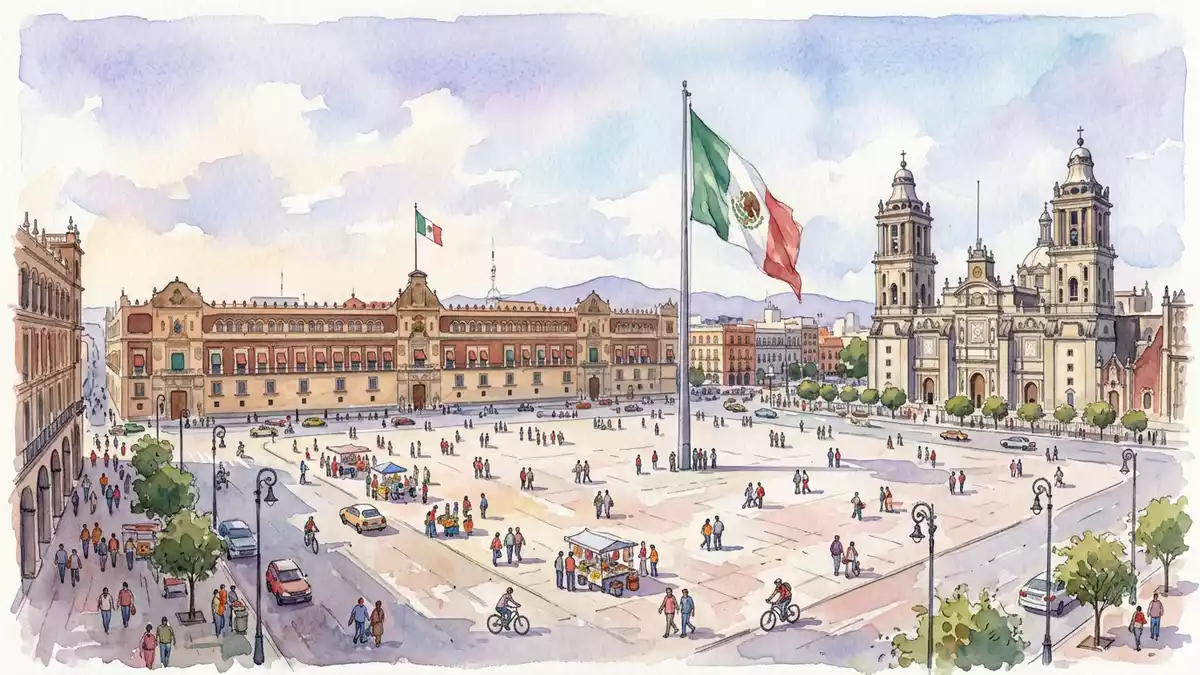
Zocalo, formally Plaza de la Constitución, is the great public square at the centre of Mexico City’s historic district. Its broad open surface occupies the former centre of Tenochtitlan, placing Mexica, Spanish colonial and national histories around one urban space.
Zocalo and the city beneath the city
The square occupies the centre of the historic district in Cuauhtémoc, beside the archaeological remains of Templo Mayor. The city of Tenochtitlan was founded in 1325 on islands and wetlands within Lake Texcoco, and its ceremonial centre stood in this part of the present capital.
The history of the central plaza reaches from the Mexica capital into the Spanish city established after the conquest. The square therefore reads as an urban palimpsest: a public space whose surrounding buildings belong to different periods, while the ground carries traces of an older ceremonial centre.
The square framed by cathedral and palace
Zocalo measures about 240 metres by 240 metres, covering roughly 57,600 square metres. Its open expanse is framed by the Metropolitan Cathedral to the north, the National Palace to the east, the Mexico City government buildings to the south, and arcaded commercial buildings to the west.
The Metropolitan Cathedral combines architectural work from the sixteenth to the nineteenth centuries, with Baroque and Neoclassical elements visible across its long construction history. The National Palace occupies the eastern side, while Diego Rivera’s murals inside present a sweeping visual account of Mexican history. The buildings around Zocalo give the square its distinctive civic and religious frame.
From ceremonial centre to national stage
Zocalo is formally named Plaza de la Constitución after the Constitution of Cádiz, promulgated in 1812. The familiar name comes from the Spanish word for a pedestal or plinth. A planned monument to Mexican independence left its pedestal behind, and the name remained attached to the square.
The space has served as a setting for civic ceremonies, religious observances, public gatherings and political demonstrations. Its broad surface also connects directly with the history of national power, since the cathedral, palace and government buildings face one another across the same civic ground.
The historic centre and archaeological areas of Mexico City entered the UNESCO World Heritage list in 1987. The historic centre and Zocalo form part of a protected cultural landscape containing pre-Hispanic remains and colonial architecture.
Visiting Zocalo: what travellers from Western Europe should know
- Zocalo lies in Mexico City’s Centro Histórico. Metro Line 2 reaches the square through Zócalo station, and the Templo Mayor archaeological zone lies beside it.
- The square itself is a broad paved urban surface. The cathedral, National Palace and nearby archaeological areas involve extensive walking across hard ground.
- The official language is Spanish and the currency is the Mexican peso.
- Entry requirements depend on your nationality; UK travellers can check the FCDO travel advice at gov.uk/foreign-travel-advice, Irish travellers the Department of Foreign Affairs at ireland.ie.
Searching for Zocalo on social platforms
These links open searches for Zocalo on each platform.Frequently asked questions about Zocalo
Where is Zocalo?
Zocalo is in the Centro Histórico of Mexico City, in the Cuauhtémoc borough. It is adjacent to the Metropolitan Cathedral, National Palace and Templo Mayor.
What can travellers expect at Zocalo?
The square presents a large paved civic space surrounded by major religious, governmental and commercial buildings. Nearby streets lead to museums, archaeological remains and historic architecture.
What makes Zocalo distinctive?
Its distinctive character comes from the layers gathered around one square: the former ceremonial centre of Tenochtitlan, Spanish colonial buildings and the civic institutions of Mexico.


