
Kiyomizu-dera and its wooden stage above Kyoto
Published on 09/04/2026 at 22:47 | Editorial responsibility: Rafael Müller, Editor-in-Chief AD HOC NEWS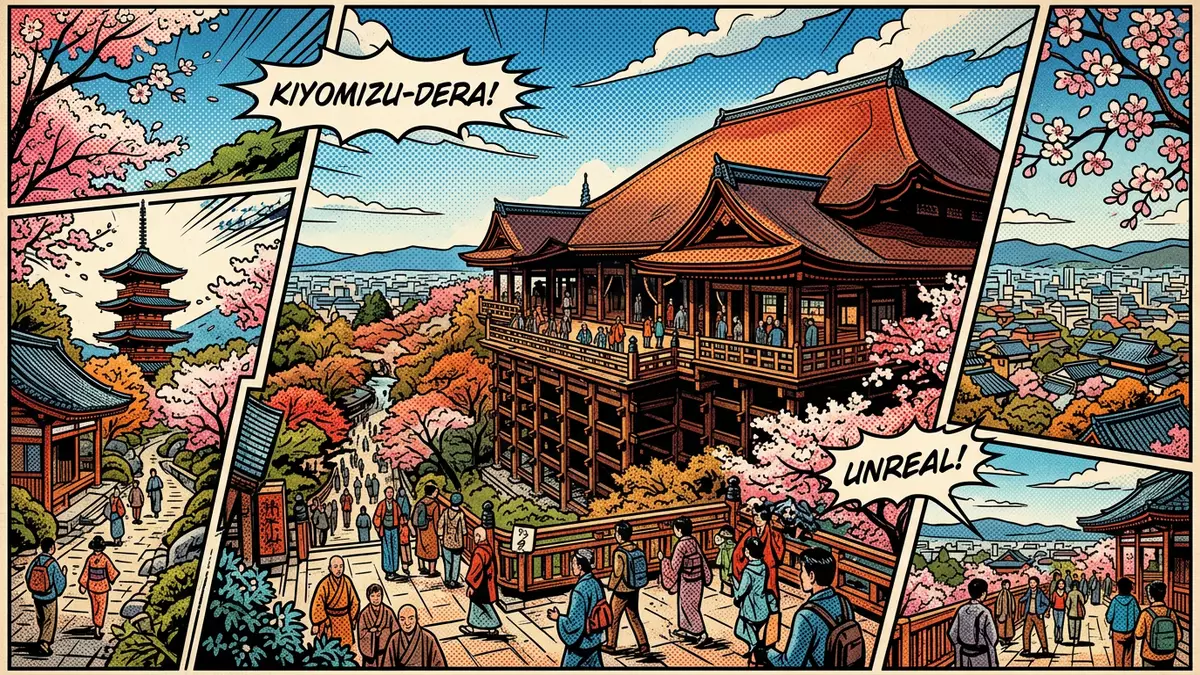
Kiyomizu-dera is a Buddhist temple complex on the eastern hills of Kyoto, known for a wide wooden veranda that projects from its main hall over a steep forested slope. The temple’s history reaches back to 778, towards the end of the Nara period, and the ensemble visible today largely dates from a seventeenth-century rebuilding under the Tokugawa shogunate.
A temple on the slope of Mount Otowa
Kiyomizu-dera stands halfway up Mount Otowa, one of the peaks in Kyoto’s Higashiyama range on the city’s eastern side. The complex is formally known as Otowa-san Kiyomizu-dera, a name that links the temple to the mountain and to the waters that flow from its hillside spring.Otowa-san Kiyomizu-dera Temple The site forms part of the Historic Monuments of Ancient Kyoto, a World Heritage ensemble that gathers significant religious and imperial buildings across Kyoto, Uji and ?tsu.Historic Monuments of Ancient Kyoto
The temple belongs to the Kita-Hosso sect of Japanese Buddhism and is dedicated to Kannon, a figure of mercy and compassion whose image is enshrined in the main hall.temple of the Kita-Hosso sect The Japanese name Kiyomizu-dera, meaning “Temple of Pure Water”, refers to the Otowa Spring, whose clear streams run at the base of the complex and have long been associated with blessings and well-being.Temple of Pure Water
From Nara-period origins to Edo-period architecture
Tradition links the foundation of Kiyomizu-dera to the monk Enchin in 778, when an image of Kannon was enshrined on the mountain above the Otowa Falls.originated in 778 when the monk Enchin In 780, the military leader Sakanoue no Tamuramaro established a hall here, giving the temple a foundation story tied to the transition from the Nara to the early Heian period.Sakanoue no Tamuramaro built a Buddha hall Over the centuries, repeated fires destroyed earlier buildings, and the main ensemble visible today dates from a reconstruction in the early seventeenth century under the third Tokugawa shogun, Tokugawa Iemitsu.seventeenth-century rebuilding under Tokugawa Iemitsu
The present main hall and its projecting stage are associated with work carried out in the 1630s, giving Kiyomizu-dera a clear place in early Edo-period architecture.the present stage was reconstructed in 1633 The complex brings together gates, pagodas and halls arranged along a terrace running roughly east–west along the slope, including the three-storey pagoda known as Sanjunoto, the west gate Saimon and subsidiary structures such as the sutra hall and founder’s hall.principal temple buildings are the Saimon and Sanjunoto
The wooden stage and the Otowa Spring
The feature that most defines Kiyomizu-dera in the landscape is the broad wooden stage that projects from the main hall over the valley below. This veranda rests on a framework of tall timber columns and crossbeams rising from the slope, creating a viewing platform above the trees without stone foundations at its outer edge.viewing platform supported by tall wooden columns Visitors standing on the stage look out towards Kyoto’s urban plain, with the city spreading across the basin and other temple roofs rising from the nearby hills.
Below the main hall, the Otowa Spring emerges in three streams at the base of the complex, feeding basins where its water is collected. The temple’s name, “Pure Water”, reflects the long-standing association of these waters with good fortune, and the relationship between the hillside buildings and the spring gives the complex a clear interplay between architecture and landscape.founded in 780 on the site of the Otowa Waterfall
Visiting Kiyomizu-dera: what travellers from Western Europe should know
- Kiyomizu-dera stands in the Higashiyama district in eastern Kyoto, on the slope of Mount Otowa above streets lined with shops and traditional townhouses.
- The approach from the lower city runs uphill along paved lanes such as Kiyomizu-zaka, leading to the Nio-mon gate at the edge of the temple grounds.
- The complex sits on a hillside terrace, with stairways and sloping paths between gates, halls and pagodas, so a visit involves walking on gradients and climbing steps.
- The official language is Japanese and the currency is the Japanese yen.
- Entry requirements depend on your nationality; UK travellers can check the FCDO travel advice at gov.uk/foreign-travel-advice, Irish travellers the Department of Foreign Affairs at ireland.ie.
Searching for Kiyomizu-dera on social platforms
These links open searches for Kiyomizu-dera on each platform.
Frequently asked questions about Kiyomizu-dera
Where is Kiyomizu-dera located?
Kiyomizu-dera stands on the slope of Mount Otowa in Kyoto’s Higashiyama district, on the eastern side of the city above traditional streets.
What should visitors expect during a visit?
A visit involves walking uphill through the approach streets, passing gates and halls on terraces connected by stairways, and reaching the wooden viewing stage of the main hall.
What makes Kiyomizu-dera distinctive among Kyoto’s temples?
The temple combines its long history, early Edo-period wooden architecture and the hillside stage overlooking Kyoto with the presence of the Otowa Spring at the base of the complex.


